In short
- The oldest cultural institution in Montenegro. The idea dates from 1884, when the Cetinje Reading Room appealed for ‘a house with room for a theatre, a library and a museum’ to be built by public subscription.
- Designed by Josip Slade of Trogir, the engineer who also laid out the town. The foundation stone was laid on 1 May 1884; the first play was performed in the unfinished hall in December 1888; the building was formally completed in 1896.
- The first play was by the prince. Nikola I’s verse drama The Balkan Empress opened the stage, with writers, generals and ministers in the cast.
- It has been a parliament, a hospital and a stable. Montenegro’s first elected assembly sat here from 1906 to 1910; the building was wrecked in the First World War, rebuilt in 1931, burnt in 1962 and restored after the 1979 earthquake.
- It is a working theatre, one of Montenegro’s two national houses, with about 240 seats. The way to see the inside is to buy a ticket for a performance.
A theatre before there was a town
In 1883 Cetinje was a town of a couple of thousand people with a single hotel. It also had a Reading Room, and at the end of that year the Reading Room formed a Voluntary Theatre Society. On 14 January 1884 (2 January by the calendar then in use) the society gave its first production: The Balkan Empress (Balkanska carica), a verse drama in three acts that Prince Nikola had just finished, staged in the still unfinished house of Vojvoda Mašo Vrbica, the building that a year later would be sold to the sultan as the Ottoman legation. Among the amateur actors was the Dalmatian novelist Simo Matavulj.
The success produced an ambition out of all proportion to the place. That same year the Reading Room published an appeal in the Glas Crnogorca for the building of Zetski dom, the ‘Zeta House’, named for the medieval principality from which Montenegro grew: ‘a special house in which there will be room for a theatre, a library and a museum’. The appeal insisted on how it should be paid for. ‘Zetski dom cannot and must not be the property of any private society, but of the whole Montenegrin people; it is therefore right that the people should build it.’
They did. Contributions came from the princely family and the state, from the townspeople of Cetinje and the villages around, from Podgorica, Nikšić and the other Montenegrin towns, and from sympathisers in Shkodër, Novi Sad, Sremski Karlovci, Split, Zagreb and Vienna. The foundation stone was laid on 1 May 1884. The design was by Josip Slade, the Trogir engineer who was then regulating the town’s streets; the builders were masons from the Bay of Kotor under Jovo Terzović. Both men received the Order of Danilo I for the work.
- Name
- Kraljevsko pozorište Zetski dom (Royal Theatre Zetski dom)
- Foundation stone
- 1 May 1884
- First performance
- 17 December 1888 (5 December, old style): The Balkan Empress
- Formally completed and opened
- 26 October 1896
- Architect
- Josip Slade Šilović of Trogir
- Seats
- About 300 originally; about 240 today
- Protected monument
- Since 29 June 1961
1888 and 1896: two openings
The shell was finished in 1888. The Reading Room moved in, and on St Nicholas’s Day, 5 December by the old calendar, The Balkan Empress was performed again in the unfinished auditorium. This is remembered as the first play in Zetski dom. The cast list reads like a register of the state: teachers, the prince’s adjutant, a general, voivodes and sirdars, ministry officials, merchants, and two of the best-known writers in the Serbian language, Simo Matavulj and the poet Laza Kostić, who played Voivode Lale. The first theatre poster printed in Montenegro advertised it.
Fitting out took another eight years. In 1896 the journal Luča reported the house complete: twenty boxes, ten rows of stalls, ‘large enough, and in beauty yielding to none of the smaller theatres’. It was formally opened on 26 October 1896 as the Princely Montenegrin National Theatre with another play by the prince, Knjaz Arvanit. Under the law of the same year the building also housed the state library and museum, so that for two decades the whole cultural apparatus of the country, its books, its trophies and its stage, sat under one roof.
The interior was the pride of the town. The auditorium had gilded baroque ornament and a ceiling painted with seven Muses by the Czech painter František Ženíšek, one of the artists who decorated the National Theatre in Prague. With the prince’s approval he also painted the first curtain, which showed a guslar, a singer of epic songs, under a tree with Montenegrins gathered round to listen.
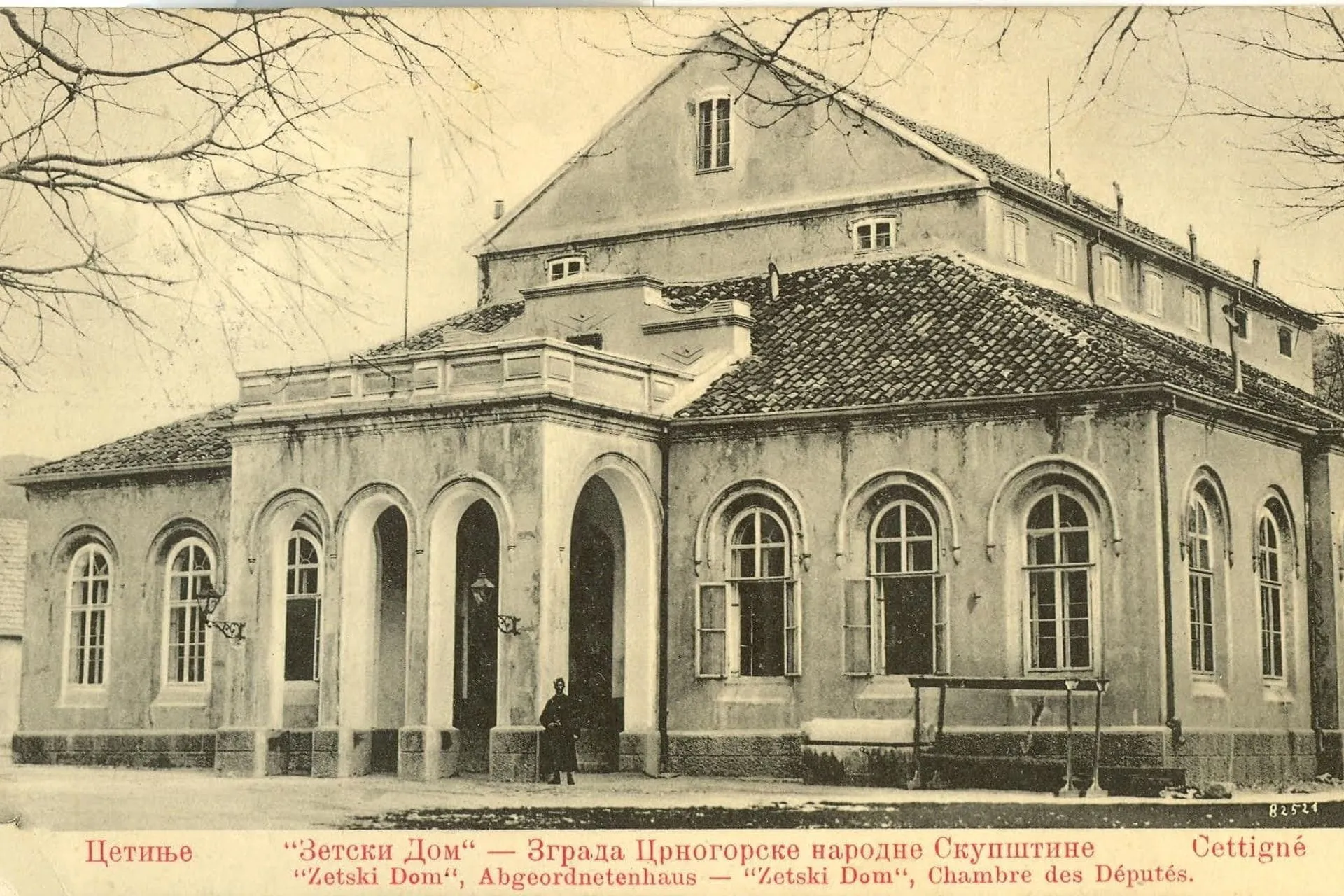
Zetski dom on a postcard of about 1910, captioned in Serbian, German and French as the building of the Montenegrin National Assembly. Unknown publisher; public domain.
The building
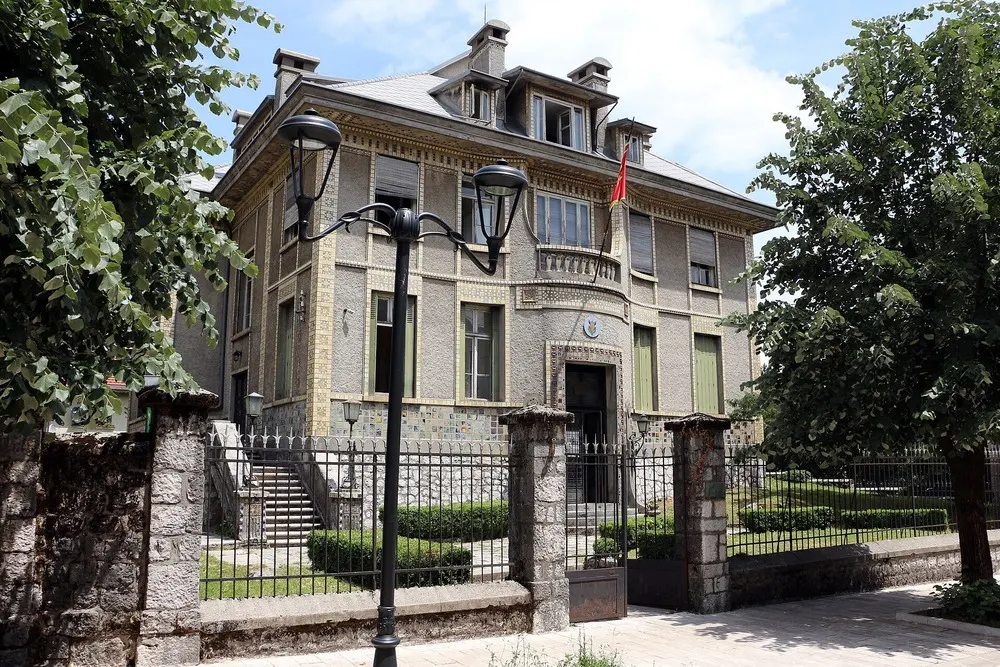
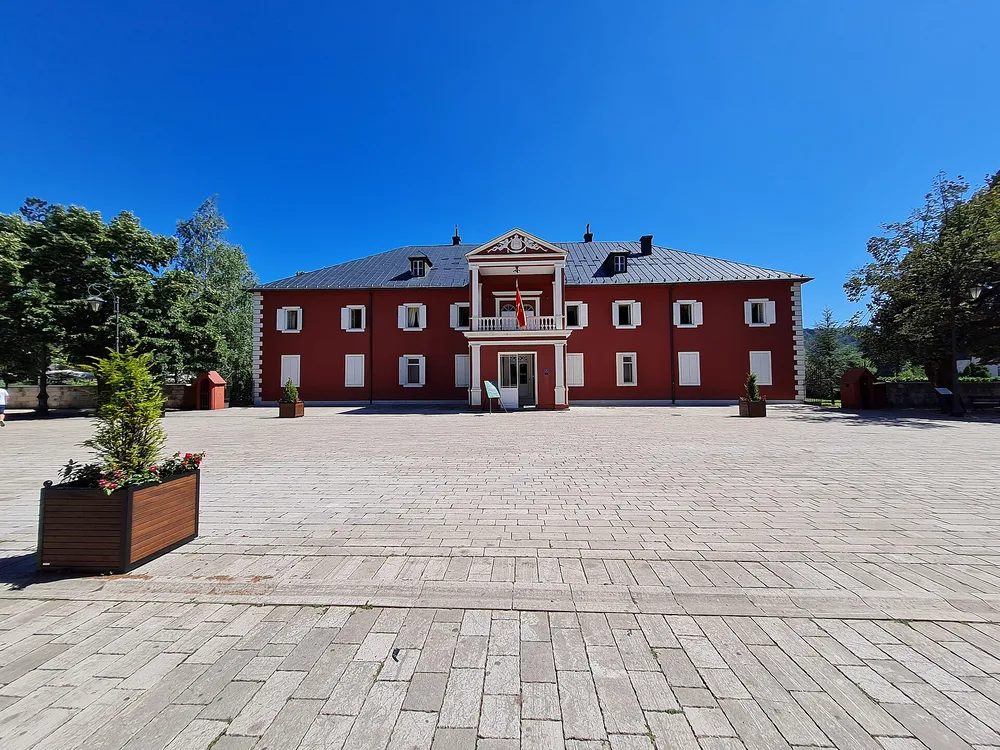
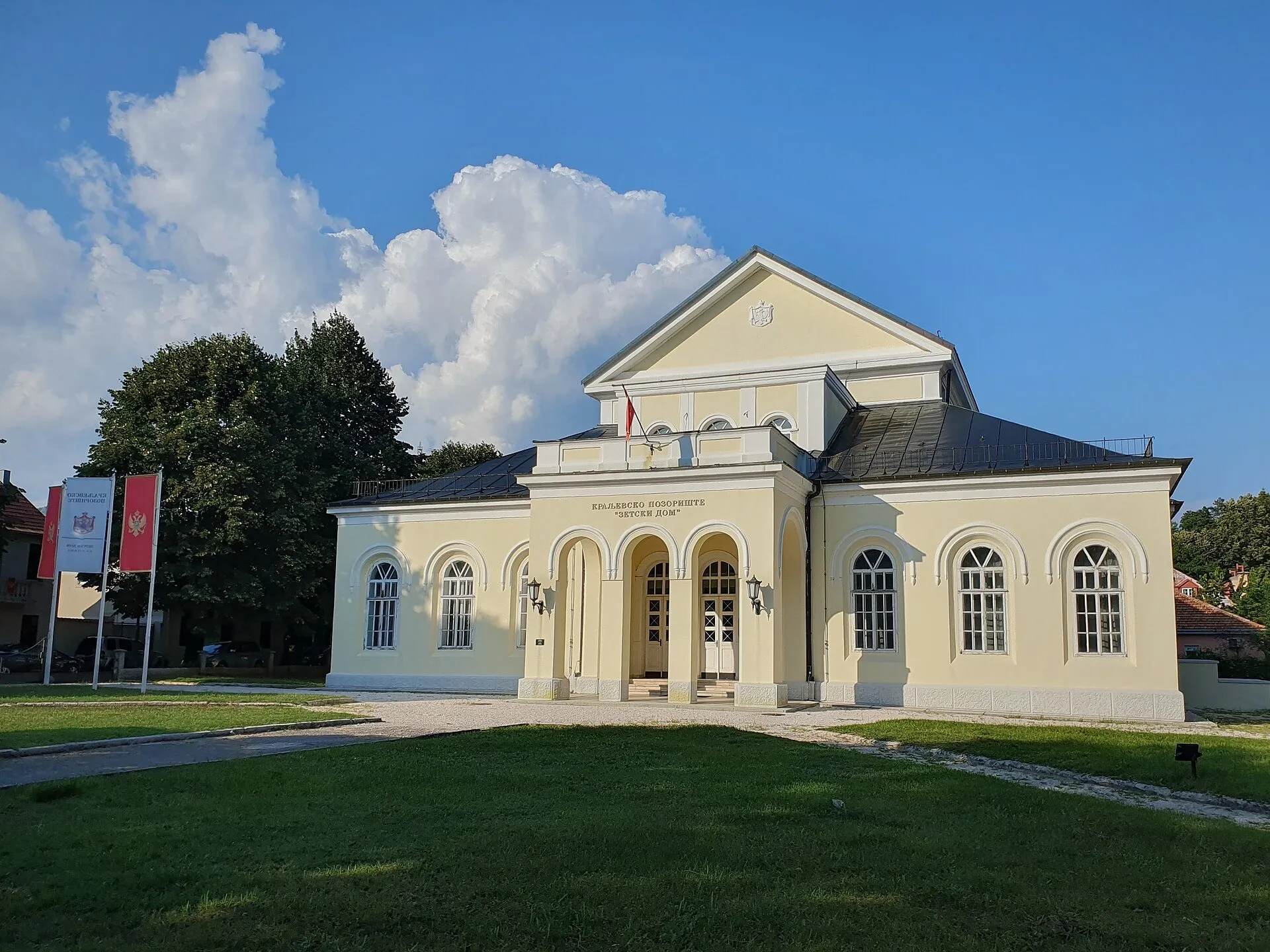
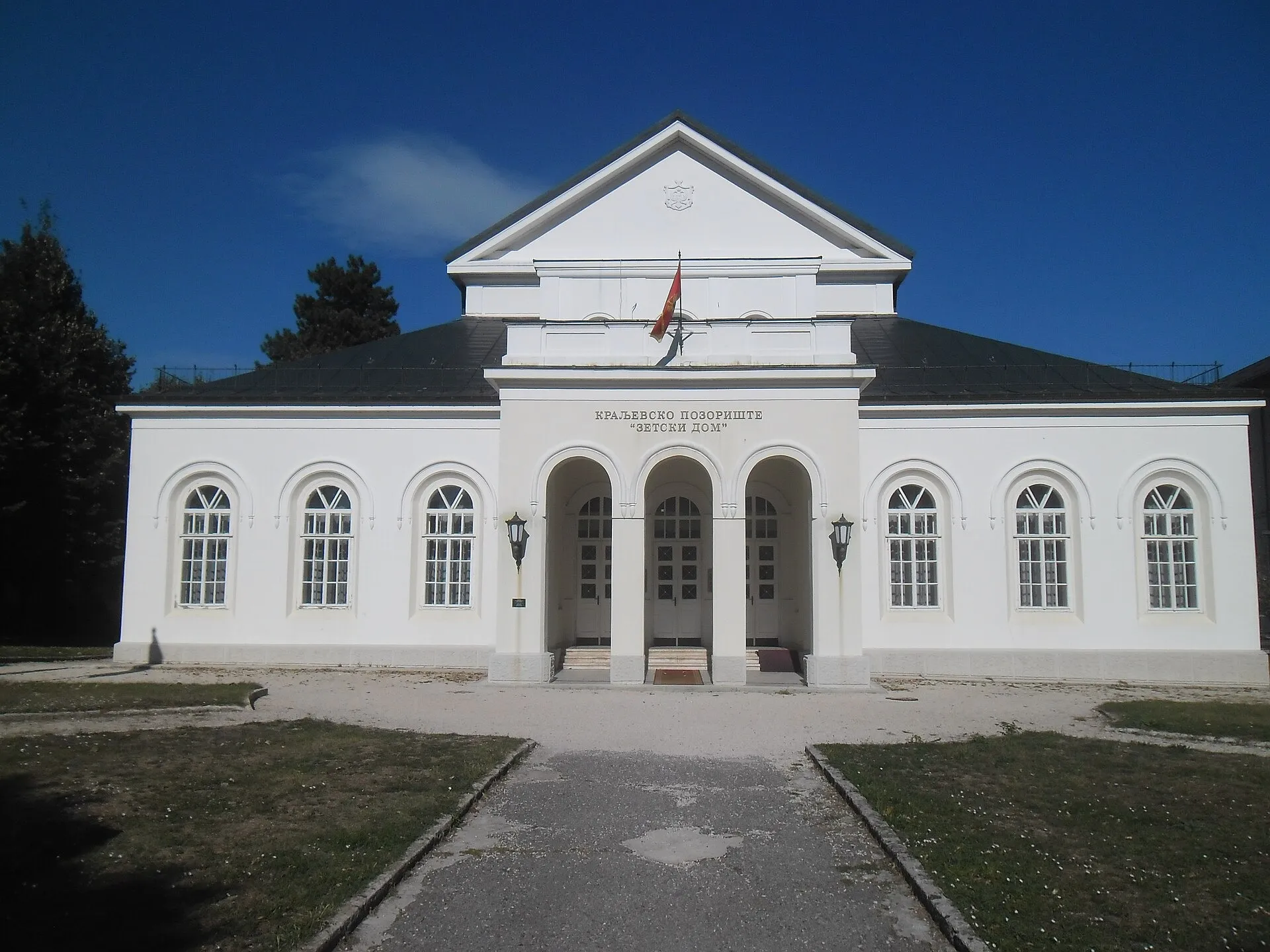
Zetski dom stands free in a small square a couple of hundred metres east of the palace, with the former Ottoman legation a few steps away and the City Park close by. It is a long, low, symmetrical building with a higher central block. The entrance is a porch of three arches with a terrace above; behind it rises a plain pediment; the side wings have tall round-headed windows. Inside, the plan is a clear three-part one, with the foyer, auditorium and stage in the central nave. When it opened it covered 964 square metres and had stalls, a gallery and boxes for about 300 people, and a stage 14 m deep and 7 m wide.
Writers do not agree on what to call the style. Serbian-language reference works describe it as neo-Romanesque or neoclassical; the tourist organisation remembers a baroque façade with a clock. All three are responding to something real: the round arches, the pediment, and the lost ornament of the original front. What matters more is the type. This is a small Central European theatre of the 1880s, built in a capital that did not yet have a government building.
Very little of the fabric you see is original. The entrance front was rebuilt in simplified form in 1931, with a single arch instead of three, and returned to its first design only in the restoration of the 1980s. Research for a later restoration found, in the National Library, three of Ženíšek’s seven rolled canvases of the Muses and the pattern book of 1881 from which the ceiling was designed, enough to reconstruct the original interior on paper; that project was drawn up and not carried out.
Parliament, stable, ruin and theatre again
Because it was the only hall in the country, Zetski dom was used for everything. After the constitution of 1905, Montenegro’s first elected National Assembly met here from 1906 until the Government House was ready in 1910. The theatre was then thoroughly refurbished under the Italian architect Gian Carlo Magugliani and reopened on 16 May 1910, in the jubilee year, as a professional house, the Royal Montenegrin National Theatre.
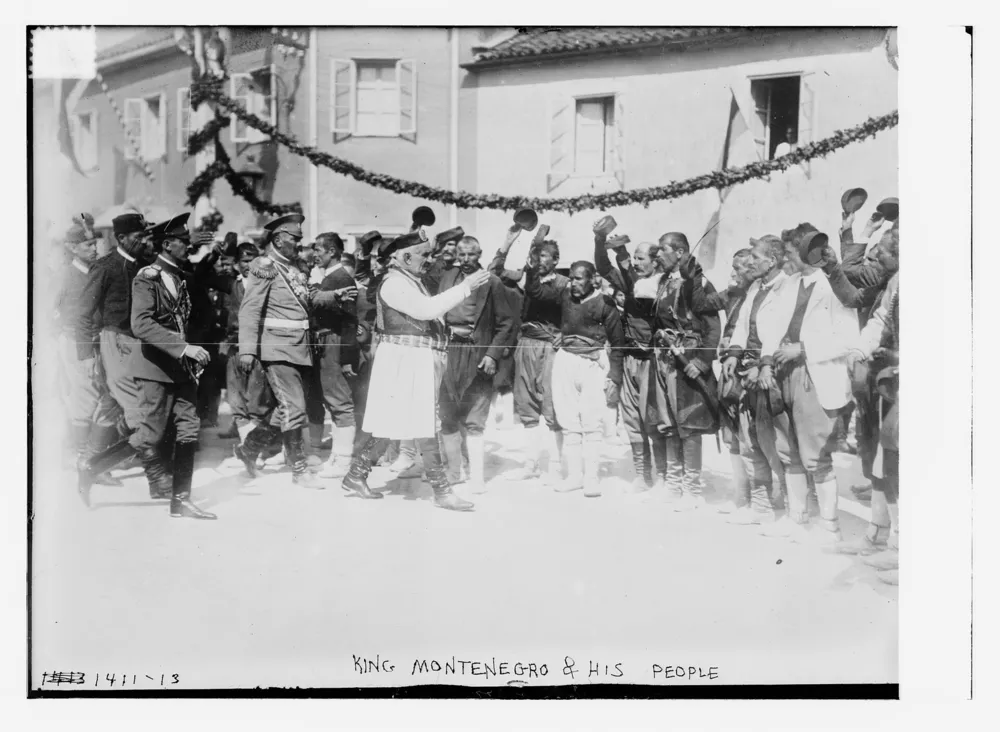
It had five seasons. The Balkan Wars interrupted performances, wounded soldiers were nursed in the building, and in 1915 the theatre closed. During the Austro-Hungarian occupation of 1916–1918 the building burned and was used as a stable; by the end of the war it had been looted and burnt, and the clock on its front was lost. It was rebuilt in 1931, badly: from half the seats the stage could not be seen, and the acoustics had been spoiled. The Irish playwright George Bernard Shaw passed through Cetinje with his wife that spring, according to the local paper, and stayed at the Hotel Paris next door while the interior was being finished; whether he looked in is not recorded.
A fire in 1962 and the earthquake of 1979 left it derelict again. The restoration that followed, with the main works in the mid-1980s and the theatre fully equipped and reopened in the early 1990s (sources give 1992 and 1993), gave back the three-arched front and produced the present auditorium of about 240 seats in stalls, gallery and balcony. The roof and façades were renewed in 2005.
- 1883
Voluntary Theatre Society
Founded within the Cetinje Reading Room.
- 1884
The Balkan Empress
First staged on 14 January in an unfinished private house; on 1 May the foundation stone of Zetski dom is laid.
- 1888
First performance in the building
The Balkan Empress on St Nicholas’s Day (17 December, new style).
- 1896
Formal opening
26 October, as the Princely Montenegrin National Theatre; the state library and museum share the building.
- 1906–1910
Parliament
The National Assembly sits in the auditorium.
- 1910
Royal theatre
Reopened on 16 May as a professional house after refurbishment.
- 1915–1918
War
Theatre closed; the building burned and used as a stable under occupation.
- 1931
First rebuilding
With an altered front and a poor auditorium.
- 1962
Fire
The building is damaged again.
- 1979
Earthquake
Followed by restoration in the 1980s and reopening in the early 1990s.
- 2014
European Route of Historic Theatres
Zetski dom joins the route and from 2017 leads its Adriatic section.
- 2020
An ensemble again
For the first time in seven decades the theatre has a permanent company of actors.
Zetski dom today
The Royal Theatre Zetski dom is one of Montenegro’s two national professional theatres, the other being the Montenegrin National Theatre in Podgorica. It produces its own plays, hosts visiting companies and concerts, publishes, screens films and runs programmes for children. Since 2015 it has organised the MIT festival (Montenegrin International Theatre Festival), and it is a member of the European Route of Historic Theatres, a network of more than 120 houses founded between the sixteenth and nineteenth centuries, in which it heads the Adriatic route alongside theatres in Ljubljana, Zagreb, Šibenik, Hvar, Belgrade and Sarajevo. At the end of 2020 it acquired a permanent ensemble again, of five actors at the time of the theatre’s own account.
The repertoire mixes contemporary writing with the classics of the Montenegrin stage. For most foreign visitors the attraction is the occasion and the room rather than the text.
Visiting and seeing a performance
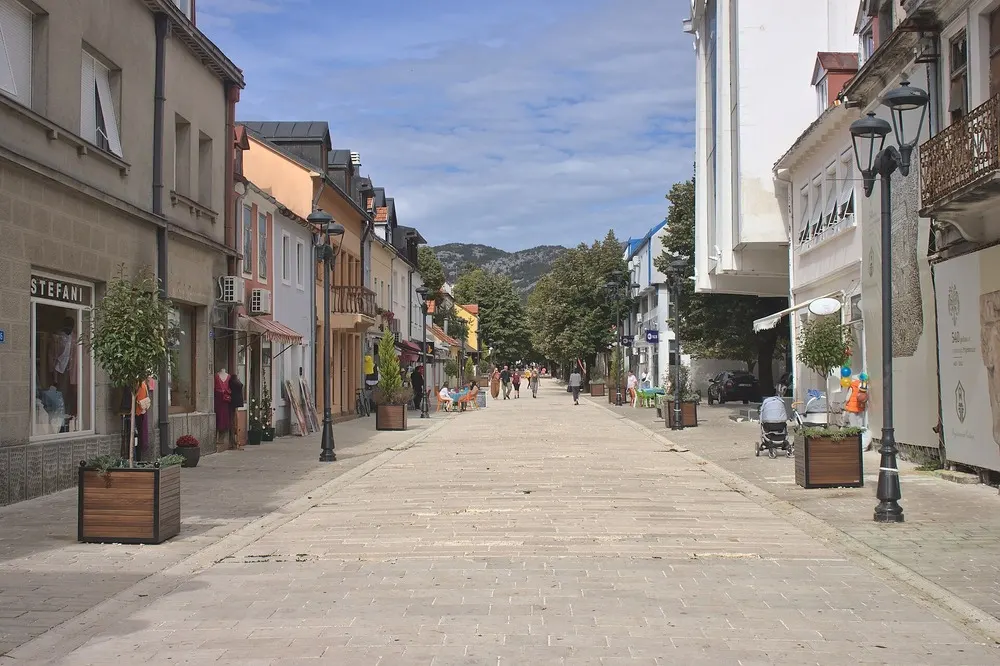
- Outside: the building can be seen at any time; it is on our walking tour, between the Vlach Church and the Russian legation.
- Inside: there are no regular guided tours that we could confirm. The reliable way in is a ticket for a performance.
- Box office: according to the theatre’s website in November 2026, open Monday to Friday from 10:00 AM to 1:00 PM and from 6:00 PM to 8:00 PM, local time. The programme is published on the site under upcoming events.
- Language: performances are in Montenegrin. Do not count on surtitles; a concert or a dance programme avoids the problem.
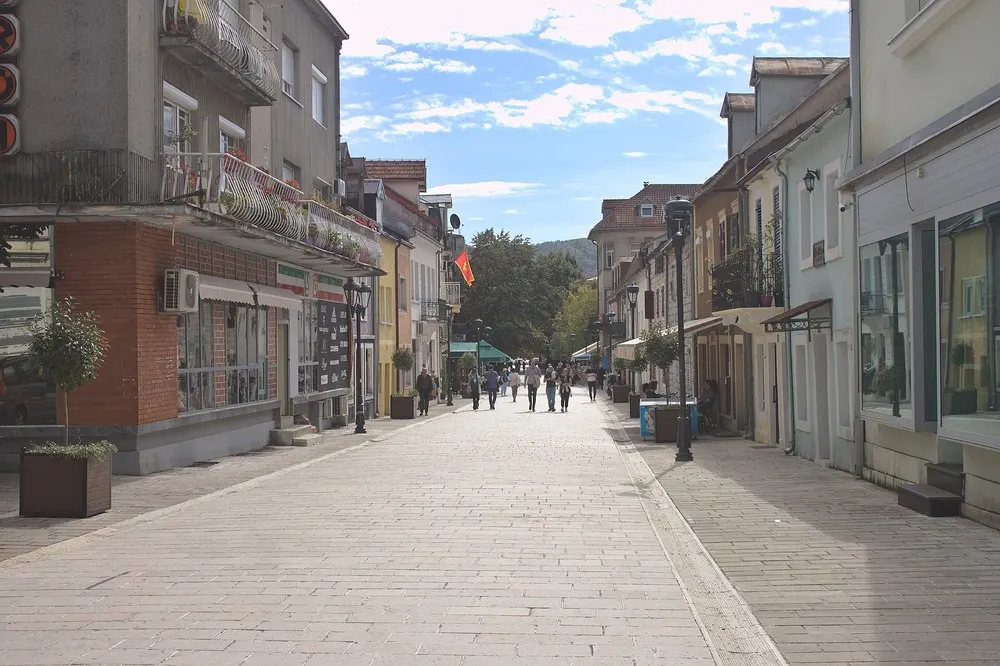
If you are staying overnight, an evening at Zetski dom is one of the best reasons to do so: the day visitors have gone, the lime-tree streets are quiet and the audience is local. For where to sleep within a few minutes’ walk, see where to stay; for the rest of the building’s neighbours, the architecture of Cetinje.
Frequently asked questions
What is Zetski dom?
The Royal Theatre Zetski dom in Cetinje, the oldest theatre and the oldest cultural institution in Montenegro. The building was begun in 1884 and first used in 1888; it is still a working national theatre.
Why is it called Zetski dom?
The name means ‘Zeta House’. Zeta was the medieval principality that preceded Montenegro, and the building was conceived as a national home for a theatre, a library and a museum.
Who designed Zetski dom?
Josip Slade Šilović, an engineer from Trogir in Dalmatia who served as Montenegro’s state architect and also planned Cetinje’s street grid and the road to Kotor.
What was the first play performed there?
The Balkan Empress (Balkanska carica), a verse drama by Prince Nikola I, on St Nicholas’s Day 1888, which was 17 December by the Gregorian calendar.
Can you go inside Zetski dom?
Yes, by attending a performance. We could not confirm regular guided tours of the building. The box office is open on weekday mornings and early evenings.
Was Zetski dom really a parliament?
Yes. Montenegro’s National Assembly met in the theatre from 1906 until the Government House was completed in 1910.
Sources and official information
Facts were checked against these official and scholarly sources in November 2026. Opening hours, ticket prices, park fees and timetables change, so confirm before you go.
- zetskidom.me
- zetskidom.me
- zetskidom.me
- cetinje.travel
- stari.maticacrnogorska.me
- sr.wikipedia.org
- sr.wikipedia.org
- narodnimuzej.me
- aseestant.ceon.rs
Cetinje.com is an independent guide, not the official site of the Old Royal Capital Cetinje, the National Museum of Montenegro, any tour operator, hotel or the government of Montenegro. Some links are affiliate links: tours go to GetYourGuide and accommodation goes to Booking.com, and we may earn a commission at no extra cost to you.