In short
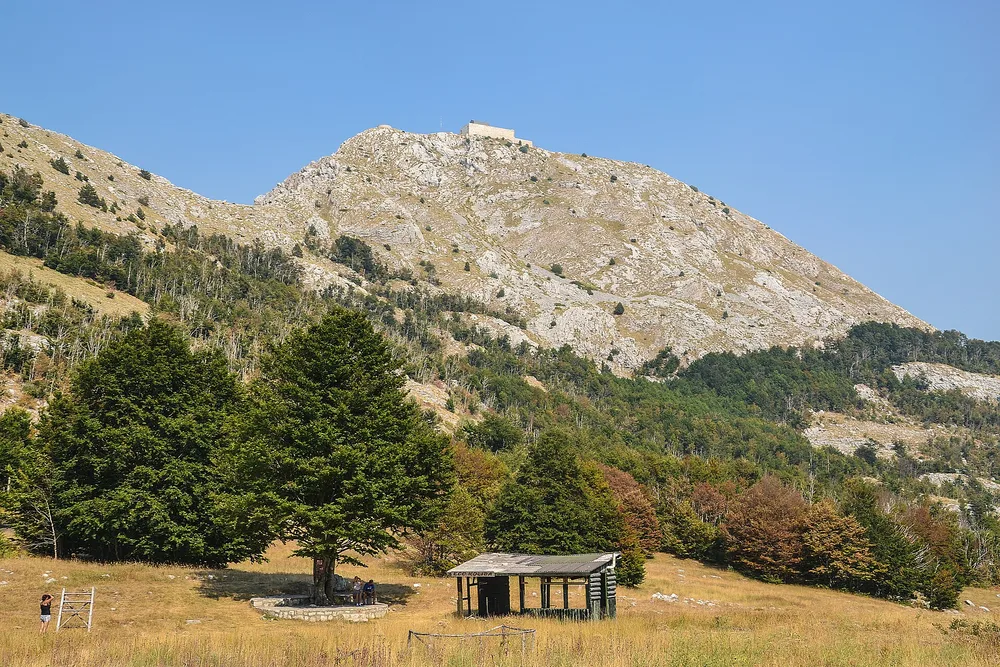
- Where: on the summit of Jezerski vrh (1,660 m according to the National Museum) in Lovćen National Park, about 20 km by road from Cetinje.
- What: the tomb of Petar II Petrović-Njegoš, prince-bishop and poet, designed by Ivan Meštrović and opened on 28 July 1974 on the site of the chapel Njegoš built in 1845.
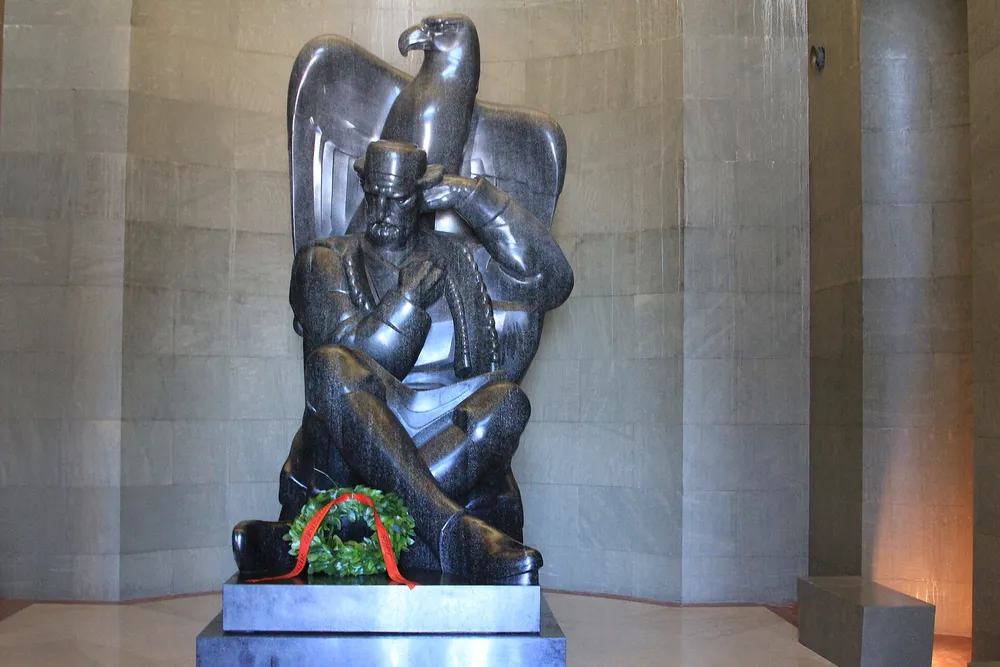
- The climb: a tunnel stairway of 461 steps from the car park; inside, Njegoš’s 28-tonne granite figure under a vault of gilded mosaic; behind, a path to a round viewing platform.
- Hours and tickets (as checked November 2026): summer season only, daily, closed from 16 November to the April opening; adult ticket 8 euro, including Njegoš’s birth house in Njeguši. The park fee is separate.
- Still argued over: the demolition of the chapel to build the mausoleum was contested at the time and is still a point of dispute between Church and state.
A tomb chosen by the man himself
Petar II Petrović-Njegoš, ruler of Montenegro from 1830 to 1851 and author of The Mountain Wreath, decided where he wanted to lie. In 1845 he built a small stone chapel on Jezerski vrh, the second summit of Lovćen and the one that looks down on Cetinje, dedicated it to his uncle and predecessor Petar I, Saint Peter of Cetinje, and asked to be buried there. When he died in October 1851 the request could not be carried out at once, because the peak was exposed to Ottoman raids; he was buried in Cetinje Monastery, and in 1855 Prince Danilo had his remains carried up the mountain.
Since then the summit has been rebuilt three times, each time by a different state with its own idea of who Njegoš was. The chapel was wrecked in the fighting for Lovćen in 1916, and the Austro-Hungarian occupiers took the remains back down to Cetinje. In 1925 King Alexander of Yugoslavia, a grandson of King Nikola, paid for a new chapel close in form to the old one, and Njegoš was reburied there in a three-day ceremony. After the Second World War the government of the People’s Republic of Montenegro decided, on the centenary of his death, to replace the chapel with a monument by the most celebrated sculptor of the South Slavs. The National Museum, which runs the site, dates that decision to 1951; other accounts give 1952.
The life and work of the poet, and the long argument about his legacy, are in our Njegoš biography. This page is about the building and the visit.
- Location
- Summit of Jezerski vrh, Lovćen National Park
- Altitude
- 1,660 m (National Museum); 1,657 m on most maps
- Designed by
- Ivan Meštrović (1883–1962)
- Built
- 1970–1974; opened 28 July 1974
- Steps
- 461, mostly in a tunnel
- Run by
- National Museum of Montenegro
- From Cetinje
- About 20 km by road, about 35 minutes
- Adult ticket
- 8 euro, includes Njegoš’s birth house (as checked November 2026)
Meštrović’s design and how it was built
Ivan Meštrović (1883–1962), the Croatian-born sculptor who had made his name before the First World War with a projected ‘Vidovdan Temple’ for the South Slavs, had thought about a Njegoš monument since the 1920s. He completed a design for Lovćen in the 1950s, while living in the United States, and died in 1962 without seeing the site built. His conception is a sequence of spaces, closer to an ancient hero’s tomb than to a church: an approach through the mountain, a guarded forecourt, a dark chapel-like hall for the statue, a crypt below, and finally the open sky at the platform beyond.
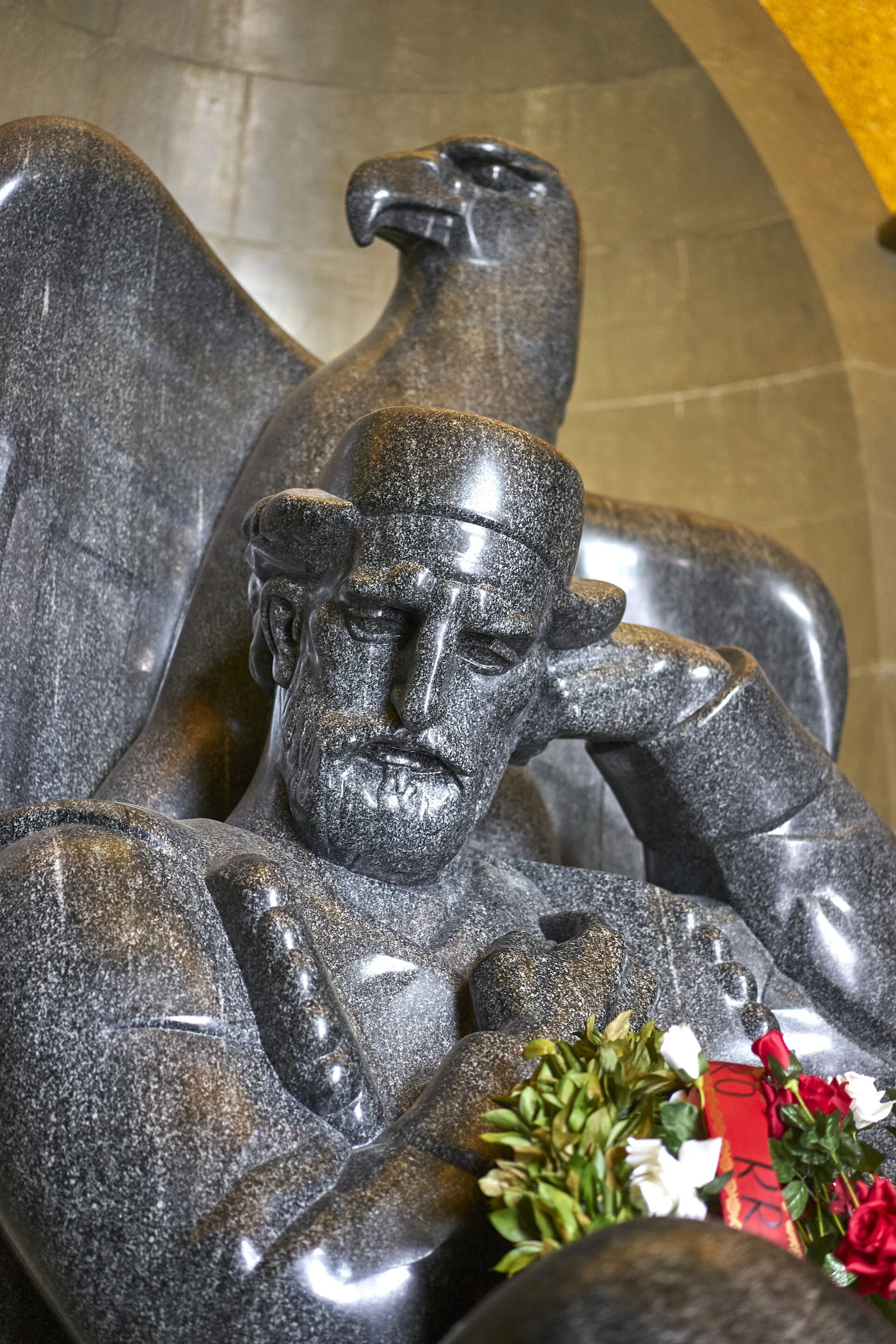
Work on the summit began in 1970. The chapel of 1925 was dismantled and the top of the peak cut down to take the new building. The project was realised under the architect Harold Bilinić, whose role, and the politics of the whole undertaking, are examined in a 2018 study by Dragan Komatina and Ema Alihodžić Jašarović of the University of Montenegro’s Faculty of Architecture. The sculpture was carved by Andrija Krstulović, a pupil of Meštrović, from about 50 tonnes of granite from Jablanica in Herzegovina, according to Radio Free Europe’s account of the building, which draws on the National Museum. The figure of Njegoš alone weighs 28 tonnes; it was brought from Split to Cetinje in September 1972 and set in place before the walls were closed, because the entrance would have been too narrow to admit it afterwards.
The building itself is of grey Lovćen stone. Inside, the walls are lined with polished green stone from near Split and the crypt with stone from the island of Brač. The mausoleum was opened on 28 July 1974. The National Museum counts close to 70,000 visitors a year, which makes it one of the most visited monuments in Montenegro.
- 1845
Njegoš’s chapel
Njegoš builds a small chapel on Jezerski vrh, dedicated to Petar I, and asks to be buried in it.
- 1851
Death in Cetinje
He dies on 31 October (19 October old style) and is buried in Cetinje Monastery.
- 1855
First burial on Lovćen
Prince Danilo has the remains carried up to the chapel.
- 1916
War and removal
The chapel is damaged in the Austro-Hungarian offensive; the occupiers move the remains to Cetinje.
- 1925
Chapel rebuilt
King Alexander of Yugoslavia funds a new chapel; Njegoš is reburied with great ceremony.
- 1951
Decision for a mausoleum
The government of the People’s Republic of Montenegro decides to replace the chapel (the National Museum’s date; some sources give 1952).
- 1970–1974
Construction
The chapel is dismantled and the mausoleum built to Meštrović’s design.
- 28 July 1974
Opening
The mausoleum is opened; the remains rest in its crypt.
The visit, step by step
- The car park. The road from Cetinje or Njeguši ends in a car park and turning area below the summit, with a café and souvenir stands in season. The National Museum’s ticket office is at the start of the climb.
- The 461 steps. A long, covered stairway climbs through a tunnel in the rock, lit and fairly even but steep in places, with landings where you can rest. Allow 10 to 15 minutes at an easy pace. There is no lift, so the mausoleum is not accessible to wheelchair users.
- The forecourt and the caryatids. You emerge into an open court on the summit. At the entrance to the building stand two colossal female figures in black granite, Montenegrin women in national dress, each about 7.5 tonnes, acting as caryatids, the sculptural guardians of the tomb.
- The hall of Njegoš. Inside, the light drops. Under a vault covered, according to the Cetinje Tourist Organisation, with some 200,000 gilded mosaic tiles, the poet sits on a rock, an open book on his knees, beneath the outspread wings of an eagle: the 3.74-metre granite figure carved by Krstulović after Meštrović. Speak quietly; this is a tomb.
- The crypt. Steps lead down to the crypt, where Njegoš lies in a plain marble sarcophagus carved with a cross and the state coat of arms, the two symbols of his double role as bishop and ruler.
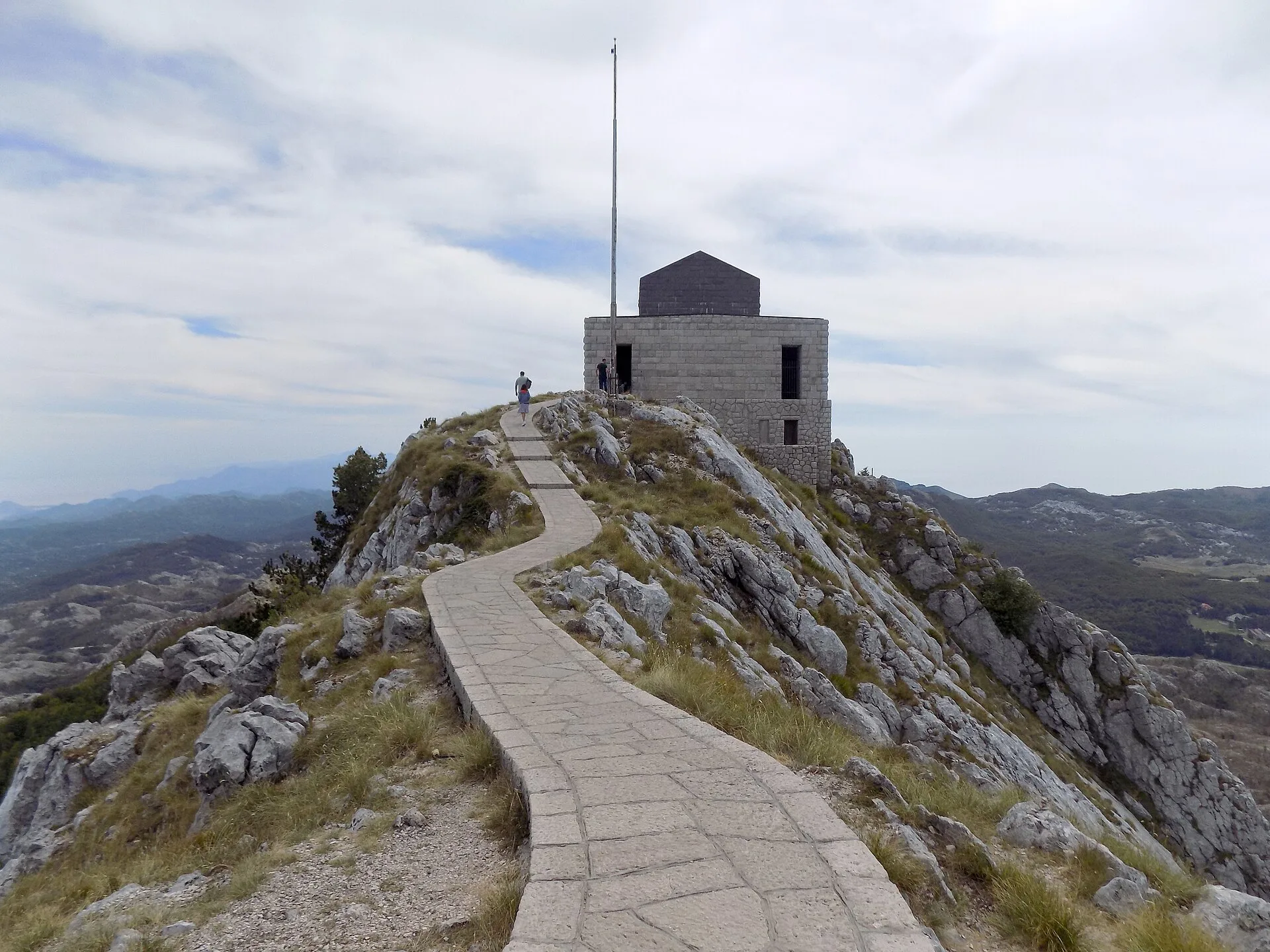
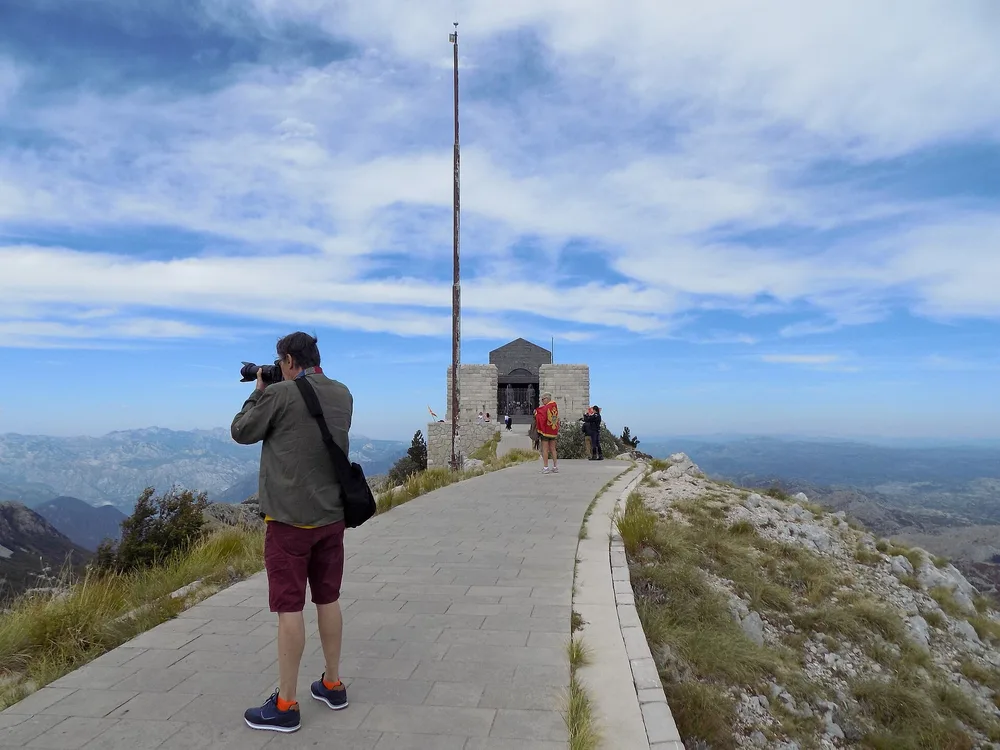
- The ridge path and the platform. Leaving the building at the back, a paved path runs along the narrow crest of the peak to a round viewing platform with a low parapet at the very edge of the mountain. Take your time here. In clear weather it is one of the great views of the Balkans.
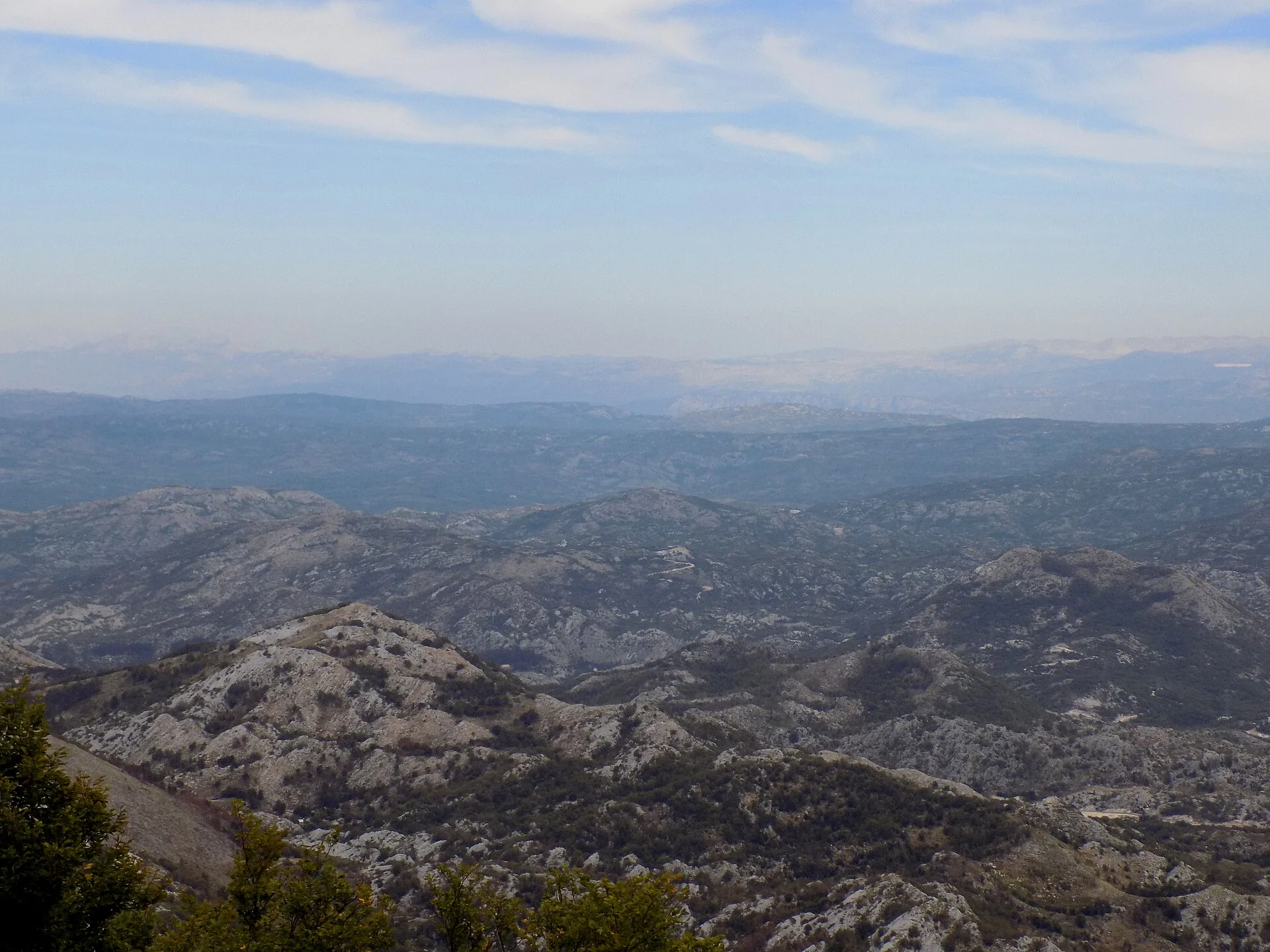
From the viewing platform: the bare limestone ranges of Old Montenegro roll away to the east.
What you can see from the top
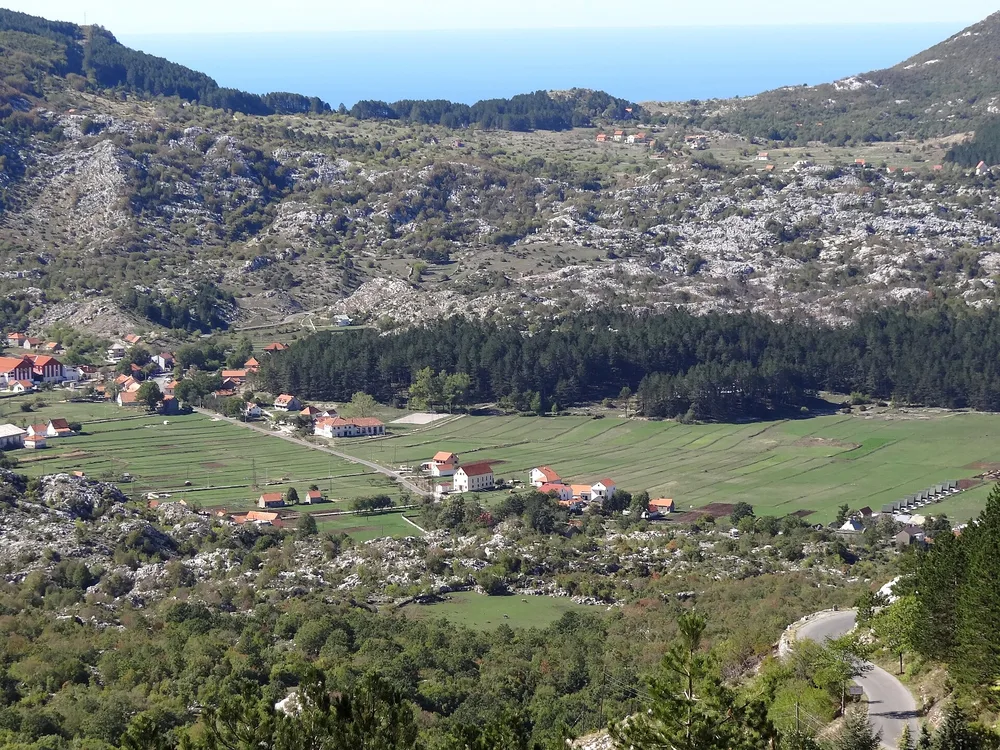
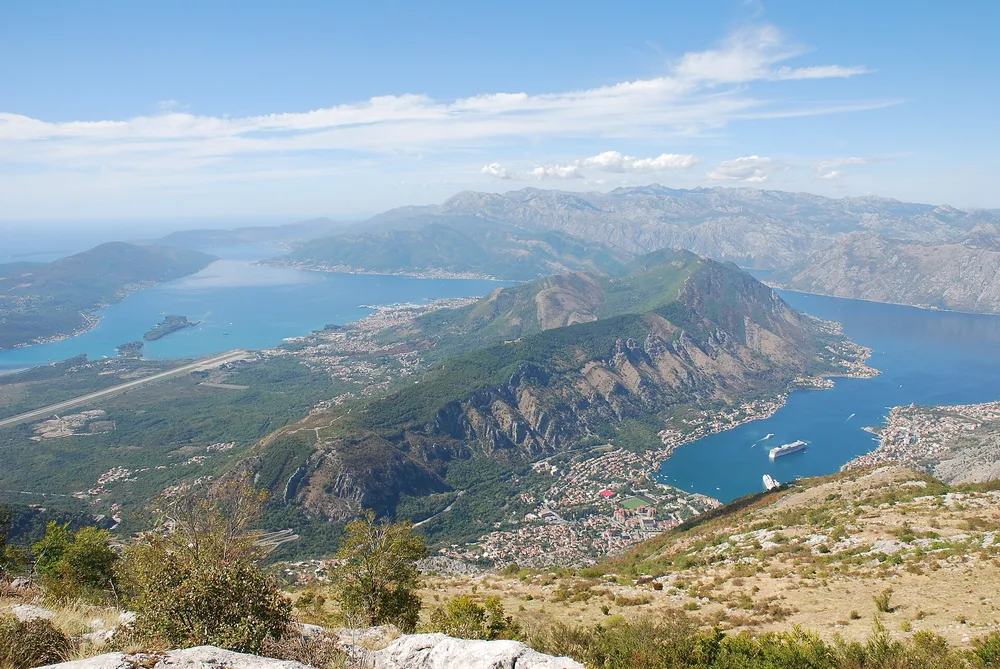
The platform turns through a full circle. West and south-west the mountain drops to the Bay of Kotor and the Tivat plain, with the Adriatic beyond; south-east lies the grey, pitted karst of Old Montenegro, the Cetinje field hidden in its fold, and on clear days the shine of Lake Skadar and the mountains of northern Albania behind it; north the eye runs over ridge after ridge towards the high massifs of the interior. The neighbouring dome to the west, with its masts, is Štirovnik, at 1,749 m the true summit of Lovćen.
Haze is common on summer afternoons, and cloud can sit on the summit even when Cetinje is in sunshine. The clearest air usually comes in the morning, after rain, and in September and October. If the summit is in cloud when you arrive, have a coffee in the car park and wait half an hour: it often clears as quickly as it came.
The argument over the chapel
The mausoleum has been controversial from the day the decision was made, and a visit is better for knowing why. The Metropolitanate of Montenegro and the Littoral of the Serbian Orthodox Church opposed the demolition of a consecrated church built by the man it commemorated, and the removal of a bishop’s grave from a place of worship to a secular monument; it tried and failed to stop the work in the courts, and it continues to call for the chapel to be rebuilt. A number of writers and artists across Yugoslavia objected too, some on religious grounds and some because they found Meštrović’s monumental design wrong for a poet who had asked for a mountain chapel.
The Montenegrin authorities of the time, and many Montenegrins since, saw it the other way: the chapel of 1925 was itself a reconstruction paid for by the dynasty that had absorbed Montenegro into Yugoslavia, and the country’s greatest figure deserved a national monument by the greatest sculptor of the region. Behind the aesthetic question lies a political one about whether Njegoš belongs first to the Church and the wider Serbian tradition or to a secular Montenegrin one, a question that the Montenegrin language and identity page explains without taking sides. You will meet both views in Cetinje; the building, whatever one thinks of the decision, is a serious work of twentieth-century sculpture.
Opening hours and tickets
The mausoleum is a unit of the National Museum of Montenegro, which sets the season and sells the tickets. Its two websites do not agree on the exact hours, so plan for the shorter version and check the museum’s site before an early-spring or late-autumn visit.
| Montenegrin page of the museum | English timetable of the museum | |
|---|---|---|
| Season | 15 April – 15 November | 11 April – 15 November |
| Daily hours in season | 9:00–18:00 local time | 9:00–16:00 local time |
| Winter | Closed 16 November – 14 April | Closed 16 November – 10 April |
| Last entry | Not stated | 30 minutes before closing |
| Adult ticket | 8 euro, with Njegoš’s birth house | 8 euro, with Njegoš’s birth house |
| Pupils and students | 4 euro | 4 euro |
| Combined ticket, all museum units and the mausoleum | 20 euro (pupils and students 10 euro) | 20 euro (pupils and students 10 euro) |
| Children under 12 | Free | Free |
Getting there
By car from Cetinje, follow the signs for Lovćen and Ivanova korita out of the western end of town: about 20 km and a little over half an hour to the car park, the last few kilometres narrow and winding. From Njeguši a road climbs about 13 km to the same car park, so the classic circuit is Cetinje, mausoleum, Njeguši and back, or on down the serpentine road to Kotor. The park ticket is sold on the way; parking is charged by the hour.
Without a car, there is no bus. Take a taxi from Cetinje and agree the waiting time, or join a tour: GetYourGuide lists a Lovćen, Njeguši and Cetinje trip, a Lovćen day tour from Kotor that uses the cable car, and a private tour from Kotor to Lovćen, Cetinje and Budva. Check in each listing whether the mausoleum ticket is included.
By cable car, the Kotor–Lovćen gondola ends at Kuk, about 6 km by road from the mausoleum car park, with no scheduled connection; it is closed until spring 2027 according to its operator. The mountain around the summit, with its trails and the clearing of Ivanova korita, is covered in our Lovćen National Park guide and in ExploreMontenegro’s guide to Mount Lovćen.
Practical tips
- Dress: it is a tomb rather than a church, and no dress code is published, but modest clothing is appreciated. Bring a warm layer: the summit is often 10 °C cooler than the coast and windy.
- Timing: arrive before about 10:00 local time in July and August to climb ahead of the tour groups, or late in the afternoon if the museum is keeping the longer hours.
- Fitness: the 461 steps are manageable for most people at their own pace, but there is no alternative route for those who cannot climb.
- Photography: the views are the point; inside the hall, follow the instructions of the museum staff.
- In winter: from mid-November to April the building is closed; the road may still be open in dry weather, but snow often closes it. Carry chains.
Majestic Montenegro: Lovćen, Njeguši and Cetinje
The classic mountain circuit: Lovćen National Park, the village of Njeguši and the Old Royal Capital. Check the listing for the starting town, the mausoleum visit and the group size.
Check availabilityBook via GetYourGuide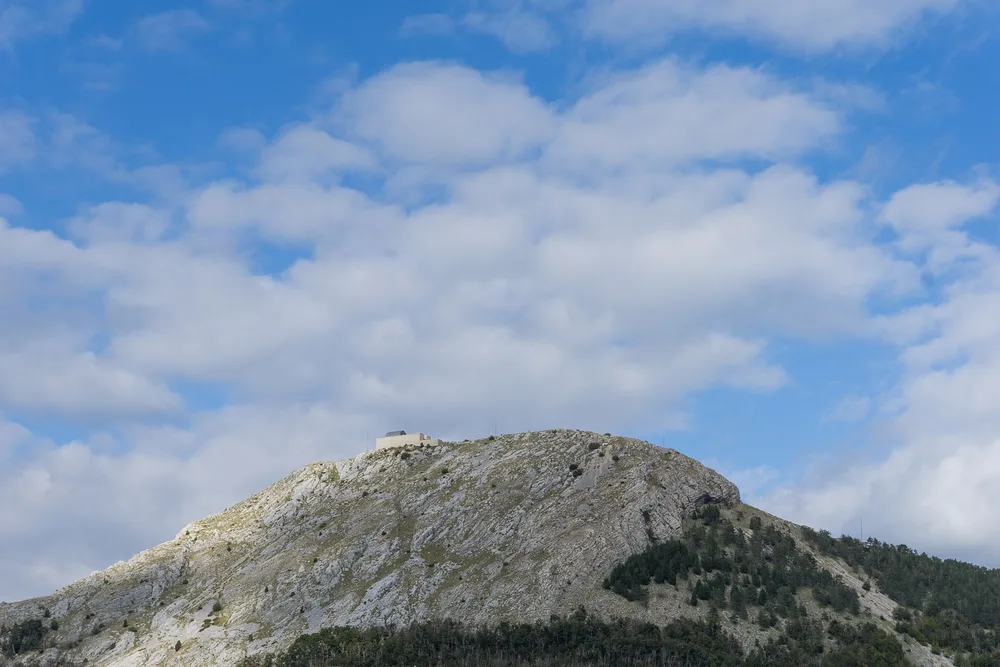
Lovćen, cable car, Njeguši and Cetinje day tour
A day from Kotor that rides the cable car up Lovćen and continues to Njeguši and Cetinje, as the title describes. Read the listing for the stops, whether the mausoleum ticket is included and what happens while the cable car is closed.
Check availabilityBook via GetYourGuide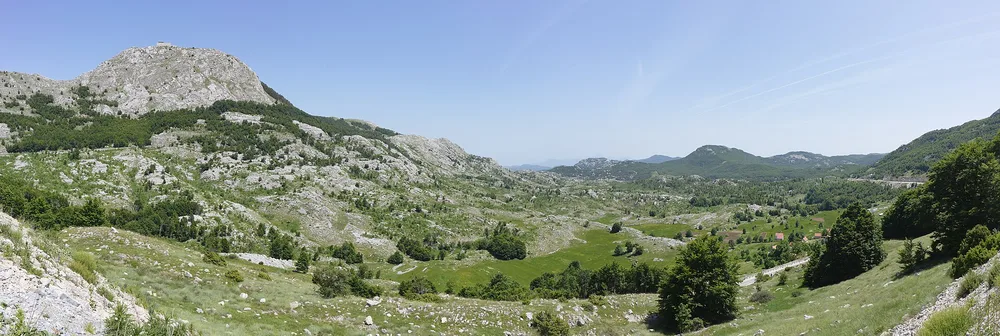
Kotor: private tour to Lovćen, Cetinje and Budva
A private day from Kotor over Lovćen to Cetinje and down to Budva, with your own driver-guide. Agree the stops and the time in each place when you book.
Check availabilityBook via GetYourGuideTour listings are on GetYourGuide. Prices, dates and cancellation terms are shown live on each listing and can change; Cetinje.com may earn a commission at no extra cost to you.
Frequently asked questions
How many steps are there to the Njegoš Mausoleum?
461, most of them in a covered tunnel stairway from the car park to the summit. Allow 10 to 15 minutes; there is no lift.
Is the Njegoš Mausoleum open in winter?
No. According to the National Museum of Montenegro it is closed to visitors from 16 November until the spring opening in April (the museum’s two websites give 11 April and 15 April).
How much is the ticket?
8 euro for adults and 4 euro for pupils and students, including Njegoš’s birth house in Njeguši, as checked November 2026. The Lovćen park fee and parking are extra.
Who designed the mausoleum?
The sculptor Ivan Meštrović, who died in 1962; it was built in 1970–1974, with the statues carved by his pupil Andrija Krstulović, and opened on 28 July 1974.
How far is it from Cetinje?
About 20 km by road, a little over half an hour by car.
Why is the mausoleum controversial?
It replaced the chapel Njegoš built for his own grave. The Serbian Orthodox Metropolitanate opposed its demolition and still asks for the chapel to be rebuilt; supporters regard the mausoleum as a fitting national monument.
Sources and official information
Facts were checked against these official and scholarly sources in November 2026. Opening hours, ticket prices, park fees and timetables change, so confirm before you go.
- en.narodnimuzej.me
- narodnimuzej.me
- en.narodnimuzej.me
- en.narodnimuzej.me
- cetinje.travel
- slobodnaevropa.org
- hrcak.srce.hr
- nparkovi.me
- en.wikipedia.org
- en.wikipedia.org
Cetinje.com is an independent guide, not the official site of the Old Royal Capital Cetinje, the National Museum of Montenegro, any tour operator, hotel or the government of Montenegro. Some links are affiliate links: tours go to GetYourGuide and accommodation goes to Booking.com, and we may earn a commission at no extra cost to you.