In short
- One loop, about 3 km, almost flat. It starts and ends at the car park by the tourist information point and passes every major monument of the historic core.
- Two to three hours if you look at buildings from outside and step into the monastery; half a day if you add the interiors of King Nikola’s Museum and Biljarda and the two outlying legations.
- Chronological at the start: the 1484 foundations, the 1701 monastery, the 1838 residence, the 1867 palace and the 1910 Government House follow one another within 500 m.
- Then the capital of 1900: Njegoševa Street, the French legation, the Vlach Church, the theatre, the Russian and British legations and the Blue Palace.
- Prefer a guide? The Cetinje guided walking tour with museum entry and the Cetinje city private tour are bookable on GetYourGuide.
Before you set out
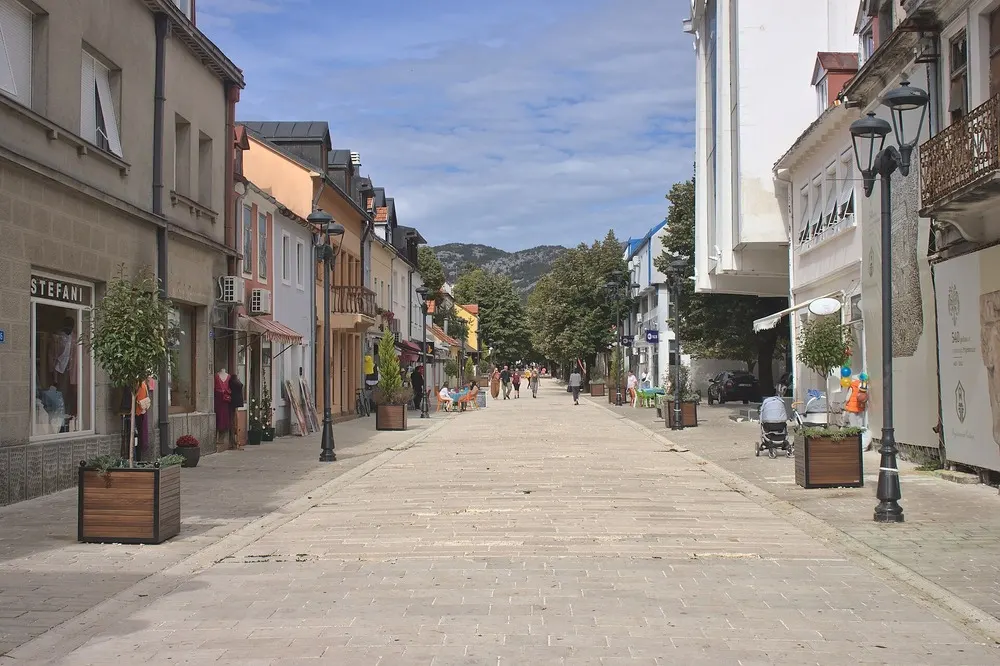
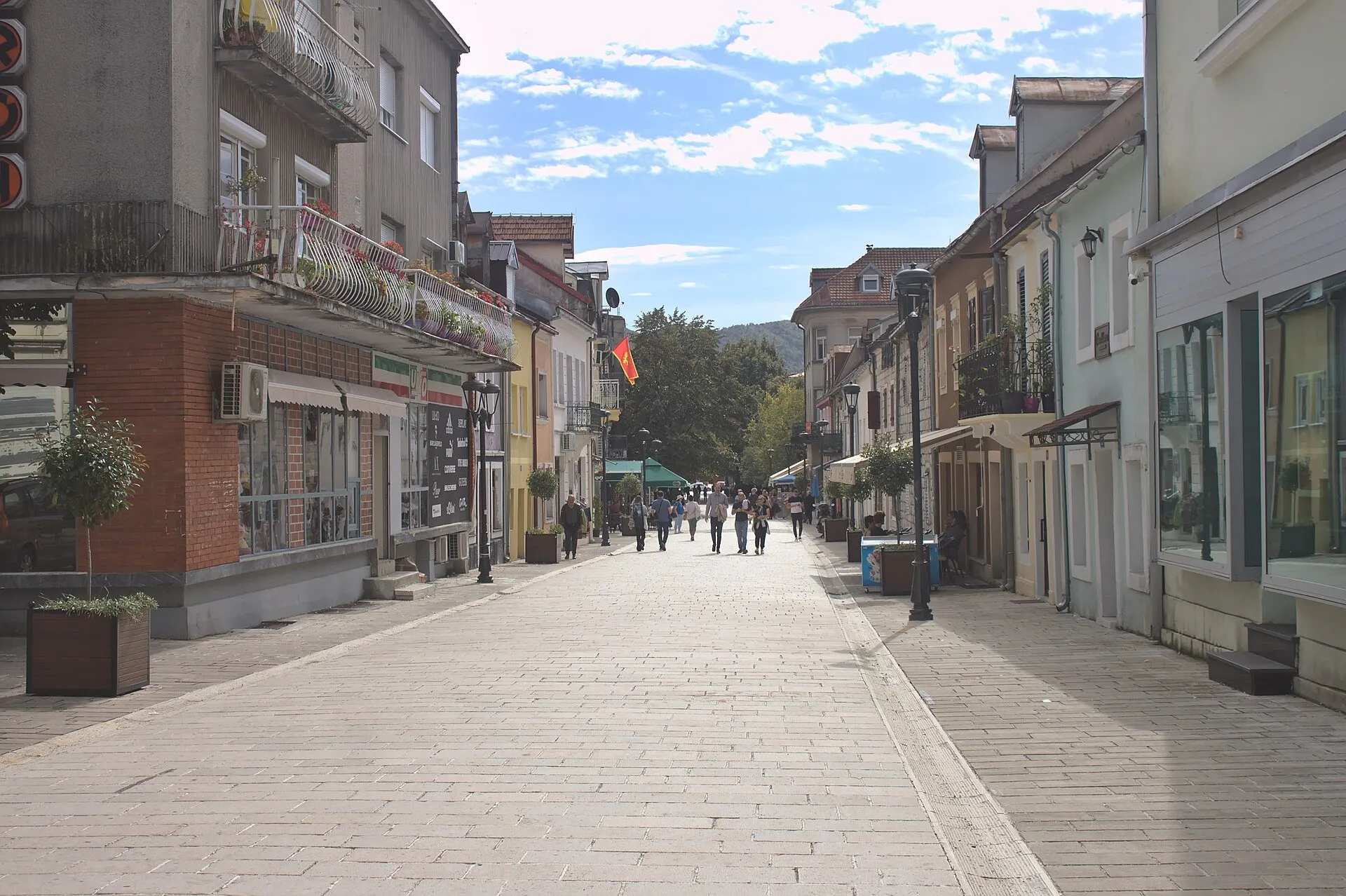
Cetinje is one of the easiest historic towns in Europe to walk. The old core lies on the floor of a level field, the streets are straight, much of the main one is closed to traffic, and nothing on this route is more than twelve minutes’ walk from the palace square. You do not need a map so much as an order, and that is what this page provides.
- Start: the public car park with the tourist information point, on the south side of the historic core, a minute from Ćipur. The National Museum quotes 2 euro a day for cars. If you arrive by bus, the station on Grahovska Street is about 450 m from the palace square: walk to the square and join the loop at stop 4.
- Distance and time: about 3 km. Walking alone takes 45 minutes; with stops, two to three hours.
- When: start by 9:00 AM in summer. The monastery is quietest early, the museums open at 9:00 AM, and by late morning the coach groups from the coast are in town. In winter the museums close at 3:00 PM and are shut at weekends.
- Dress: for the monastery, shoulders and knees covered. Otherwise ordinary walking shoes; the pavements are smooth stone and can be slippery when wet.
- Weather: Cetinje is often described as one of the rainiest towns in Europe and lies several hundred metres above the coast, so it is cooler than Kotor or Budva and often cloudier. Carry a layer and a waterproof outside high summer. See best time to visit.
Distances between stops are approximate and measured in a straight line from mapped positions; add a little for corners.
- Length
- About 3 km (loop); about 5.5 km with the outer legations and Orlov krš
- Time
- 2–3 hours; half a day with two museum interiors
- Start and finish
- Car park and tourist information point south of Ćipur
- Terrain
- Level, paved; one optional climb to Orlov krš
- Stops
- 16
- Paid interiors on the route
- King Nikola’s Museum, Biljarda with the Relief Map, Government House, Ethnographic Museum
Stops 1–5: the court quarter
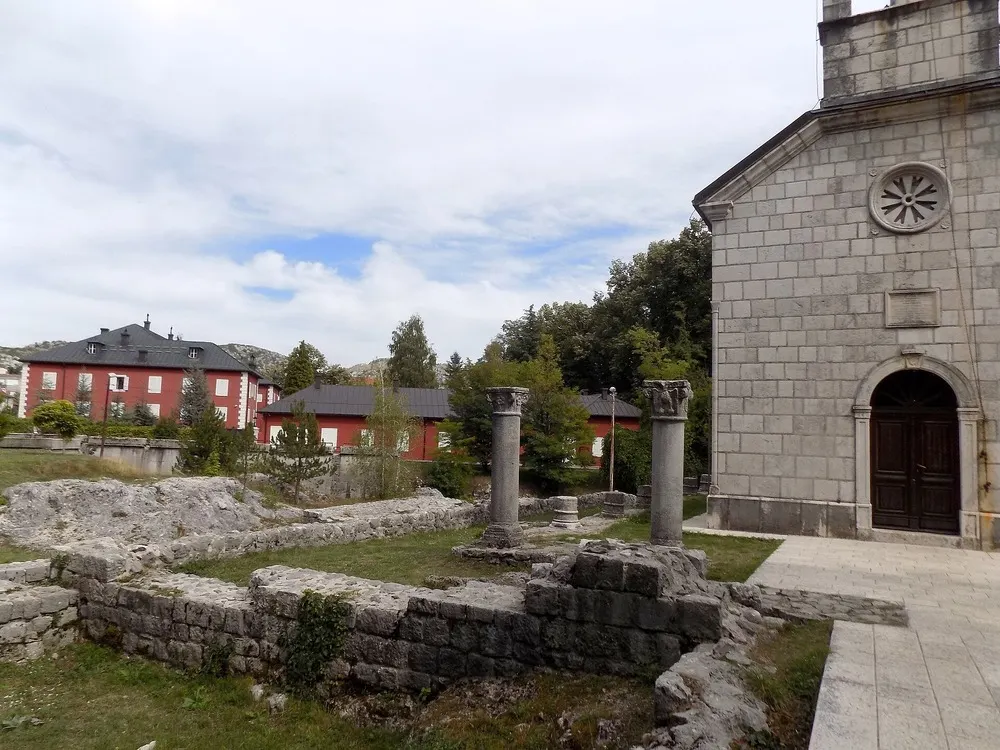
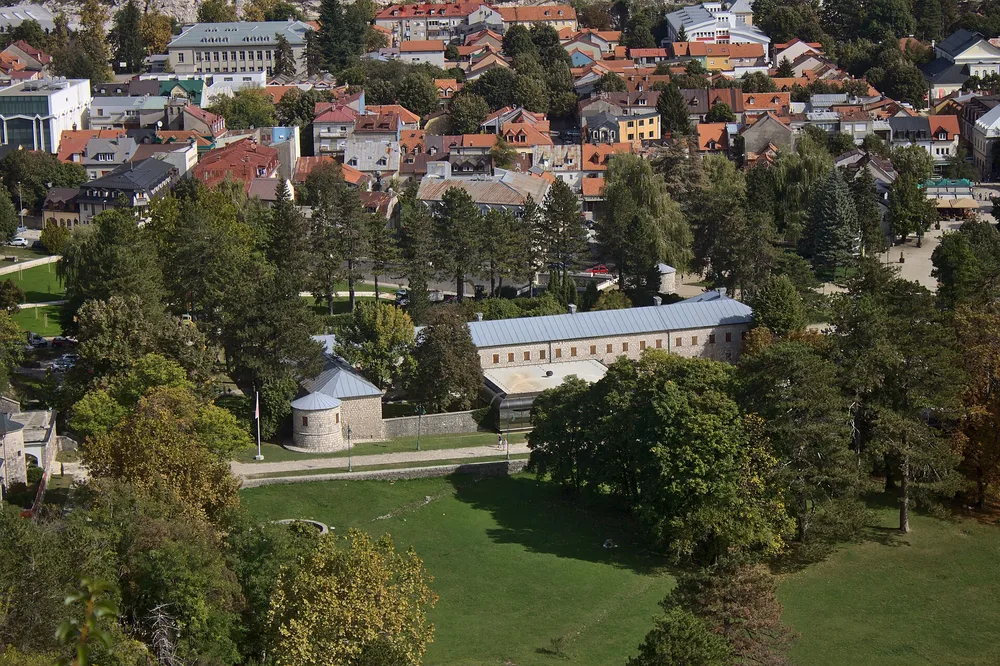
- Ćipur and the Court Church (80 m from the start). Begin where Cetinje began. The low walls and replica columns in the grass are the foundations of the monastery Ivan Crnojević built in 1484 and a Venetian mine destroyed in 1692. The small white church standing on them was finished in 1890 for Prince Nikola’s court; King Nikola and Queen Milena have lain inside since 1989. Five minutes, more if the church is open. Details.
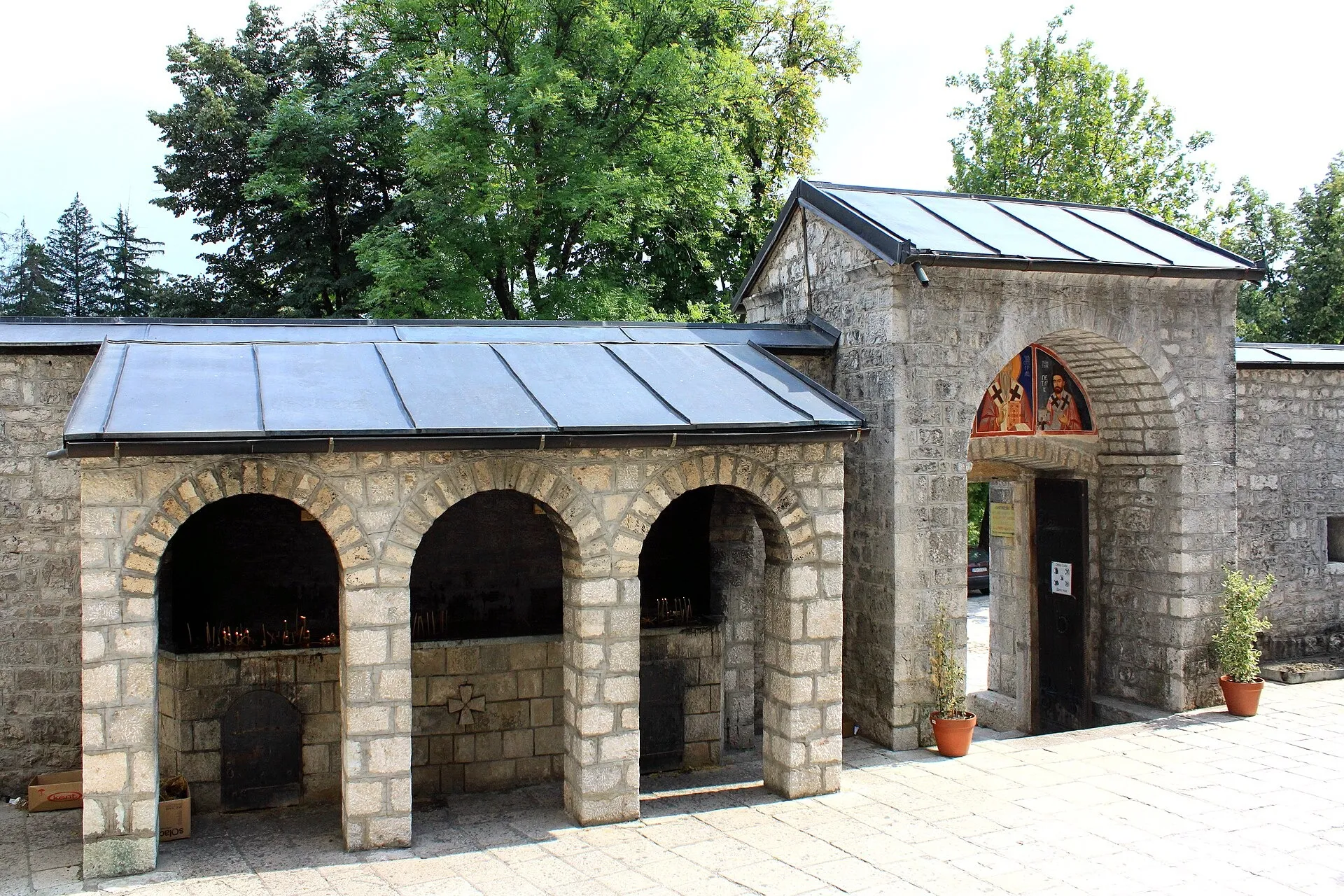
- Cetinje Monastery (175 m). Walk west along the path with Orlov krš ahead of you. The present monastery dates from 1701–1704 and was the seat of Montenegro’s prince-bishops; inside are the relics of St Peter of Cetinje and, shown at set times, the hand venerated as St John the Baptist’s. Entry is free. Allow 30 minutes. Optional: a path and a road climb in ten to fifteen minutes to the open mausoleum of Bishop Danilo (1896) on Orlov krš, the best viewpoint over the roofs; add half an hour.
- Biljarda (135 m). Return across the lawn to the long stone house with round corner towers that Njegoš built in 1838. If you are going into one museum besides the palace, make it this one: an hour inside covers the Njegoš Museum and, in the south courtyard, the Relief Map of Montenegro. From outside, walk the length of the enclosure wall. Details.
- Dvorski trg and King Nikola’s Palace (85 m). The court square. The red house with the porch was the royal palace from 1867 to 1916 and is now the country’s most visited museum; allow an hour inside. On the paved space towards the State Archives stands the statue of Ivan Crnojević, sword on shoulder. Details.
- The houses on the square (50 m). Opposite the palace, the cream house with the museum sign is the former Serbian legation, now the Ethnographic Museum. Beside the palace, the hotel with the terrace is the former Bulgarian legation, for decades the town’s café, Gradska kafana. A plaque nearby marks the Belgian vice-consulate of 1910–1912. This is the first good place to sit down.
Stops 6–10: the Government House and Njegoševa Street
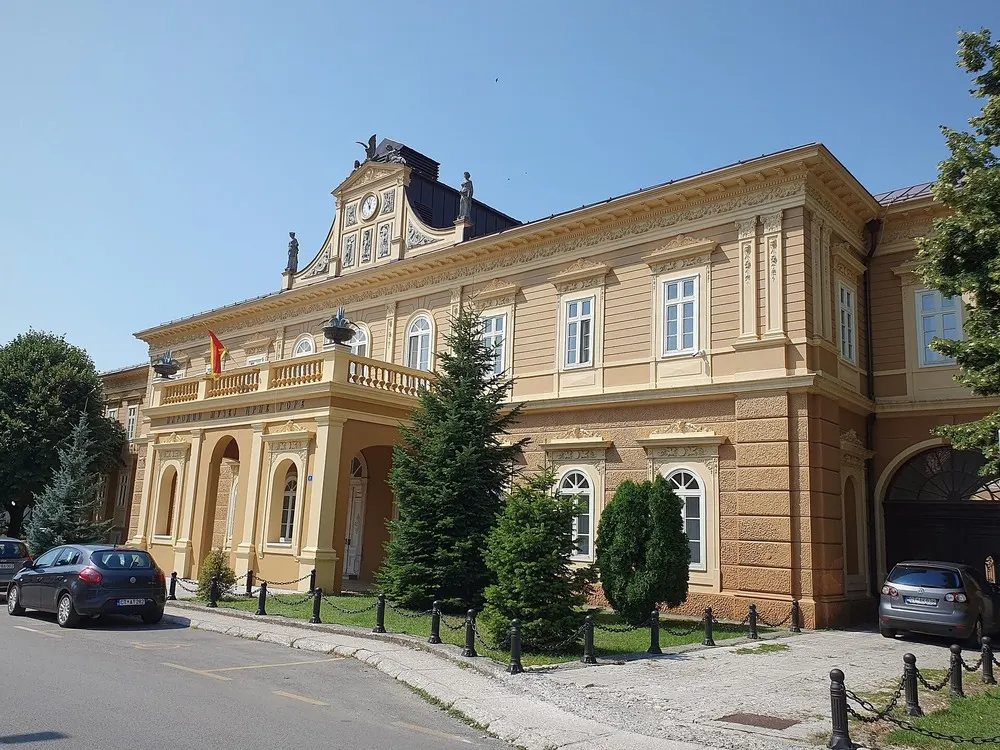
- Government House, Vladin dom (225 m). Leave the square heading north-west, by Novice Cerovića Street, for the ochre palace with the clock gable. Built in fourteen months for the proclamation of the kingdom in 1910, it was the largest building in Montenegro. Today it holds the Art Museum, with the icon of Our Lady of Philermos; allow an hour if you go in, ten minutes for the façade. Details.
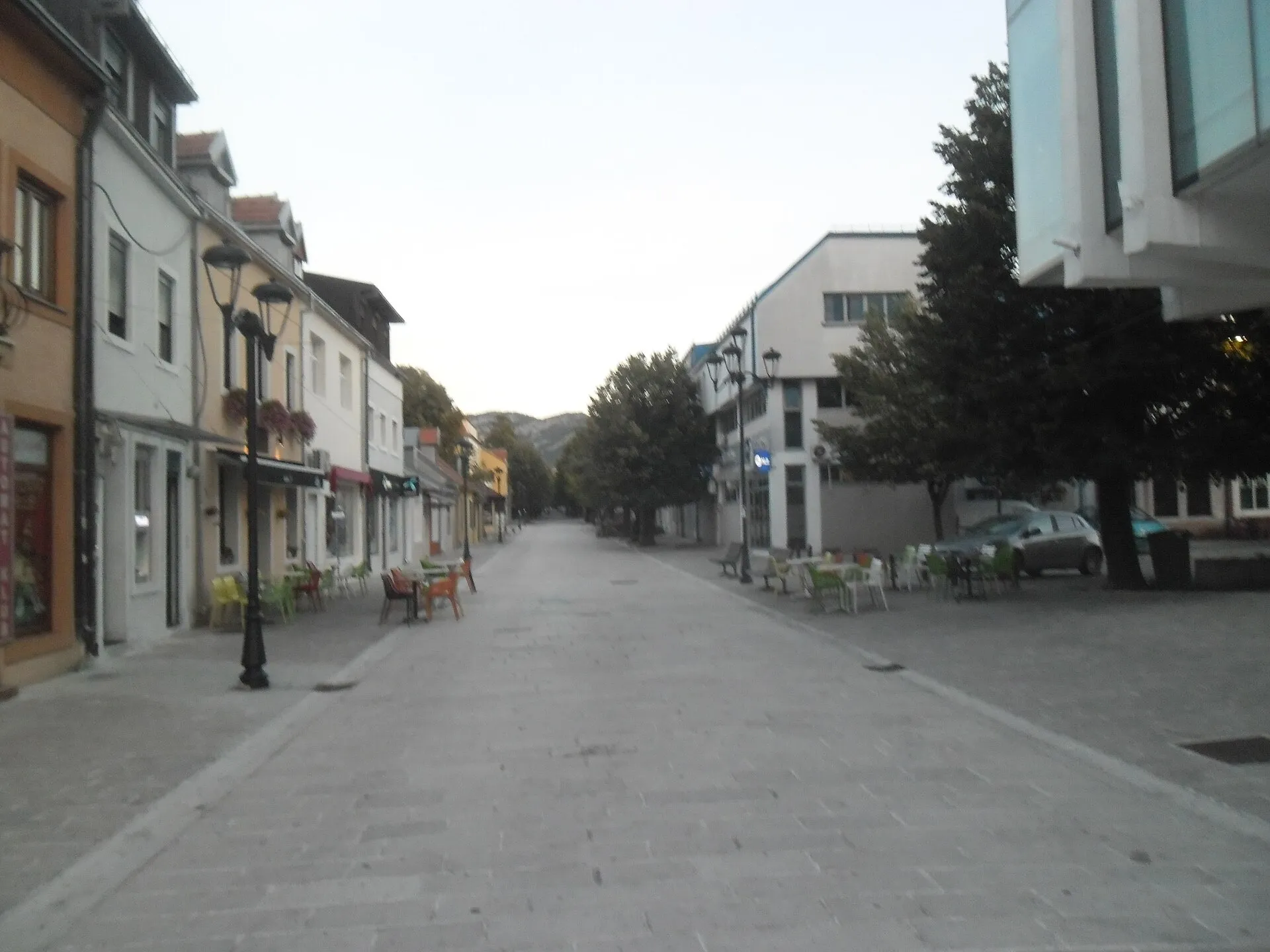
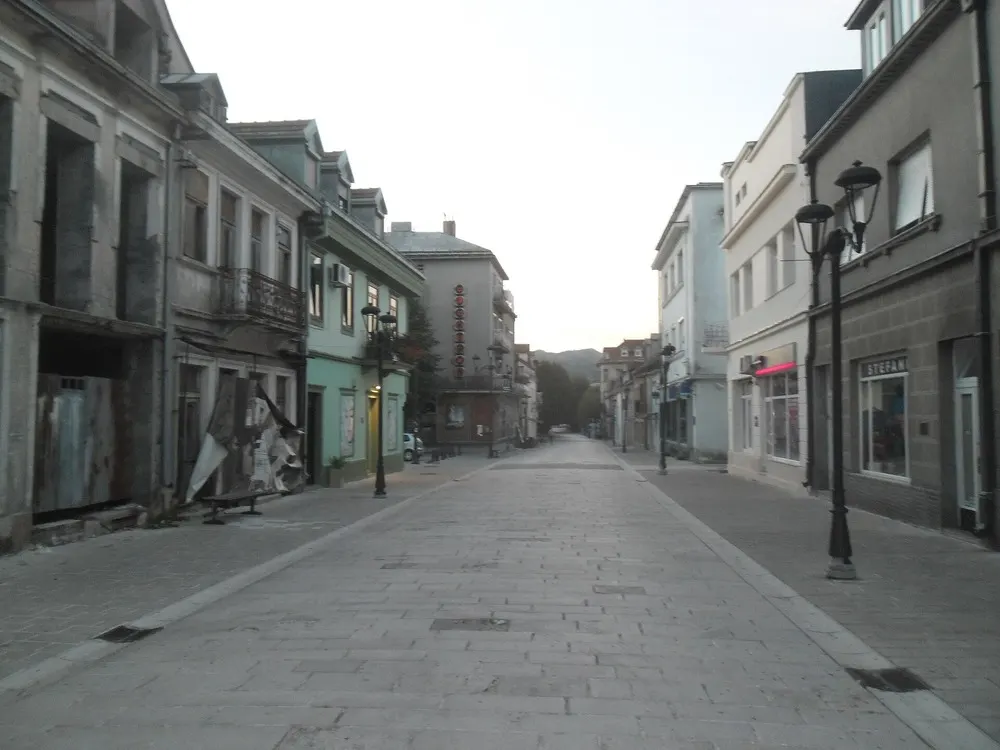
- Upper Njegoševa Street: the ‘Four Seasons’ house (110 m). Cross to the main street and turn away from the palace. Among the ordinary two-storey houses look for the yellow Đukanović house of 1910, set back behind four cast figures of the seasons, and, a few doors further, the bare cubic Vukotić house of the same year. Both are private; both are described in the architecture of Cetinje.
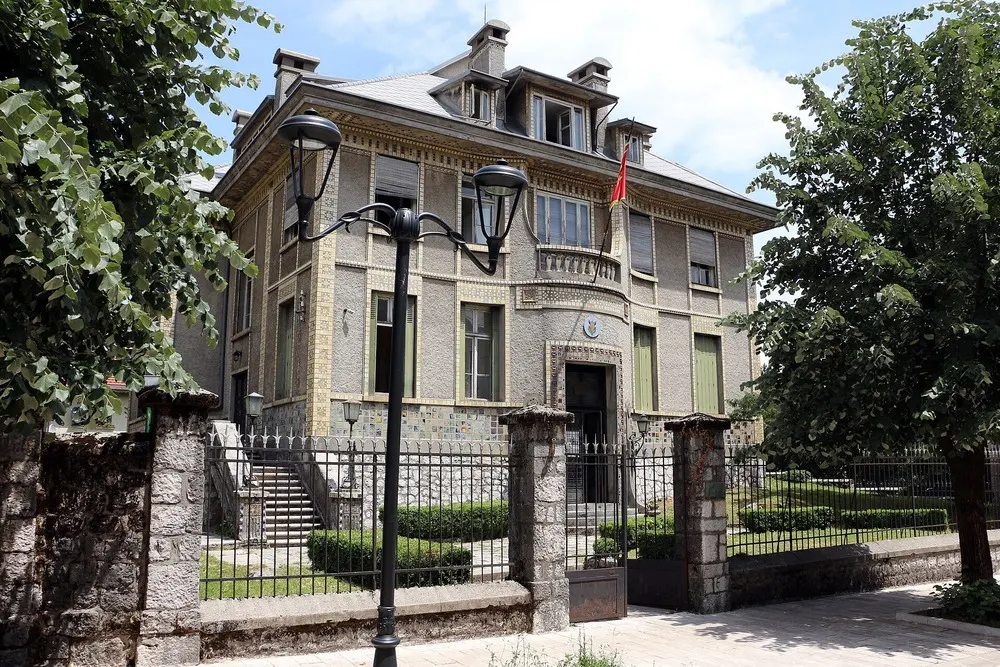
- The French legation (80 m). The town’s one Art Nouveau building, finished in 1910 to a design by Paul Guadet, faced in glazed tiles. It belongs to the National Library and is seen from outside. The Money Museum of the Central Bank is about 85 m further up the street if coins interest you. Details.
- The Vlach Church and the Lovćenska vila (120 m). Turn east into the square under the pines. The church was founded around 1450 and rebuilt in 1864; the uprights of its railing are rifle barrels captured from the Ottoman army; two medieval tombstones stand in the yard; and in front is Risto Stijović’s memorial of 1939 to the volunteers drowned in 1916. Ten minutes. Details.
- Balšića pazar (125 m). Walk south to the old market square, which appears on the town plan by 1901. The Montenegrin Art Gallery ‘Miodrag Dado Đurić’ is here, open Tuesday to Saturday, with changing exhibitions. A second place to pause.
Stops 11–16: theatre, legations and the Blue Palace
- Zetski dom (220 m). Continue south-east to the theatre with the three-arched porch. Begun by public subscription in 1884, it was Montenegro’s parliament from 1906 to 1910 and is still its royal theatre. To see inside, come back for a performance. Details.
- The Ottoman legation (80 m). The pale green house with the crescent medallion, a few steps from the theatre, was bought by the sultan’s government in 1885, the first legation in Cetinje to own its premises. It is now the Faculty of Dramatic Arts.
- The Russian legation and the Banovina (130 m). Past the heavy interwar block of the Zeta Banovina (1932, by Nikolai Krasnov), now the town hall, is the pink neo-baroque Russian legation of 1900–1903 behind its wrought-iron fence, the first Cetinje work of the architect Corradini.
- Through the City Park to the British legation (225 m). Cross the park, laid out in the English manner in the early 1890s, back to the lower end of Njegoševa Street. The dark red villa with white trim and the royal arms over the porch was built by the British Office of Works in 1912–1914 and is now the Music Academy; on a term-time afternoon you may hear it before you see it. The former German legation is a few doors up the street.
- The Blue Palace (90 m). Next door, behind railings, is the villa built in 1894–1895 for Crown Prince Danilo, since 2010 the official residence of the President of Montenegro. Exterior only. Details.
- Back to the start (about 250 m). Walk up Njegoševa Street to Dvorski trg and a table at the café, or cut through the Palace Park, laid out in the French manner in the early 1890s, to the car park.
The half-day version
With four or five hours you can turn the loop into a full reading of the town. Keep the same order and add:
- Two interiors. King Nikola’s Museum (60–75 minutes) and Biljarda with the Relief Map (60 minutes). If you would rather have art than biography, swap Biljarda for the Art Museum in the Government House. Tickets and hours are on the museums page.
- Orlov krš from the monastery (30 minutes there and back), for the view of the whole field and the ring of hills that kept it safe.
- The Austro-Hungarian legation. From the French legation continue north-west for about 500 m to Josip Slade’s stone house of 1897–1899 with its Catholic chapel, on Baja Pivljanina Street.
- The Italian legation. A further 450 m west, on the road to Lovćen, is the villa of 1905–1910 in its park that houses the National Library. From there it is about 1 km back to the centre.
That makes roughly 5.5 km of walking. A sensible rhythm is the court quarter and one museum before a coffee on the square, the Government House and Njegoševa Street before lunch, and the outer legations, theatre and parks afterwards.
| Version | Walking | Interiors | Total time |
|---|---|---|---|
| Short loop | About 3 km | Monastery only | 2–3 hours |
| Loop with one museum | About 3 km | Monastery and King Nikola’s Museum | 3–4 hours |
| Half day | About 5.5 km | Monastery, palace, Biljarda with the Relief Map | 4–5 hours |
| Full day | About 5.5 km | All of the above plus the Art Museum and Ethnographic Museum | 6–7 hours with lunch |
Self-guided or with a guide?
The town explains itself poorly. There are few information boards, several of the best buildings are unlabelled, and the stories that make sense of the place, who married whom, which power built what and why, are not on the walls. A good guide adds a great deal. On the other hand the distances are short, the order is easy, and nothing stops you taking your time. The table sets out the choice; the tour names are the listing titles on GetYourGuide, and we do not quote prices or ratings.
| This self-guided loop | Top pickGuided walking tour with museum entry | Cetinje city private tour | Day tour from the coast | |
|---|---|---|---|---|
| Starts | Car park or bus station, any time | In Cetinje | In Cetinje | On the coast (see the listing) |
| Pace | Yours | The group’s | Yours, with a guide | A short stop among several |
| Depth on Cetinje | ●●●○○ | ●●●●○ | ●●●●● | ●●○○○ |
| Freedom to linger | ●●●●● | ●●●○○ | ●●●●○ | ●○○○○ |
| Good without a car | ●●●○○If you come by bus | ●●●○○If you come by bus | ●●●○○If you come by bus | ●●●●●Transport included |
| Best for | Independent travellers and architecture lovers | First-time visitors who want context | History enthusiasts and families | Those based in Kotor or Budva with one day |
| Read the guide | Check dates | Check dates | See the tour |
-
This self-guided loop
- Starts
- Car park or bus station, any time
- Pace
- Yours
- Depth on Cetinje
- ●●●○○
- Freedom to linger
- ●●●●●
- Good without a car
- ●●●○○If you come by bus
- Best for
- Independent travellers and architecture lovers
-
Guided walking tour with museum entry
Top pick- Starts
- In Cetinje
- Pace
- The group’s
- Depth on Cetinje
- ●●●●○
- Freedom to linger
- ●●●○○
- Good without a car
- ●●●○○If you come by bus
- Best for
- First-time visitors who want context
-
Cetinje city private tour
- Starts
- In Cetinje
- Pace
- Yours, with a guide
- Depth on Cetinje
- ●●●●●
- Freedom to linger
- ●●●●○
- Good without a car
- ●●●○○If you come by bus
- Best for
- History enthusiasts and families
-
Day tour from the coast
- Starts
- On the coast (see the listing)
- Pace
- A short stop among several
- Depth on Cetinje
- ●●○○○
- Freedom to linger
- ●○○○○
- Good without a car
- ●●●●●Transport included
- Best for
- Those based in Kotor or Budva with one day
Our editorial comparison, as of November 2026. Check each listing for what is included.
Getting to the start, and making a day of it
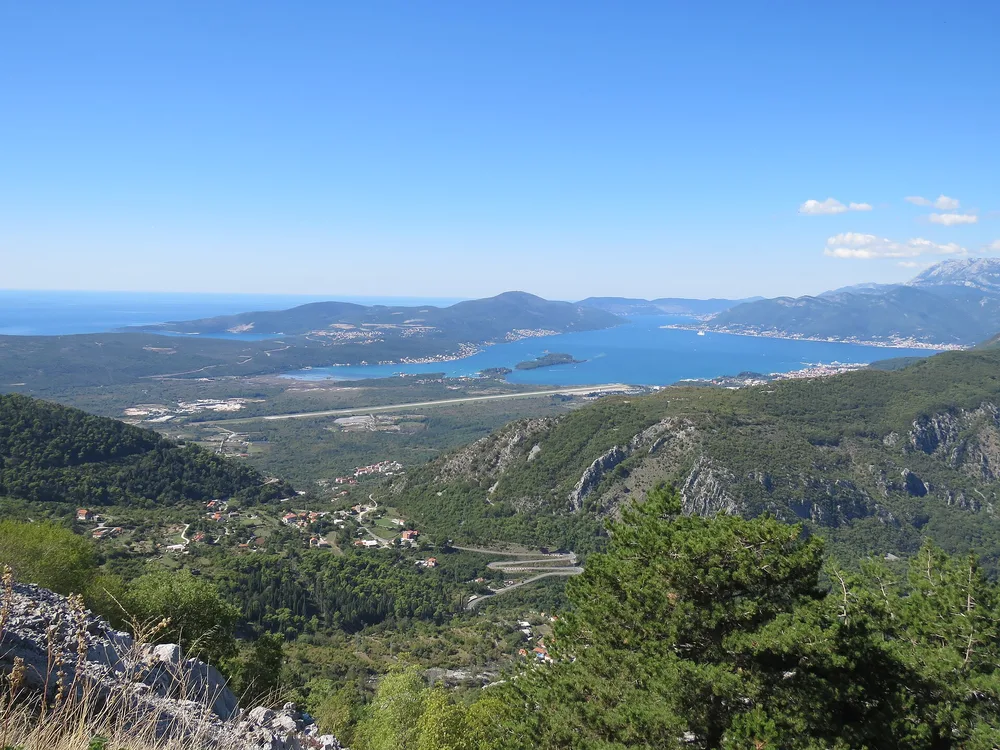
Cetinje is about 35 km from Podgorica and 31 km from Budva and roughly an hour from Kotor by the main road; buses from all three stop at the station five minutes from the palace square. Details are on getting there. If you are driving up from the coast, the old road from Kotor by the hairpins and Njeguši is one of the great drives of the Adriatic and puts you in Cetinje by mid-morning; see the Kotor guide on ExploreMontenegro for the town at the bottom of it and our own page on the serpentine and the cable car.
After the walk, the obvious extension is Mount Lovćen and the Njegoš Mausoleum, about 25 minutes by car from the town according to the museum, which is why so many organised tours pair the two. The listings below include Cetinje among other stops; their titles are all we know of their content, so read the details before you book.
From Podgorica: Rijeka Crnojevića and Cetinje, history and nature
A day out from the capital that pairs the two seats of the Crnojević lords: the river port of Rijeka Crnojevića and the Old Royal Capital. The listing title promises history and nature; check it for the stops, the museum entries and the group size.
Check availabilityBook via GetYourGuide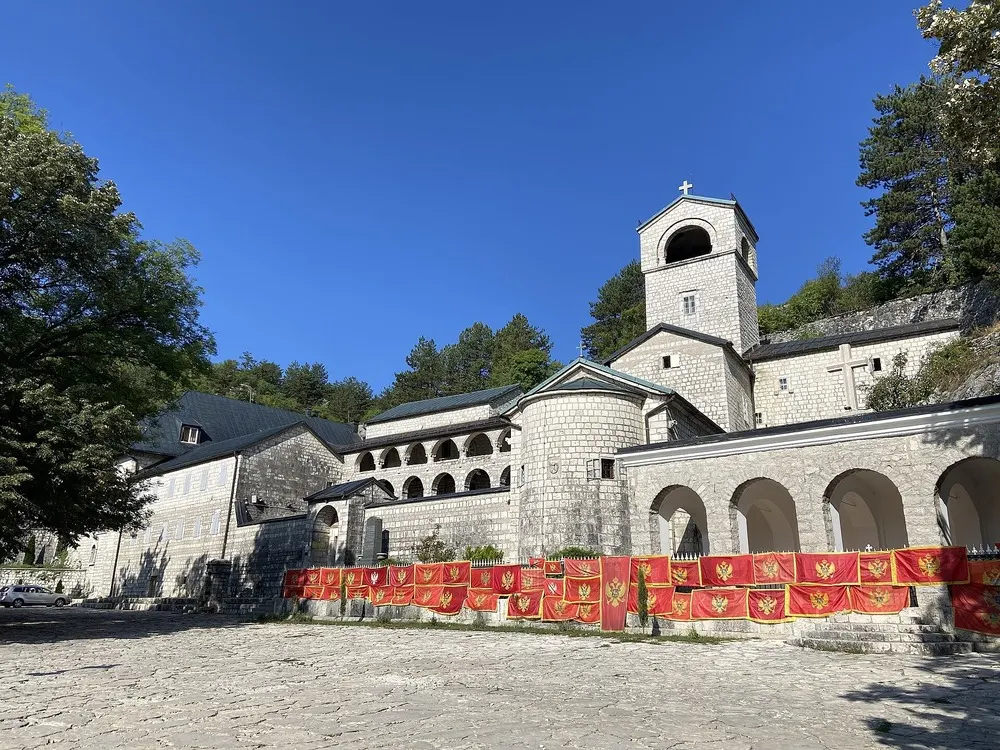
Montenegro tour: history, tradition, culture
A culture-led tour listed under Njeguši, the home village of the Petrović dynasty on the old road between Kotor and Cetinje. The title names history, tradition and culture; read the listing for the route and what is included.
Check availabilityBook via GetYourGuideTour listings are on GetYourGuide. Prices, dates and cancellation terms are shown live on each listing and can change; Cetinje.com may earn a commission at no extra cost to you.
Frequently asked questions
How long does it take to walk around Cetinje?
The loop described here is about 3 km and takes two to three hours with stops. Add an hour for each museum you enter. Half a day covers the walk, the monastery, King Nikola’s Museum and Biljarda.
Is Cetinje walkable?
Very. The historic core is flat and compact, the main street is pedestrianised, and every monument on this route is within about twelve minutes’ walk of the palace square.
Where should I start a walking tour of Cetinje?
At the car park with the tourist information point south of Ćipur if you drive, or at the bus station if you come by bus, joining the loop at Dvorski trg. Beginning at Ćipur and the monastery puts the monuments in chronological order.
Can I do the walk in the rain?
Yes, and you may have to: Cetinje has a reputation as one of the rainiest towns in Europe. Bring a waterproof, take care on the smooth stone paving, and plan to spend longer in the museums.
Are there guided walking tours of Cetinje?
Yes. GetYourGuide lists a Cetinje guided walking tour with museum entry and a Cetinje city private tour, both based in the town, as well as day tours from Kotor, Budva and Podgorica that include a stop here.
Is the route suitable for wheelchairs and pushchairs?
The streets and squares are level and paved. The museums are historic buildings with steps, and the path up Orlov krš is steep; ask at each museum door about step-free access.
Sources and official information
Facts were checked against these official and scholarly sources in November 2026. Opening hours, ticket prices, park fees and timetables change, so confirm before you go.
- narodnimuzej.me
- narodnimuzej.me
- cetinje.travel
- cetinje.travel
- cetinje.travel
- openstreetmap.org
- aseestant.ceon.rs
- roomfordiplomacy.com
- whc.unesco.org
Cetinje.com is an independent guide, not the official site of the Old Royal Capital Cetinje, the National Museum of Montenegro, any tour operator, hotel or the government of Montenegro. Some links are affiliate links: tours go to GetYourGuide and accommodation goes to Booking.com, and we may earn a commission at no extra cost to you.