In short
- Old Montenegro was a society of clans (plemena) and brotherhoods without towns or a nobility, held together by custom, the Orthodox Church and a code of honour.
- That code is summed up as čojstvo i junaštvo: humanity and heroism, the duty to protect others from yourself as well as yourself from others.
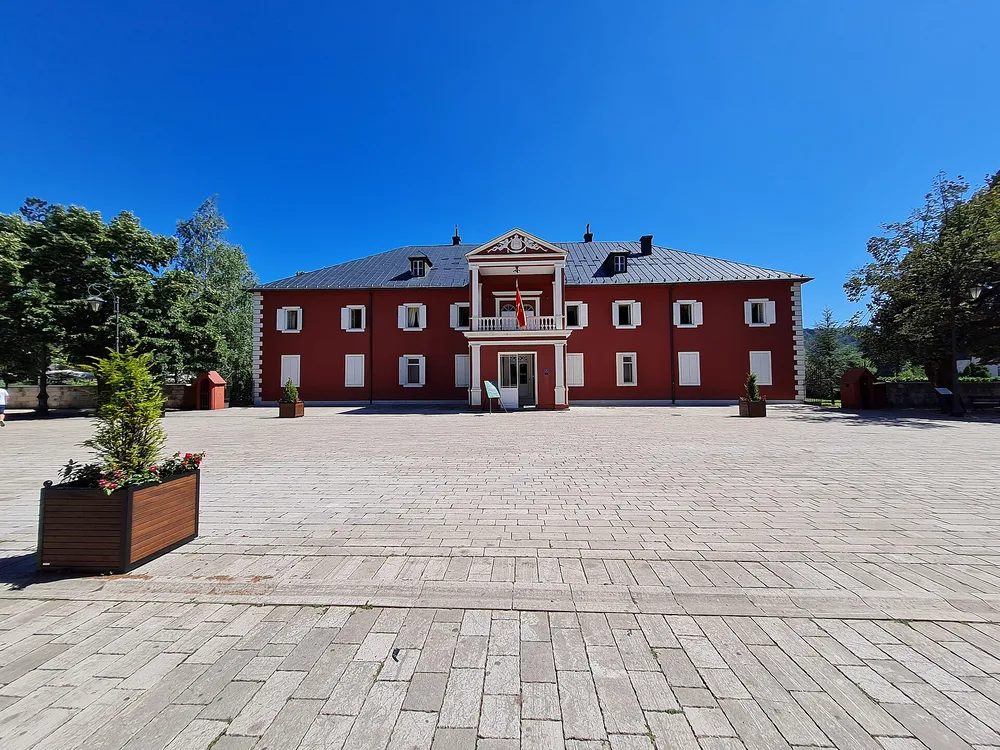
- Its visible signs are the national costume and the flat red-and-black cap, best seen in the Ethnographic Museum and King Nikola's Palace.
- Its sound is the gusle, a one-stringed fiddle to which epic poems are chanted, and its dance is the oro, the ‘eagle’ round dance.
- Cetinje today is also Montenegro's art town, home of the national faculties of fine arts, music and drama and, since 2023, a UNESCO Creative City of Design.
A capital that was the top of a clan society
Cetinje's legations and palaces can give the impression of a little Central European court town. It was never quite that. Until the last decades of the nineteenth century the people who came here to see their ruler were herdsmen and warriors organised by descent, and the manners, dress, music and values of the town were theirs. The court took its style from the mountain, not the other way round: the prince wore the same costume as his bodyguard, sat in judgement under a tree and wrote verse in the metre of the village singers.
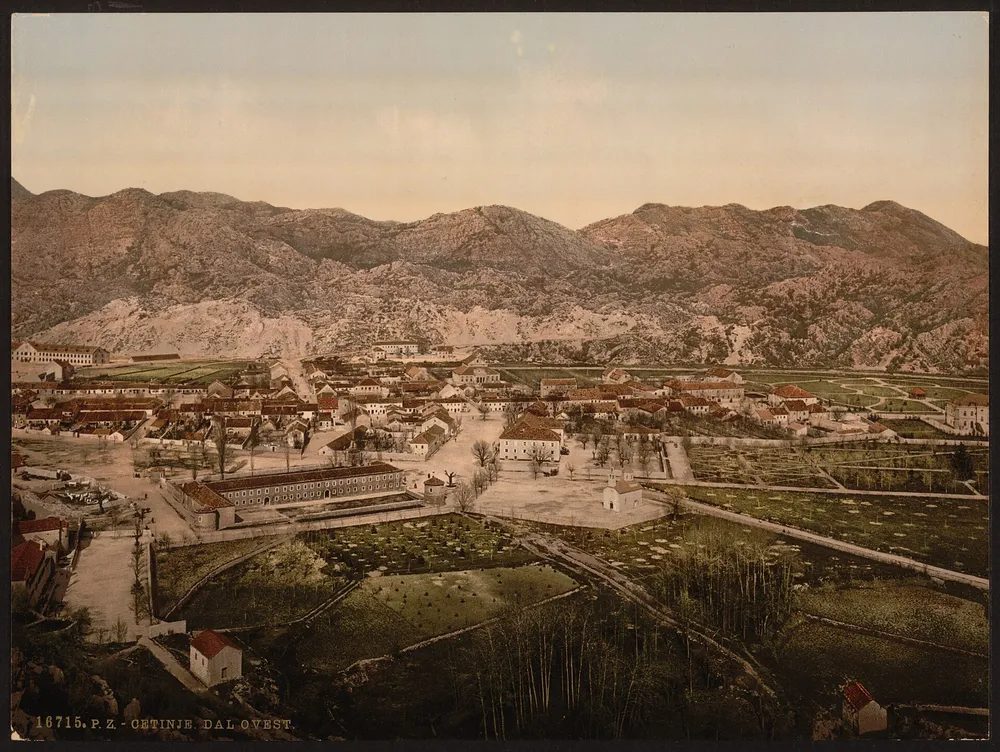
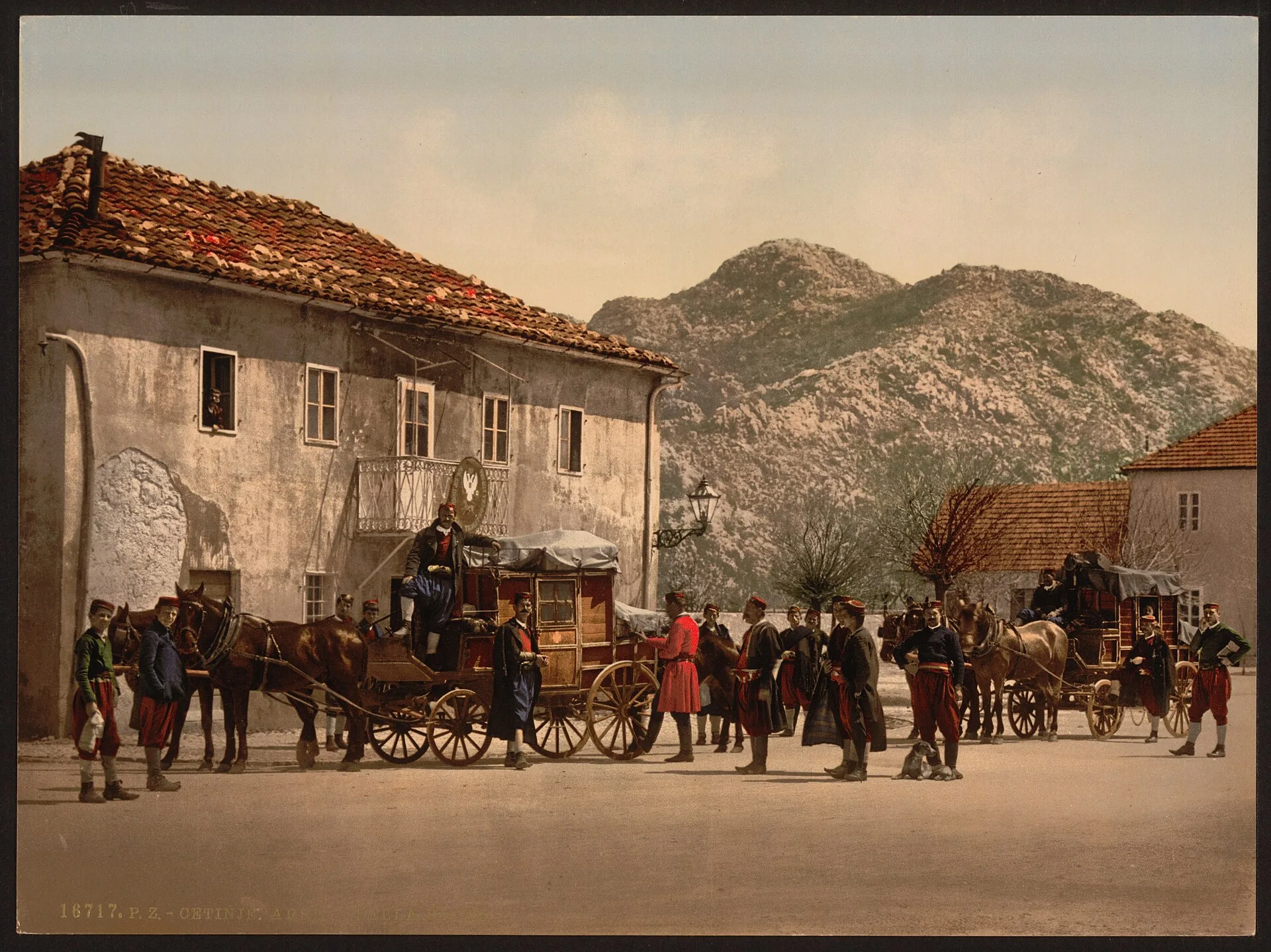
That older culture is what this guide describes. Much of it survives in some form, in ceremonies, in museums, in the way people speak about honour and family, and knowing a little about it makes the monuments easier to read. The photograph at the top of the page, a tinted view of the mail coach arriving in Cetinje in the 1890s, shows the street as it then looked: almost every man in it is wearing the national dress as everyday clothing.
Clans, brotherhoods and the four nahije
The basic unit was the bratstvo, the brotherhood: all the households descended in the male line from a common ancestor, living in the same hamlet, sharing pasture and answerable for one another. Several brotherhoods occupying a defined territory formed a pleme, a clan or tribe, with its own assembly and its own chief, the knez or vojvoda or, for military matters, the serdar. Old Montenegro, the land that was never fully subdued by the Ottomans, consisted of four districts or nahije. The largest, the Katunska nahija, lay around Cetinje and counted nine clans, among them the Cetinje clan itself, the Njeguši, the Ćeklići, the Bjelice, the Cuce and the Ozrinići. The other three, Riječka, Crmnička and Lješanska, sloped away towards Lake Skadar. From 1796 the larger highland clans to the north-east, the Brda, joined them.
A man's first loyalty was to his brotherhood, and an injury to one member was an injury to all. Hence the institution that most struck foreign observers: the blood feud, krvna osveta. A killing obliged the victim's kin to take a life from the killer's brotherhood, which created a new obligation in return, and feuds could run for generations. They could be ended only by a formal reconciliation, the umir, arranged by respected elders, in which the guilty side made a public act of humility and the two families were bound together by godparenthood (kumstvo). One of the main reasons the bishops of Cetinje acquired political authority was that they alone stood outside the feuds and could broker such settlements, and one of the main aims of every ruler from Petar I onward was to replace the feud with a court.
People in Cetinje still know which clan and brotherhood they come from, and surnames tell the story to those who can read them. The system no longer governs anything, but it explains the importance of hospitality, the long memories and the deep attachment to particular villages that visitors notice.
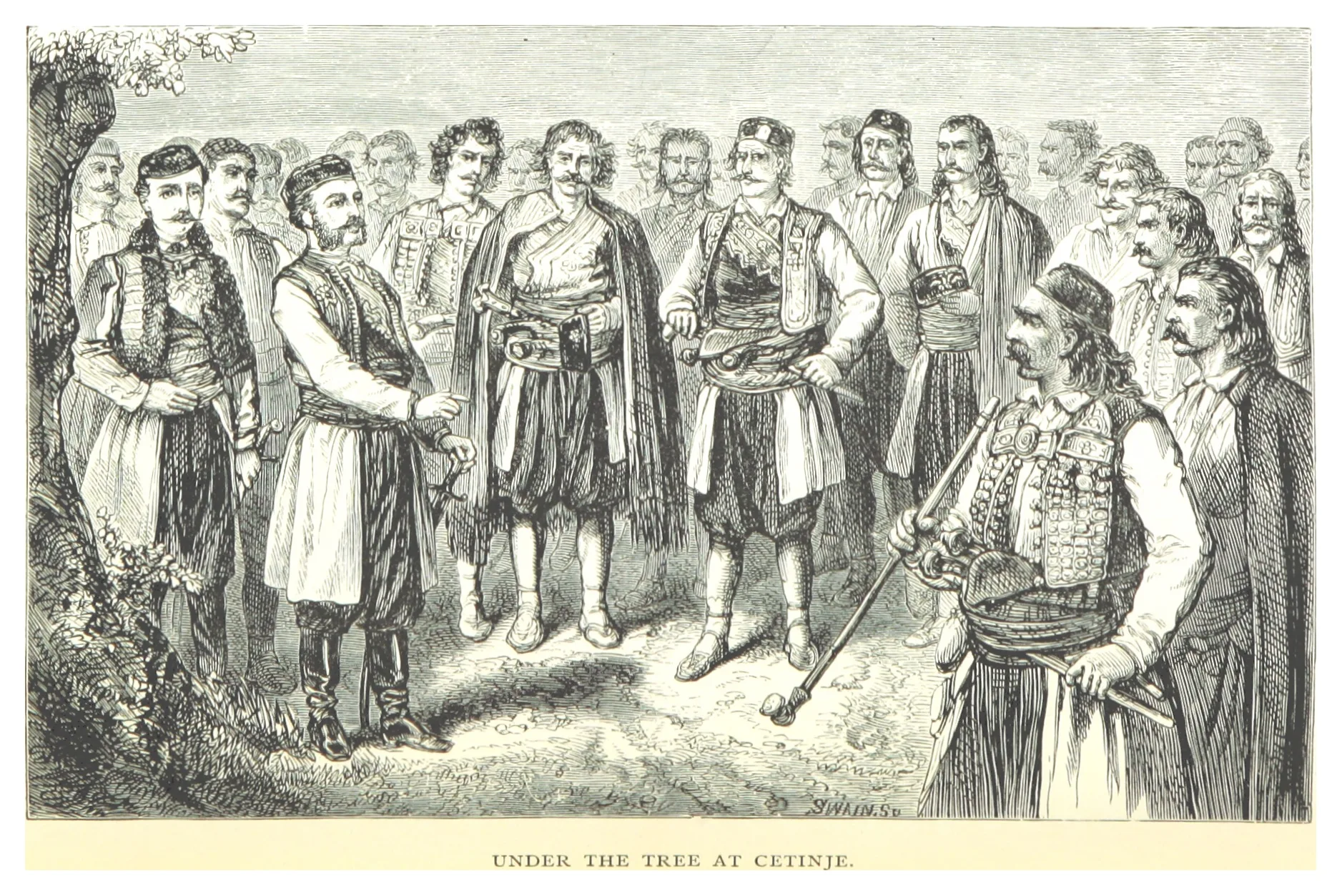
‘Under the Tree at Cetinje’: clansmen gathered before their prince, an engraving from the 1877 edition of Travels in the Slavonic Provinces of Turkey-in-Europe by Georgina Muir Mackenzie and Adeline Irby.
Čojstvo i junaštvo: the code
Ask a Montenegrin to name the national virtues and you will get a two-word answer: čojstvo i junaštvo. Junaštvo is heroism, physical courage, the quality of a junak. Čojstvo is harder to translate. It comes from čovjek, a human being, and means something like manliness in the old moral sense: integrity, magnanimity, self-command.
The classic definition is attributed to Marko Miljanov (1833–1901), a chieftain of the Kuči clan who learned to write late in life and set down a collection of true anecdotes under the title Examples of Humanity and Heroism (Primjeri čojstva i junaštva). Heroism, he said in effect, is defending yourself from another; humanity is defending another from yourself. A brave man who lacks the second quality is merely dangerous. Miljanov's stories are about exactly that restraint: the man who spares an enemy who has fallen, who keeps his word to a Turk, who gives up a claim he could have enforced.
The ideal had a hard edge in practice, and writers from Njegoš to the dissident Milovan Djilas were clear-eyed about the violence of the old society. But the phrase is still a living standard. You will hear čojstvo used of a referee, a neighbour or a politician, usually to remark on its absence.
The national costume
The Montenegrin costume as worn in Cetinje in the nineteenth century was one of the most sumptuous in Europe, and one of the most costly, with its gold embroidery and silver. Njegoš wore it in preference to his robes and King Nikola made it court dress, so that ministers, officers and the royal family all appear in it in photographs.
For men the essentials are a white linen shirt; wide dark-blue breeches (gaće or dimije) gathered below the knee; white woollen leggings (dokoljenice) and soft leather sandals (opanci) or boots; a crimson waistcoat crossed over the chest and edged with gold braid (džamadan); and over it, according to rank and occasion, a short sleeveless jacket (jelek) or a long coat in white or pale green (dolama), both heavily worked in gold thread. A broad silk sash (pas), yards long, is wound round the waist, and over it sits a leather belt in which a pistol and the long knife called a handžar were carried. On great occasions the chest was covered with toke, ornamental plates of silver or gilt that recall armour. A woollen plaid (struka) over the shoulder served as cloak and blanket.
For women the characteristic garment is the koret, a long sleeveless coat of fine pale cloth, most often light blue or green, open at the front and embroidered in gold. Under it are a silk blouse with embroidered sleeves and a long skirt, and round the waist a heavy belt of worked silver, the ćemer, which was the chief ornament and often an heirloom. Unmarried girls wore the same cap as the men, without the gold on top; married women covered their hair with a dark veil.
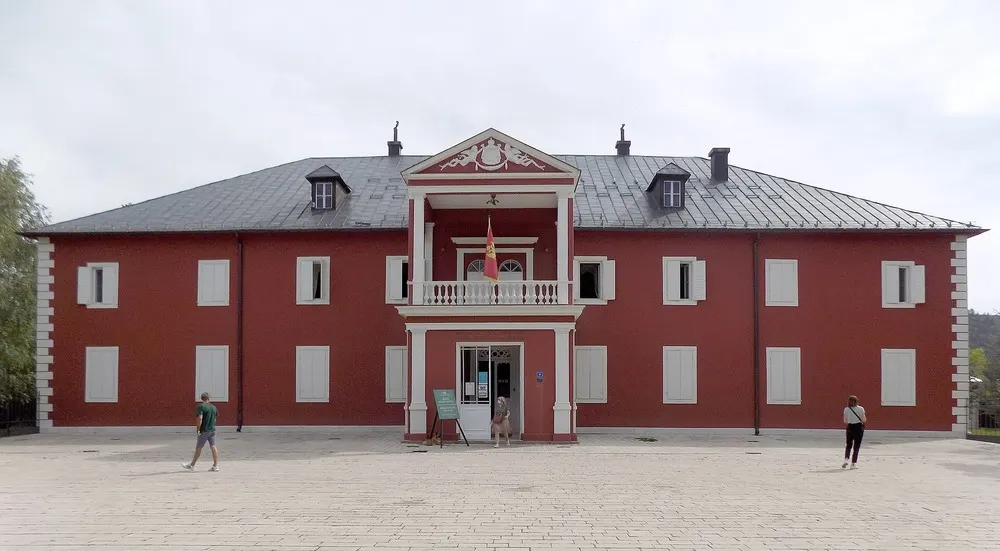
Where to see it. The Ethnographic Museum, in the former Serbian legation, shows the costume with the weaving, embroidery and silverwork that went into it. King Nikola's Palace has the court versions, including clothes worn by the king, the queen and the princesses, together with the ceremonial weapons. Both are units of the National Museum; see the museums guide. Outside the museums you will see the costume on folklore ensembles, at weddings and on state occasions.
The cap and what it is said to mean
The one piece of the costume still in ordinary use is the cap, the kapa: a low flat cylinder with a black band round the side and a red crown, on which a design is embroidered in gold. Older men wear it on feast days; you will see it at funerals, weddings and football matches, and in every souvenir shop.
It spread in the time of Njegoš, who is said to have encouraged it in place of the Ottoman-style fez, and under King Nikola it became part of army uniform. The side band, the derevija, was originally a strip of black silk; the crown is the tepeluk.
Every Montenegrin child is taught a meaning for it. In the version recorded by folklorists around 1900, the black band is mourning for the medieval Serbian empire lost at Kosovo in 1389 and the red crown the blood shed there. The gold embroidery on top has been read in several ways: the five concentric gold threads as five centuries of struggle under the Ottomans, with the small enclosed field as the corner of land that stayed free. These explanations are tradition, not documented history, and they were shaped by the national romanticism of the nineteenth century, but they are part of what the cap now is.
What goes inside the gold arcs is a statement. Under King Nikola it was commonly his cypher, the Cyrillic letters Н. I. After 1918 the Serbian cross with four fire-steels became usual, and it is still the version worn by those who feel themselves Serbs. Since the 1990s many caps carry the Montenegrin state arms, the crowned double-headed eagle with a lion on its breast. Both kinds are on sale side by side in Cetinje, and choosing one is not a neutral act; the background is in the guide to language and identity.
The gusle and the epic
The gusle is a bowed instrument carved from a single piece of maple, with a skin belly and one string of twisted horsehair. It has a compass of a few notes. It is not meant to be beautiful in the concert sense: it supports the voice of the guslar, who chants narrative poems in lines of ten syllables, the deseterac, each line more or less complete in itself. The carved neck usually ends in a horse's head, an eagle or a portrait of a hero.
In a society that until Njegoš's time had almost no schools, the songs were history, newspaper and moral instruction. The oldest cycles tell of the battle of Kosovo and of Prince Marko; the Montenegrin ones of raids, sieges and single combats against the Turks, and they were still being composed about the battles of 1858 and 1876–78 by men who had fought in them. Vuk Karadžić wrote many of them down in the 1820s and 1830s and they astonished literary Europe, where Goethe and the Grimm brothers were among their admirers. Njegoš grew up on them, and The Mountain Wreath is written in their metre.
The tradition is alive, with associations of guslars, competitions and new songs on recent events, though it is now a conscious art and no longer the common property of every household. Singing to the accompaniment of the gusle was inscribed on UNESCO's Representative List of the Intangible Cultural Heritage in 2018, on a nomination from Serbia; the instrument is equally at home in Montenegro, Herzegovina and the Dinaric highlands generally. In Cetinje you will find gusle in the Ethnographic Museum.
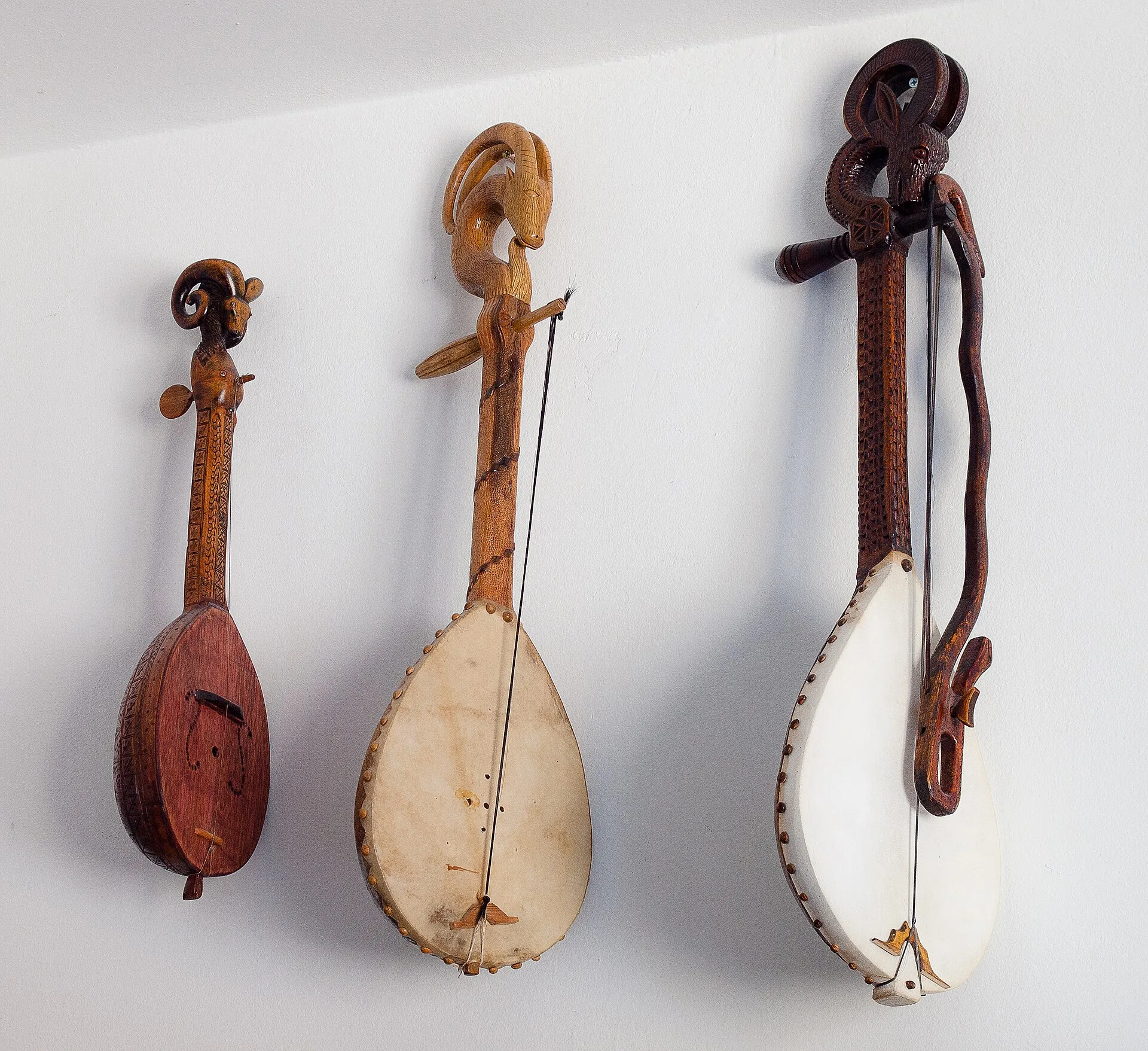
Gusle from Montenegro and Serbia: one string, a skin-covered sound box and a carved head. The instrument accompanies the chanting of epic verse.
The oro and other dances
The national dance is the oro, properly crnogorsko oro. Its name is linked to orao, the eagle, and the dance imitates the bird. Young men and women form a ring and sing, usually without instruments, verses that tease or challenge someone in the circle. A man steps into the middle and dances with high leaps, arms spread like wings; a girl joins him, moving more quietly; they give way to another pair. At the climax the men may form a second tier, standing on the shoulders of those below, so that the ring turns two storeys high.
It was danced at weddings, at church feasts and on the threshing floor, and it is still the set piece of every folklore ensemble. You are most likely to see it in Cetinje on summer evenings when the town organises concerts on the square, and on the national holidays.
Laments
The other great oral form was the lament for the dead. Women composed and sang the tužbalica, an improvised poem in a short line addressed to the dead person, recalling his life and reproaching him for leaving; a gifted mourner (tužilica) was a recognised artist, and the laments for men killed in battle were remembered and repeated. Men performed the lelek, a formal cry of grief delivered on approaching the house of the dead. Both have largely faded from use in the towns but can still be heard at village funerals in the hills around Cetinje.
Slava and the Orthodox year
The religious calendar here follows the Julian reckoning, thirteen days behind the civil one, so Christmas falls on 7 January. The feasts are family occasions first and church occasions second.
- Slava (krsna slava). Every family honours a patron saint inherited from father to son, on whose day the house is open: a candle is lit, a decorated loaf and a dish of boiled wheat are blessed, and guests come without invitation. Whole brotherhoods share the same saint, so the feast is also a map of kinship. The custom was inscribed on UNESCO's intangible heritage list in 2014 on a nomination from Serbia and is observed by Orthodox families throughout Montenegro.
- Christmas Eve, 6 January. An oak branch, the badnjak, is brought into the house and laid on the fire. In Cetinje large public bonfires are lit in the evening: one in front of the monastery and another on the square by King Nikola's Palace, organised separately by the two Orthodox churches described in the identity guide.
- Easter, by the Orthodox calculation, with red-dyed eggs.
- St Peter's Day (Petrovdan), 12 July, an old date for assemblies and the eve of Statehood Day, 13 July.
- St Peter of Cetinje, 31 October: the feast of the town's own saint, Vladika Petar I, when his relics in the monastery draw pilgrims from all over the country. The day coincides with the feast of St Luke (Lučindan).
The civil calendar adds Independence Day on 21 May, Statehood Day on 13 July and Njegoš Day on 13 November, the poet's birthday. Exact dates of the town's own events change from year to year and are listed, as far as they can be confirmed, on the events page.
Njeguši ham and cheese as heritage
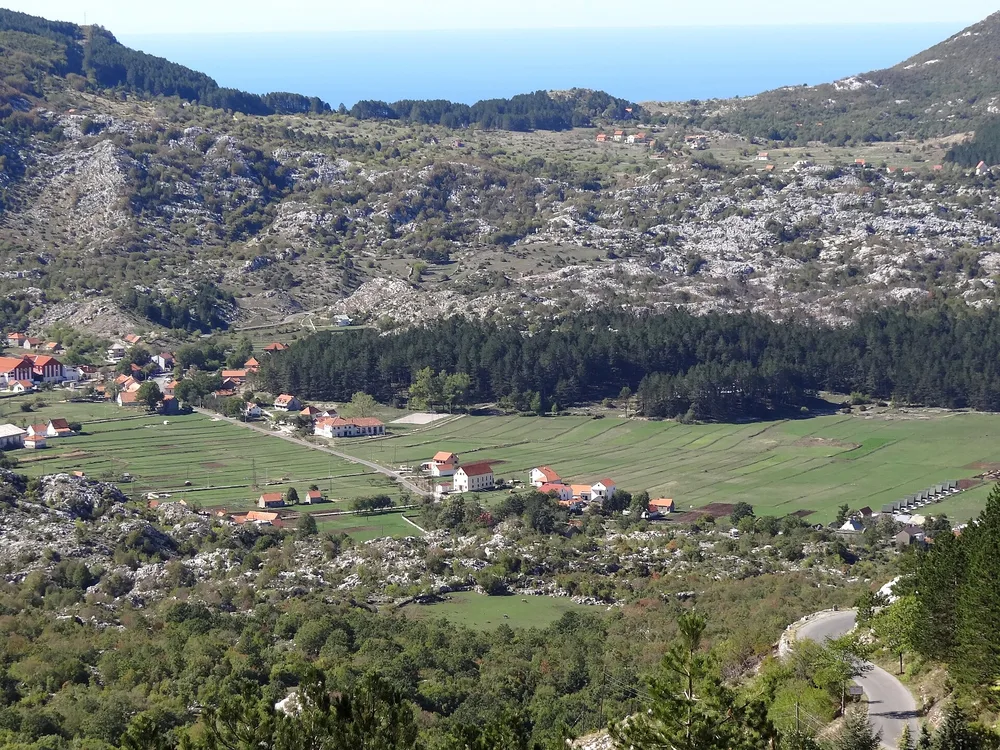
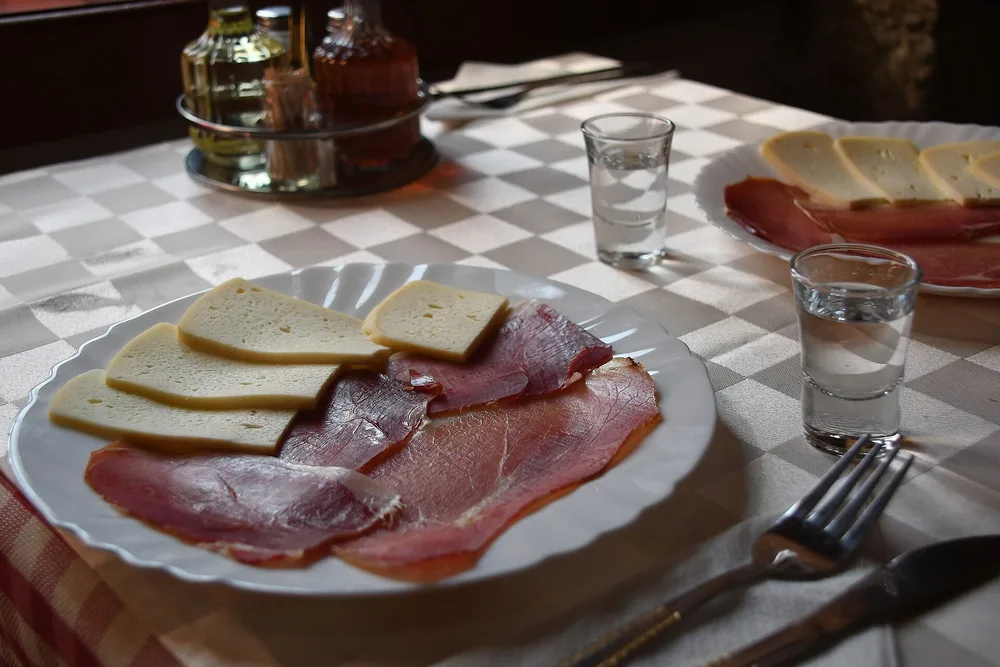
Food belongs in a guide to culture here, because the two best-known products of the Cetinje region are bound up with the dynasty's home village. Njeguši lies at about 900 metres on the saddle between the Bay of Kotor and the Cetinje field, where sea air meets mountain air, and the hams salted there in winter, smoked over beech wood and dried in the stone houses for a year are Montenegro's best-known delicacy. Njeguški pršut was the first Montenegrin food product to be protected by a national designation of origin, in 2016. The village's cheese, njeguški sir, a firm cheese made mainly from sheep's milk, sometimes from cow's or mixed milk, is its constant companion, usually with a glass of grape rakija or honey mead.
The villagers traded these down the mule track to Kotor for centuries. You can taste them in any restaurant in Cetinje, but the smokehouses of the village are the proper place: see Njeguši and food and drink, and for the country's wider table, from the lake carp to the wines of Crmnica, ExploreMontenegro's food and wine guide. A Njeguši village visit with a prosciutto tasting in a local household is the simplest way to see how it is made.
Cetinje as an art town
When the government left in 1946 the arts stayed, and they have since become the town's main business after museums. The University of Montenegro has its three arts faculties here, the Faculty of Fine Arts, the Music Academy and the Faculty of Dramatic Arts, and for decades their studios and rehearsal rooms were the former legations, which is why you may hear a piano through the windows of an embassy. Their students give the town much of its life in term time, and their degree shows and concerts are open to the public.
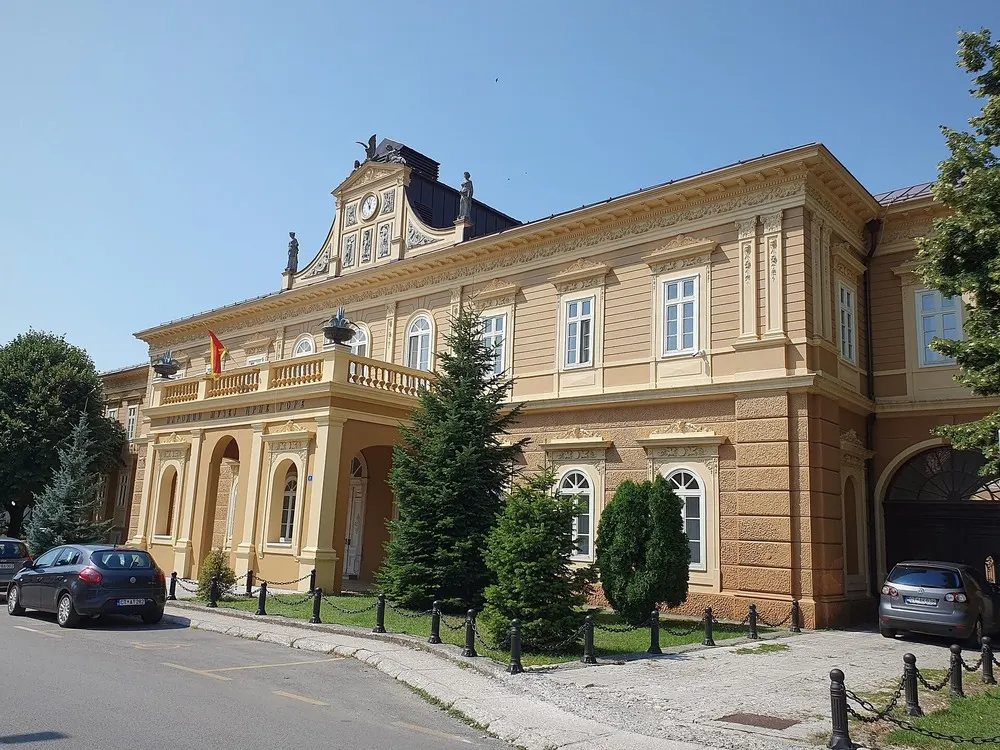
The modern Montenegrin school of painting is closely tied to Cetinje. Milo Milunović and Petar Lubarda, the two founders, were both born in or near the town, and Miodrag Đurić, known as Dado, who made his career in France, was born here in 1933. The National Museum's art collection in Government House shows all three, and the museum's contemporary gallery, named after Dado, and his former studio, the Atelje Dado, show work by living artists. The people themselves are introduced in famous people of Cetinje.
From 1991 the town also hosted an international exhibition of contemporary art, the Cetinje Biennial, founded by Prince Nikola Petrović-Njegoš, the architect great-grandson of King Nikola. Editions followed in 1994, 1997, 2002 and 2004, using the empty legations, the Biljarda and the streets themselves as exhibition space and bringing well-known foreign artists and curators to a town of fifteen thousand. It has not been held since, but it helped establish the idea of Cetinje as a place for the arts, an idea that UNESCO endorsed in 2023 by admitting the town to its Creative Cities Network as a City of Design.
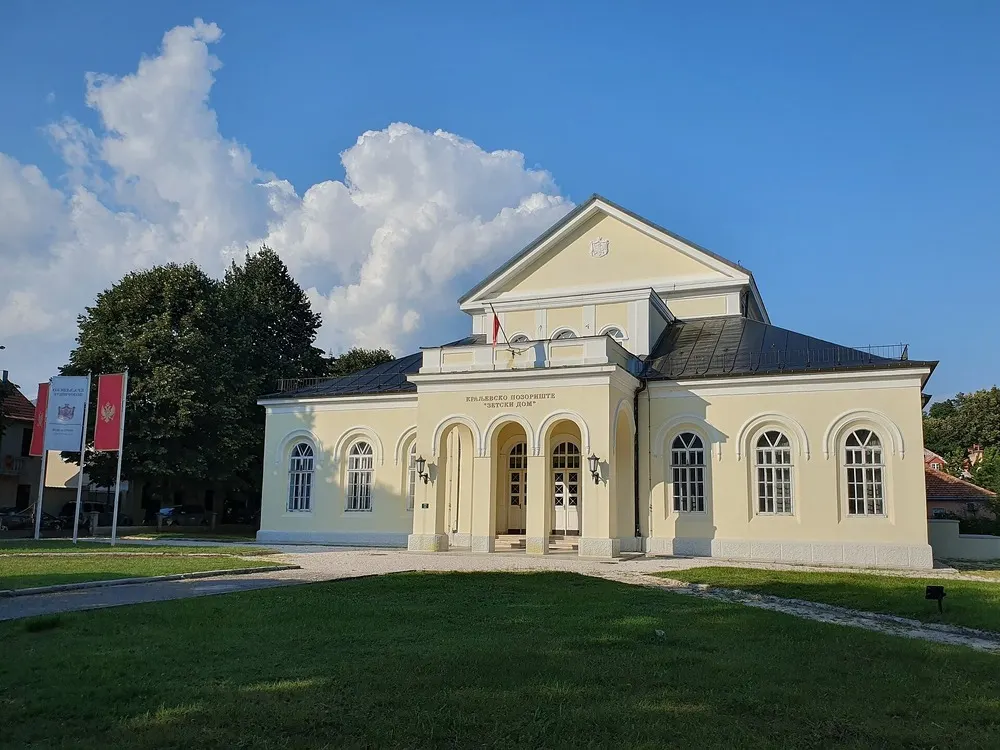
The oldest stage is the Zetski dom, the royal theatre begun in 1884, which works as a national theatre with its own repertoire. Plays are in Montenegrin, but the building is worth seeing on any pretext.
Meeting the culture as a visitor
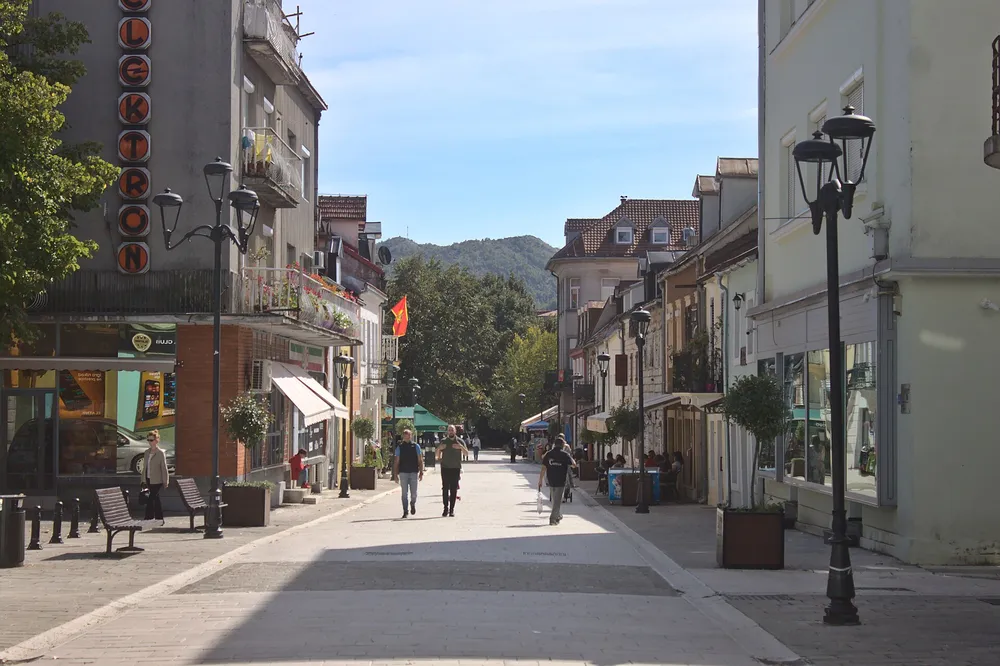
Three things are worth doing beyond the museums. Sit for an hour in one of the cafés on Njegoševa Street or Balšića pazar and watch the evening korzo, the slow walk up and down that every Montenegrin town still keeps. Go to a village household: the families around Cetinje and Njeguši who receive guests will show you the smoke room, the bread baked under an iron lid, and often a gusle on the wall; a hands-on household village experience near Cetinje is one such visit that can be booked ahead. And take a guide for the town itself. The guided walking tour with museum entry is the simplest way to arrange one; the costumes, weapons and banners described on this page are on show in King Nikola's Palace and the Ethnographic Museum.
Tours on the same theme are also sold for the wider country, for example the Montenegro tour of history, tradition and culture; check its route and starting point on the listing.
Frequently asked questions
What does čojstvo i junaštvo mean?
Humanity and heroism, the two traditional Montenegrin virtues. In the definition attributed to Marko Miljanov, heroism is defending yourself from others and humanity (čojstvo) is defending others from yourself.
What is the Montenegrin cap called and what do its colours mean?
It is the kapa. By popular tradition the black band is mourning for the medieval Serbian state lost at Kosovo in 1389, the red top the blood shed, and the gold arcs centuries of struggle against the Ottomans. These meanings are folklore recorded around 1900, not documented history.
Where can I see Montenegrin national costume in Cetinje?
In the Ethnographic Museum (former Serbian legation) and in King Nikola's Palace, which has the court costumes of the royal family. Both belong to the National Museum of Montenegro.
What is a gusle?
A one-stringed bowed instrument used to accompany the chanting of epic poems in ten-syllable lines. The player is a guslar. The tradition is shared by Montenegro, Serbia, Herzegovina and neighbouring highland regions.
What is the oro?
The Montenegrin national round dance, whose name is linked to the word for eagle. Dancers sing in a ring while couples take turns in the centre, the man leaping with outstretched arms; sometimes the men form a second tier on each other's shoulders.
What is slava?
The feast of a family's patron saint, handed down from father to son and celebrated with a blessed loaf, wheat and an open house. It is the most important family occasion of the Orthodox year.
When is Christmas in Cetinje?
On 7 January, because the Orthodox churches here keep the Julian calendar. Christmas Eve, 6 January, is marked with the burning of oak branches (badnjaci), including large public fires in the town.
Is the Cetinje Biennial still held?
No. It ran from 1991 to 2004. Contemporary art is now shown mainly in the National Museum's galleries and at exhibitions of the Faculty of Fine Arts.
Sources and official information
Facts were checked against these official and scholarly sources in November 2026. Opening hours, ticket prices, park fees and timetables change, so confirm before you go.
- narodnimuzej.me
- narodnimuzej.me
- ich.unesco.org
- ich.unesco.org
- en.wikipedia.org
- en.wikipedia.org
- en.wikipedia.org
- en.wikipedia.org
- en.wikipedia.org
- cdm.me
- artforum.com
- bosniaherzegovina.un.org
Cetinje.com is an independent guide, not the official site of the Old Royal Capital Cetinje, the National Museum of Montenegro, any tour operator, hotel or the government of Montenegro. Some links are affiliate links: tours go to GetYourGuide and accommodation goes to Booking.com, and we may earn a commission at no extra cost to you.