In short
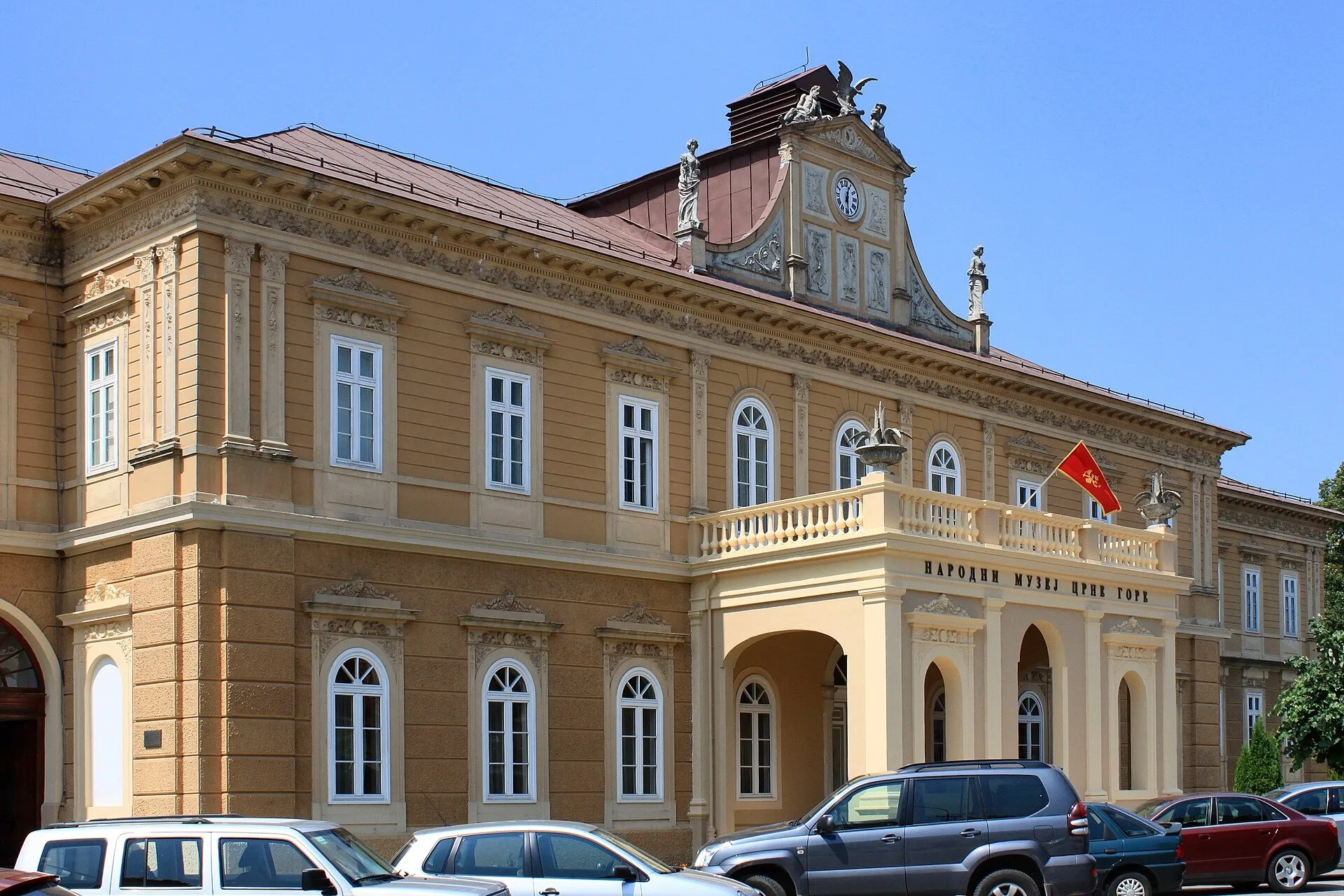
- The largest building of royal Montenegro, about 66 by 52 m around an inner court, begun on 7 June 1909 and opened on 15 August 1910 (dates in the calendar then in use) for the proclamation of the kingdom.
- Designed by the Italian architect Corradini and supervised by the Montenegrin engineer Marko Đukanović, in a mixture of neo-Renaissance and neo-baroque.
- It housed the whole state: ministries, parliament, post and telegraph, the state printing press. The last session of the kingdom’s parliament was held here in December 1915.
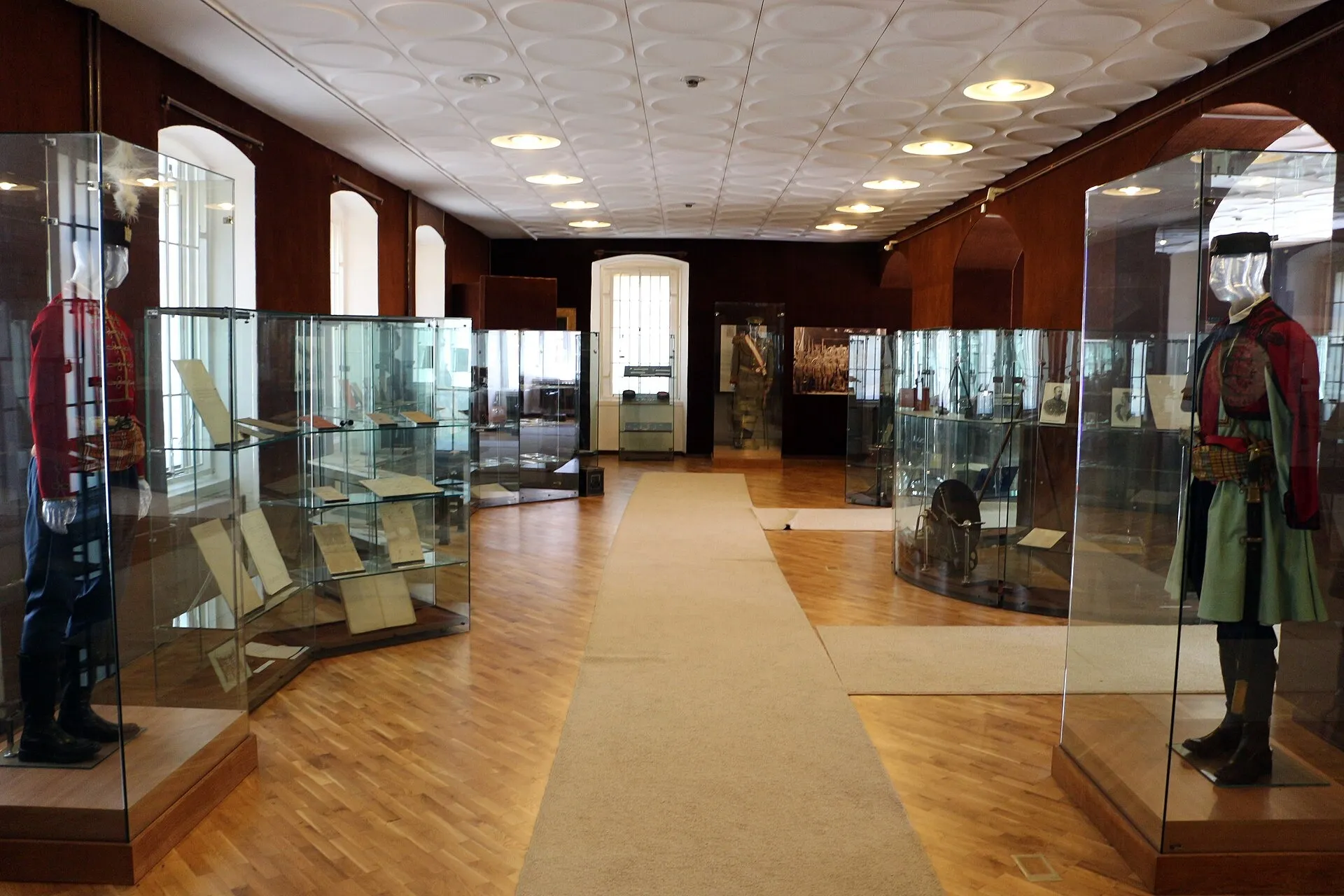
- Today it is the seat of the National Museum of Montenegro, with the Art Museum (open) and the History Museum (listed as closed to visitors in November 2026).
- In the Blue Chapel hangs the icon of Our Lady of Philermos, carried by the Knights of St John from Rhodes to Malta and by the Romanovs out of Russia.
One roof for a whole government
By 1908 Montenegro had a constitution, a parliament, a set of ministries and nowhere to put them. The offices of state were scattered through rented houses and the rooms of Biljarda; the assembly met in the theatre. That year the Cetinjski vjesnik published an argument that sounds modern: the sum the state paid each year to private landlords could service a loan, and with the loan it could build ‘one large edifice’ to hold every ministry and important office. Such a building, the paper added, would be ‘an ornament to the whole capital, and visible proof that those who hastened its construction have a sense for something beautiful, useful and progressive’.
The occasion made the argument irresistible. In 1910 Prince Nikola would mark fifty years on the throne and his golden wedding, and it was understood that he would take the title of king. The foundation stone of the House of the Princely Government was laid on 7 June 1909; the building was finished on 15 August 1910, the day the kingdom was proclaimed. (These are the dates given in Montenegrin sources, which follow the Julian calendar then in use; by the Gregorian calendar the proclamation fell on 28 August.) Fourteen months, in a town that could be reached only by mountain roads.
The architect was the Roman Corradini, who had already built the Russian legation and was at work on the Italian one. Site supervision fell to Marko Đukanović, the Paris-trained Montenegrin engineer, who that same year built himself the ‘Four Seasons’ house on Njegoševa Street and was accused, and defended himself in court, over the suggestion that materials had migrated from one site to the other. When the building opened the same newspaper wrote, with a pride that is easy to forgive: ‘Even a small state can attain in miniature all those distinctions which raise the standing of a great one.’
- Local name
- Vladin dom
- Built
- Foundation stone 7 June 1909; completed 15 August 1910 (Julian calendar)
- Architect
- Corradini (given as Augusto Cesare, also as Cesare Augusto or Carlo Antonio); supervised by Marko Đukanović
- Size
- About 66 × 52 m; inner court 39 × 36 m; roughly 7,000 square metres
- Today
- Seat of the National Museum of Montenegro; History Museum and Art Museum
- Ticket
- 5 euro for both museums; pupils and students 2.50 euro (as checked 22 November 2026)
- From Dvorski trg
- About 250 m, three minutes on foot
Reading the façade
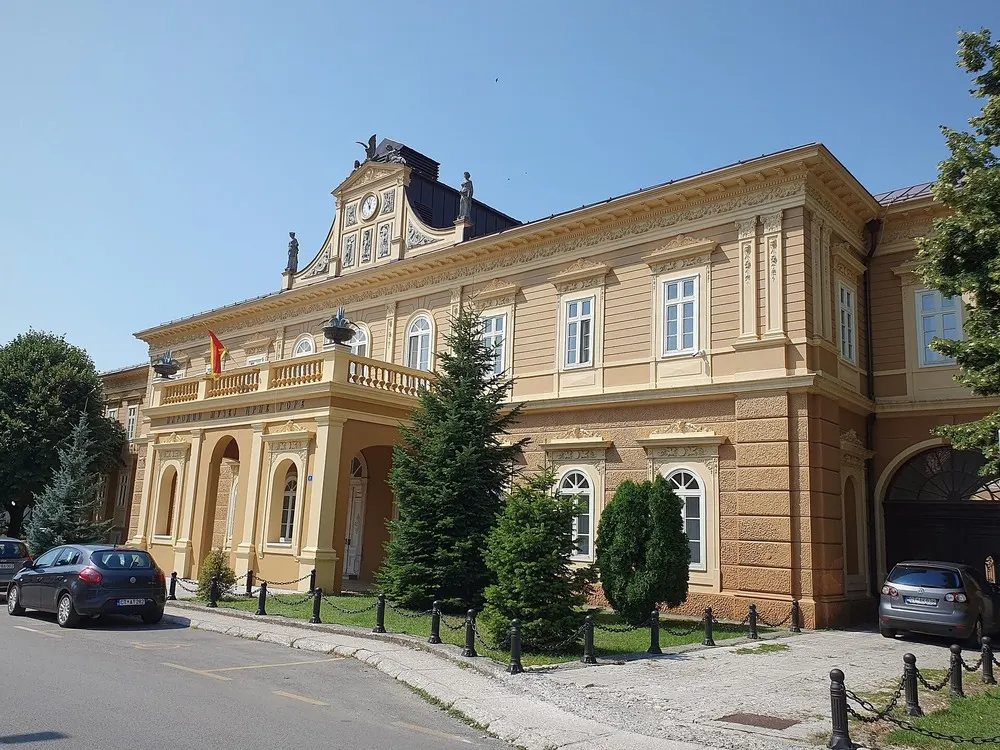
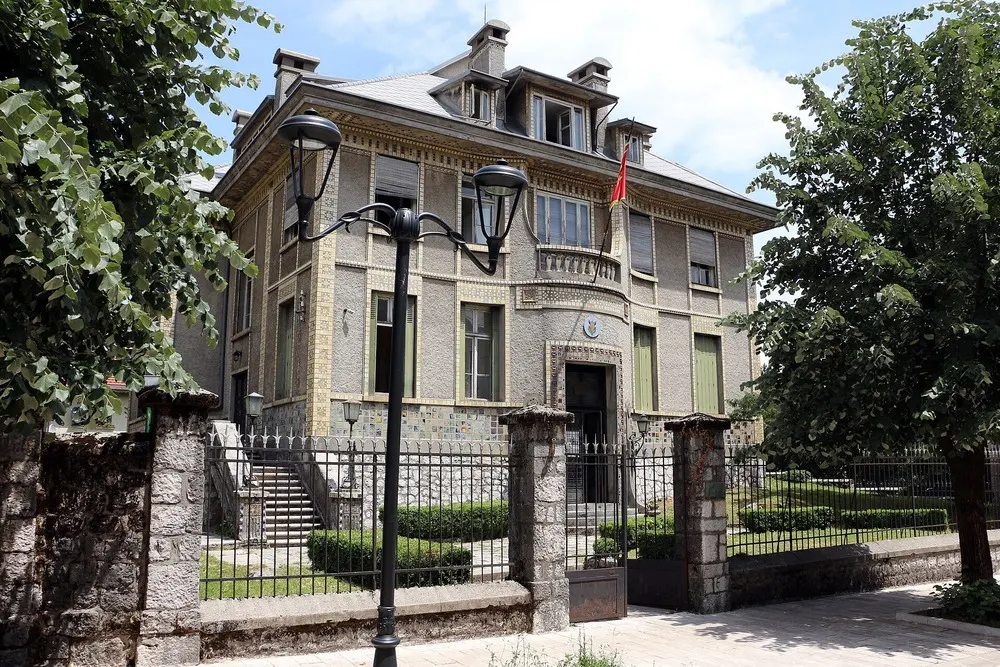
Stand across the street, far enough back to see the roofline. The building is a closed rectangle of two tall storeys, the lower one rusticated, plastered in ochre with paler dressings. The long entrance front is symmetrical: a projecting centre with a three-arched carriage porch, a balcony with a stone balustrade above it, and over that a tall baroque gable carrying the town clock. Reclining beside the clock are two figures, a man and a woman, Day and Night, modelled on Michelangelo’s tombs of the Medici in Florence; below them are the goddesses Flora and Minerva. The lettering on the balcony reads, in Cyrillic, ‘National Museum of Montenegro’.
The vocabulary is the international academic style of 1900, the same that produced ministries from Rome to Sofia: Renaissance for the storeys, baroque for the centrepiece. Contemporary accounts stress that it was planned, built and equipped to the highest standards of its day, and it has been described as the first reinforced-concrete building in Montenegro, a distinction also claimed for the French legation finished the same year.
What is original about it is the plan. Every earlier public building in Cetinje had been set back in its own garden, like a villa. Corradini instead took the form of the ordinary Cetinje town block, houses along the street with a private court behind, and enlarged it into a single palace around an atrium of 39 by 36 m. An architectural historian who has studied his work calls this his real step forward here: the largest building in the country is also the one that grows most directly out of the local pattern.
It was not meant to stand alone. Foundations for a cathedral were laid beside it in 1909, and with a row of new houses opposite the two were to form a second formal square, an administrative counterpart to the palace square. The cathedral was attempted again between the wars and never built.
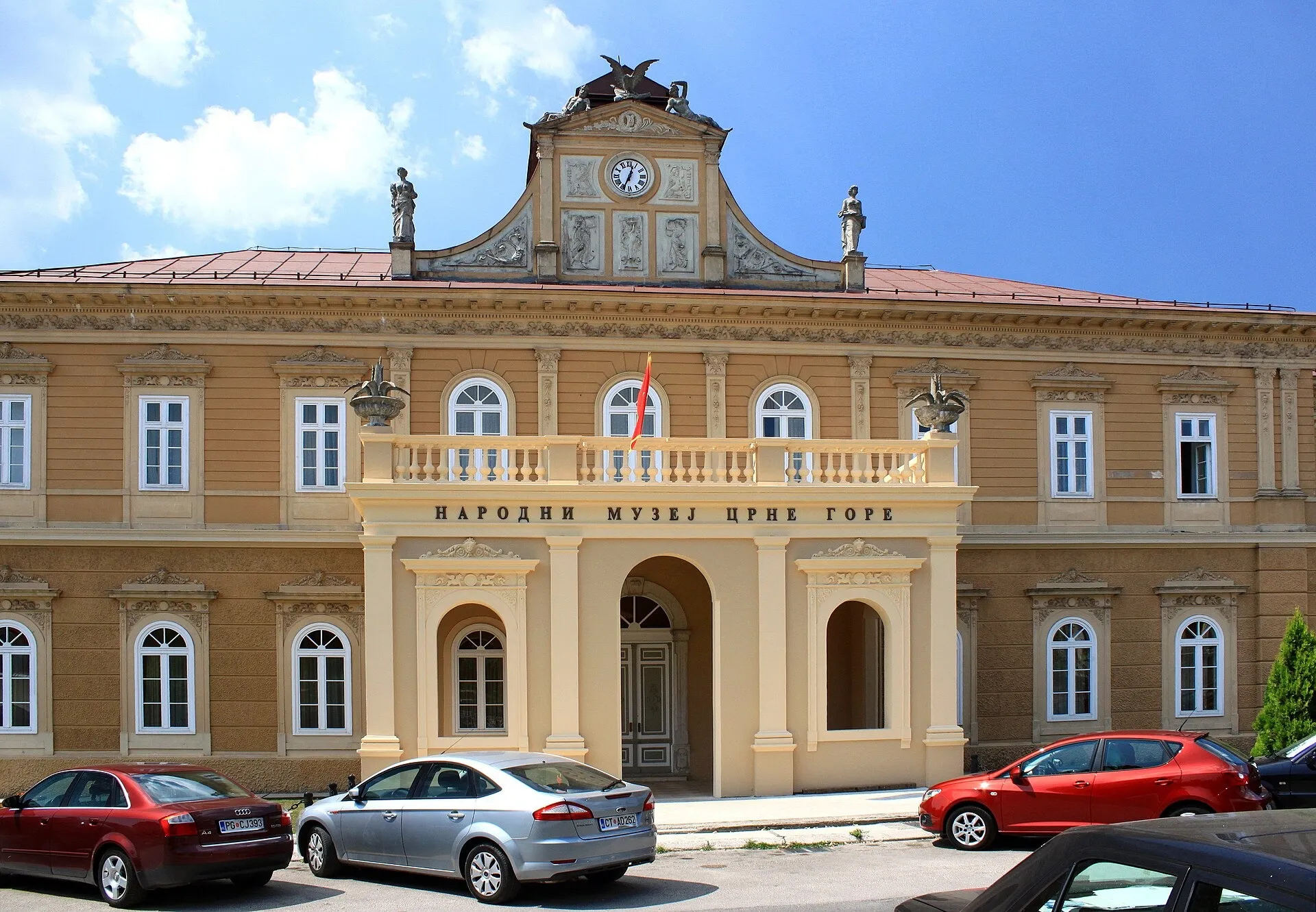
The entrance front: a three-arched porch, the balcony and the clock gable with its sculpture.
What happened inside
For five years the building did what it was built for. Its 7,000 square metres held the government and the ministries, the National Assembly, the post and telegraph office, the state printing press and, for a time, a stage. Then came the war. The last sitting of the parliament of the Kingdom of Montenegro took place here in December 1915, weeks before the fall of Lovćen.
After 1918 the building was renamed Dom slobode, the House of Freedom, and served the administration of the new Yugoslav state; the council of the Zeta Banovina held its first session here in December 1930 and promptly asked for a building of its own, which became the Banovina palace. The archives of the old ministries, left in the attic at the occupation, are said to have lain there in disorder for years.
The building’s second life began in the late 1970s, when the greater part of the museum collections was moved in (a monograph of 1980 gives the year as 1977) and, after the earthquake of 1979 had damaged Biljarda, more followed. It is today the administrative seat of the National Museum of Montenegro and holds two of its units. It is a protected monument of the first category.
The History Museum
The permanent display of the History Museum was set up in 1989. The museum’s guide moves through prehistory and antiquity; the Middle Ages, from the Slav principality of Duklja to the Crnojević lords; the centuries ‘between lion and dragon’, Venice and the Ottoman Empire; the making of the modern state under the Petrović bishops and princes; and the twentieth century. Among the objects are the original columns and capitals of Ivan Crnojević’s monastery, removed from Ćipur after the excavations of the 1980s, and a large collection of weapons, flags and documents.
In November 2026 the National Museum’s timetable listed the History Museum as closed to visitors, with no reopening date given. If the history of the country is what you came for, King Nikola’s Museum and Biljarda cover the nineteenth century in more depth than a general display can, and our own history of Cetinje fills in the rest. Ask at the desk in any case: the ticket is a joint one, and closures are not always total.
The Art Museum
The Art Museum began in 1950 as the National Gallery with 240 works and now has more than four thousand. They are organised as collections: Montenegrin art; Yugoslav art; foreign artists; the Vukmanović bequest; the gift collection ‘Artists of Yugoslavia to Njegoš’; copies of medieval frescoes; and icons.
The permanent display is a walk through a century and a half of painting and sculpture in this part of Europe. It opens with the first generation of South Slav moderns at the end of the nineteenth century and gives its best rooms to four Montenegrins, each with a memorial room showing work from different periods:
- Milo Milunović (1897–1967), born in Cetinje, trained in Florence and Paris, the painter who brought a Mediterranean Cézannism home and taught a generation.
- Petar Lubarda (1907–1974), whose turn to abstraction around 1951, in huge canvases of rock and battle, changed Yugoslav painting.
- Branko Filipović Filo (1924–1997), born in Cetinje, a master of spare, gestural abstraction.
- Miodrag Dado Đurić (1933–2010), also born here, who made his career in France with a fantastic, anatomical imagination that Jean Dubuffet was among the first to champion.
Pero Poček, Mihailo Vukotić, Miloš Vušković, Jovan Zonjić and Vojo Stanić are shown in smaller groups, and the last section, of artists working now, is changed from time to time. A selection from the icon collection is included. Allow an hour.
The Blue Chapel and Our Lady of Philermos
One room of the Art Museum is unlike the rest. In the Blue Chapel a single small icon is shown by itself: only the face of the Virgin is visible, the rest of the panel being hidden under a jewelled gold cover. This is Our Lady of Philermos (Bogorodica Filermosa), for centuries the most venerated image of the Order of St John, the Knights of Malta.
It is a Byzantine work, usually dated to the eleventh or twelfth century, that was venerated in the monastery on Mount Phileremos on Rhodes. The Knights Hospitaller found it there when they took the island in the early fourteenth century and made it their protectress; its fame grew with the Ottoman siege of 1480. When they lost Rhodes in 1522 they carried it away, and from 1530 it was in Malta, first at Birgu and from the 1570s in its own chapel in the conventual church of St John in Valletta. In 1798 Napoleon took Malta; the icon left with the knights, and the following year it was presented, with a hand of St John the Baptist and a fragment of the True Cross, to Tsar Paul I. In Russia it was given a new precious cover; a nineteenth-century copy made for processions is now at Assisi.
After the Revolution the Dowager Empress Maria Feodorovna took the three relics to Denmark. In 1932 they were given to King Alexander of Yugoslavia and kept in the palace chapel in Belgrade. In April 1941 they were brought to Montenegro and hidden at Ostrog; in the early 1950s the Yugoslav authorities removed them, and the icon was placed in the museum’s vault in Cetinje, its whereabouts unknown to the outside world for decades. Its presence here was made public in 1993. The hand and the cross fragment are now in the Cetinje Monastery; the icon has remained with the museum, an arrangement that has itself been a matter of public dispute.
Malta has not forgotten it: in December 2024 a replica was presented to the Speaker of the Maltese parliament. Whatever your own beliefs, stand in front of it for a minute. Few objects have travelled further.
Visiting
- Where: Novice Cerovića Street, at the foot of the low hill called Medovina, about 250 m from Dvorski trg and a minute from Njegoševa Street.
- Hours of the Art Museum, as published in November 2026: 15 April to 15 November, daily 9:00 AM to 5:00 PM; 16 November to 14 April, Monday to Friday 9:00 AM to 3:00 PM; last admission 30 minutes before closing. The English versions of the Art Museum’s page and of the timetable give 11 April to 15 November, 9:00 AM to 4:00 PM, so plan on 4:00 PM. Local time.
- History Museum: listed as closed to visitors.
- Tickets: 5 euro for the two museums, pupils and students 2.50 euro, under-12s free; combined ticket for all National Museum units 20 euro. See museums.
- Time: an hour for the Art Museum and the Blue Chapel; ten minutes outside for the façade.
The Cetinje guided walking tour with museum entry and the Cetinje city private tour are the two GetYourGuide listings based in the town; ask whether the Government House is on the route.
Downtown apartment
CetinjeAttic apartment opposite the Government House, about 100 m from the centre, with free parking and WiFi.
9.5Booking.com guest score · as checked in November 2026
See on Booking.comApartments Bokan
CetinjeApartments on Novice Cerovića Street, about 150 m from the centre, with free parking and WiFi.
8.9Booking.com guest score · as checked in November 2026
See on Booking.comSee all stays in Cetinje on Booking.com
Accommodation links go to Booking.com, where you see live prices and availability. We do not list prices because they change daily; Cetinje.com may earn a commission.
Frequently asked questions
What is Vladin dom?
The Government House of the Kingdom of Montenegro, built in 1909–1910 to hold the ministries and parliament. Since the 1970s it has housed the National Museum of Montenegro.
Who was the architect of the Government House?
The Italian architect Corradini, who also designed the Russian legation in Cetinje. Sources give his first names differently; the most detailed recent study calls him Augusto Cesare Corradini (1860–1932). The Montenegrin engineer Marko Đukanović supervised the works.
What can you see inside?
The Art Museum, with Montenegrin and Yugoslav painting from the late nineteenth century to today and the icon of Our Lady of Philermos in the Blue Chapel. The History Museum in the same building was listed as closed to visitors in November 2026.
Is the Our Lady of Philermos icon the original?
Yes. The icon in Cetinje is the one venerated by the Knights of St John on Rhodes and Malta and later kept by the Russian imperial family. Copies exist elsewhere, including a nineteenth-century one at Assisi.
How much is the ticket?
5 euro for adults and 2.50 euro for pupils and students for the History and Art museums together, according to the National Museum’s price list as checked on 22 November 2026.
What are the statues on the façade?
Beside the clock are reclining figures of Day and Night, modelled on Michelangelo’s Medici tombs; below them are Flora and Minerva.
Sources and official information
Facts were checked against these official and scholarly sources in November 2026. Opening hours, ticket prices, park fees and timetables change, so confirm before you go.
- narodnimuzej.me
- narodnimuzej.me
- narodnimuzej.me
- narodnimuzej.me
- narodnimuzej.me
- en.narodnimuzej.me
- cetinje.travel
- stari.maticacrnogorska.me
- aseestant.ceon.rs
- en.wikipedia.org
- en.wikipedia.org
Cetinje.com is an independent guide, not the official site of the Old Royal Capital Cetinje, the National Museum of Montenegro, any tour operator, hotel or the government of Montenegro. Some links are affiliate links: tours go to GetYourGuide and accommodation goes to Booking.com, and we may earn a commission at no extra cost to you.