In short
- Đurađ Crnojević, lord of Zeta, founded a printing press in 1493; it worked until he was driven out in 1496.
- Its first book, the Oktoih prvoglasnik, was completed on 4 January 1494: the first book printed in Cyrillic among the South Slavs.
- The printer was the hieromonk Makarije ‘of Montenegro’, who is generally identified with the Makarije who later printed the first books in Wallachia.
- Four books are known from surviving copies or fragments (two Octoechos volumes, a Psalter and a prayer book); a fifth is named differently in different sources.
- The press is usually called the first state-owned printing house in South-Eastern Europe. Whether it stood at Obod, above Rijeka Crnojevića, or in Cetinje itself is an old argument.
Why a press in the mountains?
Printing with movable type reached Venice in 1469, and within twenty years the city was the largest publishing centre in Europe. Zeta, the small Orthodox lordship in the mountains behind the Venetian towns of Kotor and Budva, was a few days' journey away and tied to Venice by trade, by politics and, in the case of its ruler, by marriage: Đurađ Crnojević's wife Elisabetta was the daughter of the Venetian patrician Antonio Erizzo.
Đurađ succeeded his father Ivan, the founder of Cetinje, in 1490. He ruled a state that everyone, including himself, could see was unlikely to survive much longer against the Ottomans. He had a reputation as an unusually learned man. The churches of his land needed service books. Manuscripts were slow to copy, and many had been lost as monasteries around Lake Skadar fell into Ottoman hands. The colophon of his first printed book says it plainly: he saw the churches empty of holy books because of the plundering of the Hagarenes, and wished to fill them.
So he bought a press. According to the National Library of Montenegro, which is named after him, the equipment was acquired in Venice in 1492 and the workshop was operating in 1493. It was not a commercial venture like the presses of Venice. It was paid for by the ruler, worked by monks and produced books for the church of the state, which is why it is described as the first state printing house in South-Eastern Europe, and in Montenegro often as the first in the world. It was certainly the first press of any kind among the South Slavs to print in Cyrillic, and only the second Cyrillic press anywhere, after that of Schweipolt Fiol in Kraków, which printed its first books in 1491.
Makarije and his seven helpers
The man who ran the workshop names himself in the books: the hieromonk (priest-monk) Makarije ot Črnije Gori, of the Black Mountain. Nothing certain is known of his origins. It is assumed that Đurađ sent him to Venice to learn the craft, and various Venetian workshops have been proposed as his school, but there is no document. What the books themselves show is that he was a master. The type was newly cut for the purpose, modelled on the formal book hand (ustav) of Serbian manuscripts; the pages are printed in black and red; and the headpieces and large initials, cut in wood, combine the interlace of the manuscript tradition with putti, garlands and other motifs straight from the Venetian Renaissance.
The colophon of the first book records that Makarije made it ‘by hand’ at the command of his lord Đurađ Crnojević, under Metropolitan Vavila of Zeta, and that eight men worked on it for a year. That gives us the size of the first printing office of the South Slavs: Makarije and seven monks whose names we do not know.
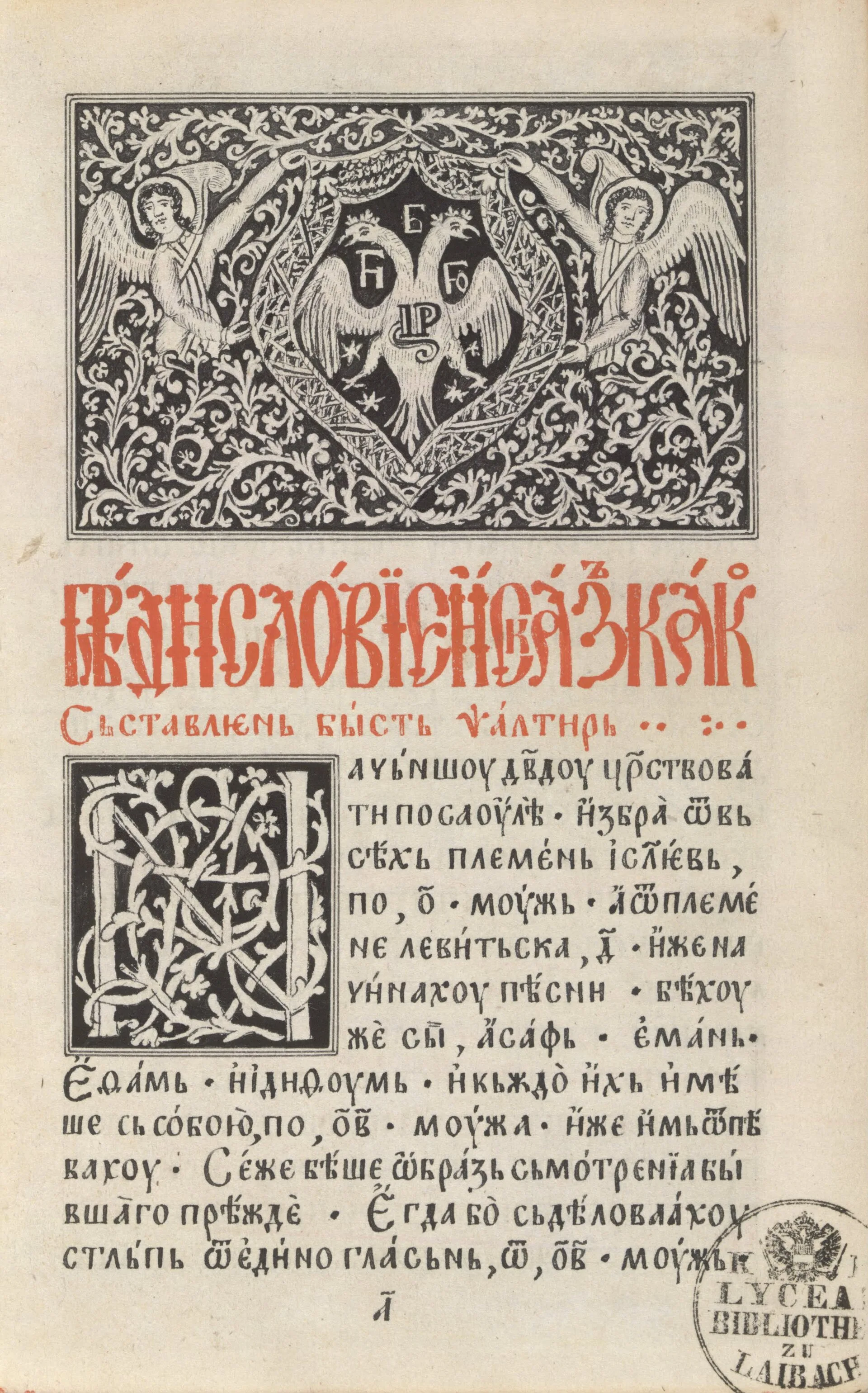
A page of the Psalter printed in 1495, with a woodcut headpiece and initial and the text in red and black. This copy belonged to the Slovene linguist Jernej Kopitar.
The books
Oktoih prvoglasnik (Octoechos of the First Tone). The Octoechos is the book of hymns for the weekly cycle of Orthodox services, arranged by the eight musical tones. Makarije printed it in two volumes, and the first, containing tones one to four, is the press's first and most famous product. Work began in 1493 and the colophon gives the date of completion as 4 January 7002 from the creation of the world, that is 1494. It is a folio of about 270 leaves, roughly 29 by 21.6 centimetres. More copies of it survive than of any other early Cyrillic printed book: bibliographers have recorded 108, complete or partial, most of them in Serbia, Montenegro and Russia.
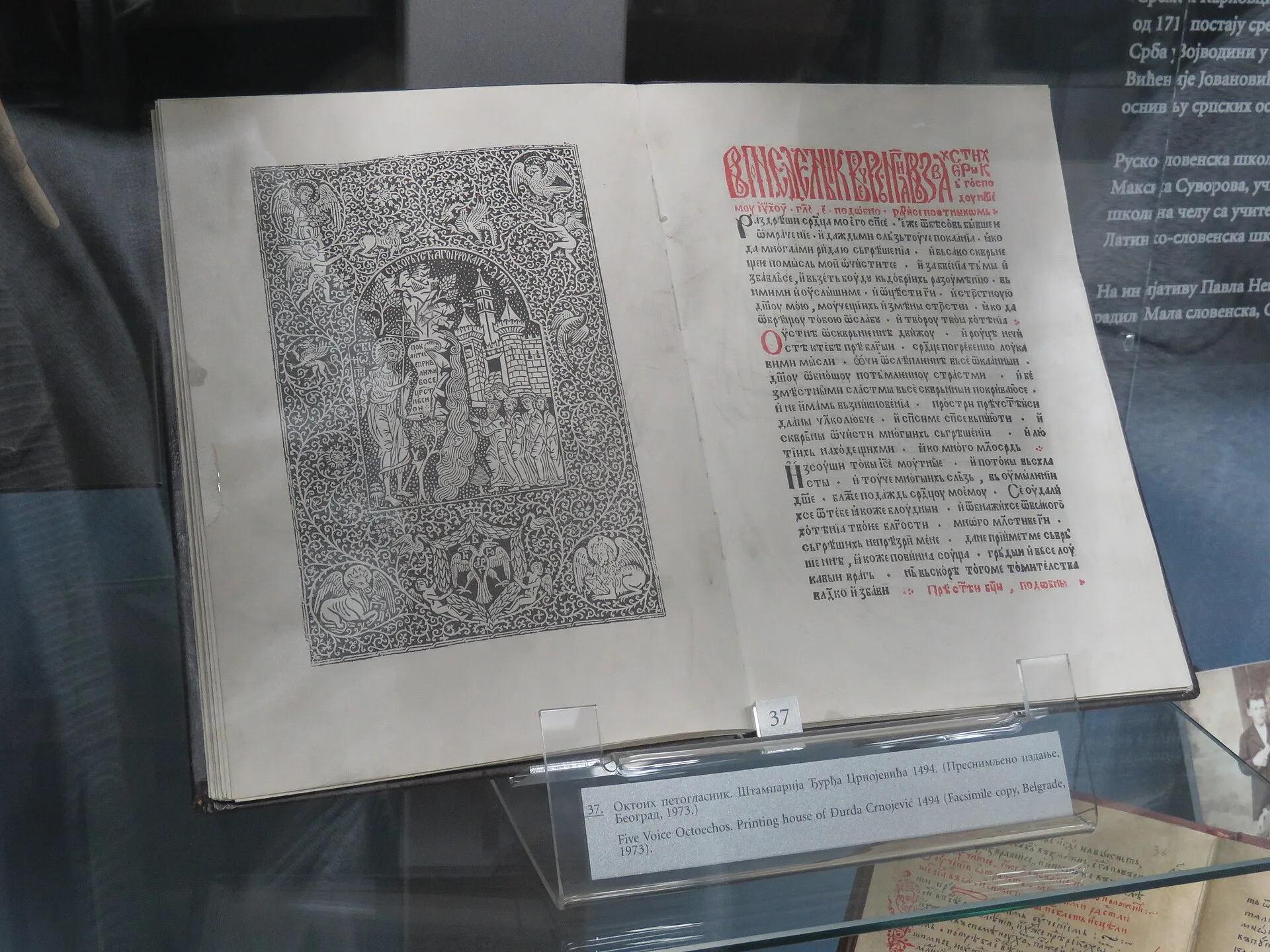
Oktoih petoglasnik (Octoechos of the Fifth Tone). The second volume, with tones five to eight, followed in 1494. It was a more ambitious book, the first illustrated book printed among the South Slavs, with six woodcut illustrations of considerable skill. It is also far rarer. No complete copy is known; the largest fragment has fewer than forty leaves.
Psaltir s posljedovanjem (Psalter with supplements). Completed in 1495, this is the Psalter with the additional offices, calendar and prayers needed for daily use, and it is commonly described, for example in the National and University Library of Slovenia's record of its copy, as printed in Cetinje. Some three dozen copies or fragments survive, among them one in the British Library and the Kopitar copy in Ljubljana shown on this page. The National Library in Cetinje published a facsimile in 1986.
Trebnik or Molitvenik (prayer book, also called Euchologion). A book of the rites a priest performs outside the liturgy, baptisms, weddings, funerals and blessings. It was printed in 1495 or 1496 and is known only from fragments.
The fifth book. Here the sources part company. The National Library of Montenegro and much of the older literature name a Četvorojevanđelje (the Four Gospels), probably of 1496, of which no copy has been found; other reference works give a Lenten Triodion (Cvjetni triod) in its place, and some count only the four books that actually survive. The honest answer is that the press printed four books we can still hold, and may have begun or completed a fifth that is lost.
What was printed, and what survives
| Book | Date | What it is | Survival |
|---|---|---|---|
| Oktoih prvoglasnik | Finished 4 January 1494 | Hymns for tones 1–4; about 270 leaves, two-colour printing | 108 recorded copies and fragments |
| Oktoih petoglasnik | 1494 | Hymns for tones 5–8; the first illustrated South Slav printed book | Fragments only |
| Psaltir s posljedovanjem | 1495 | Psalter with offices and calendar; usually described as printed in Cetinje | About 36 copies and fragments |
| Trebnik (Molitvenik) | 1495–96 | Priest's book of rites and prayers | Fragments only |
| Četvorojevanđelje or Cvjetni triod | c. 1496 | Named as the fifth book in some sources | No copy known |
Obod or Cetinje?
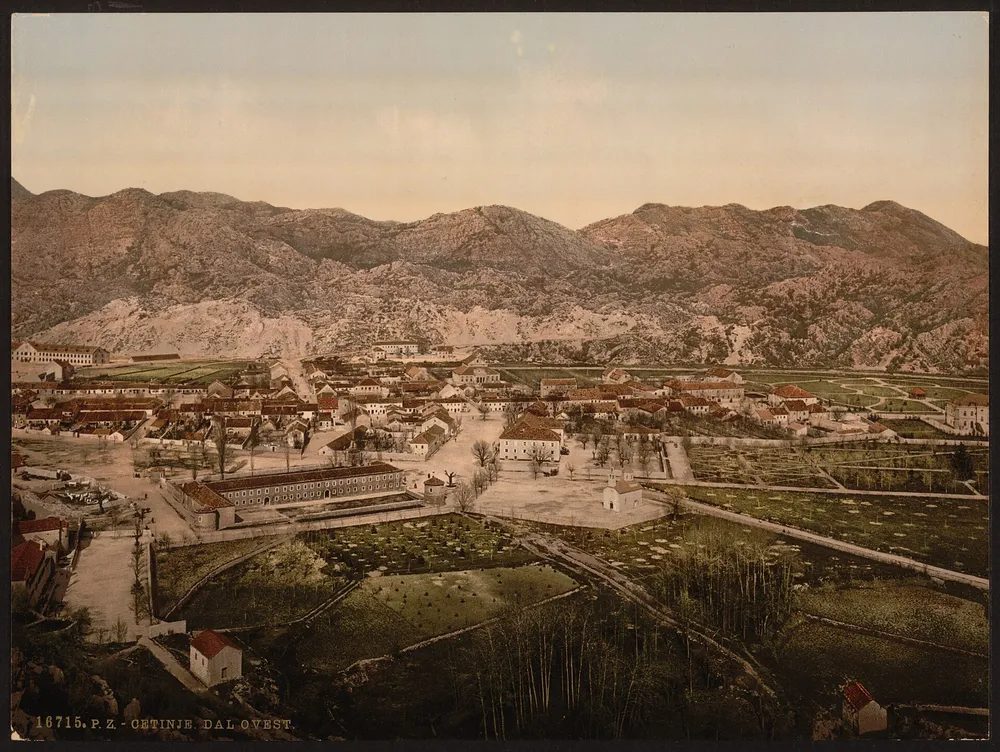
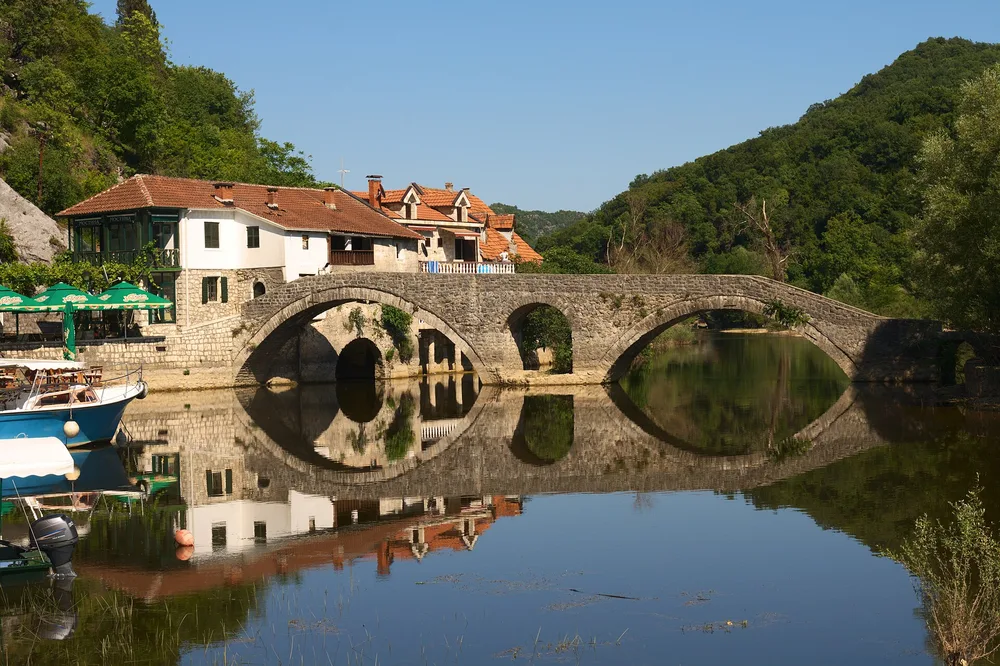
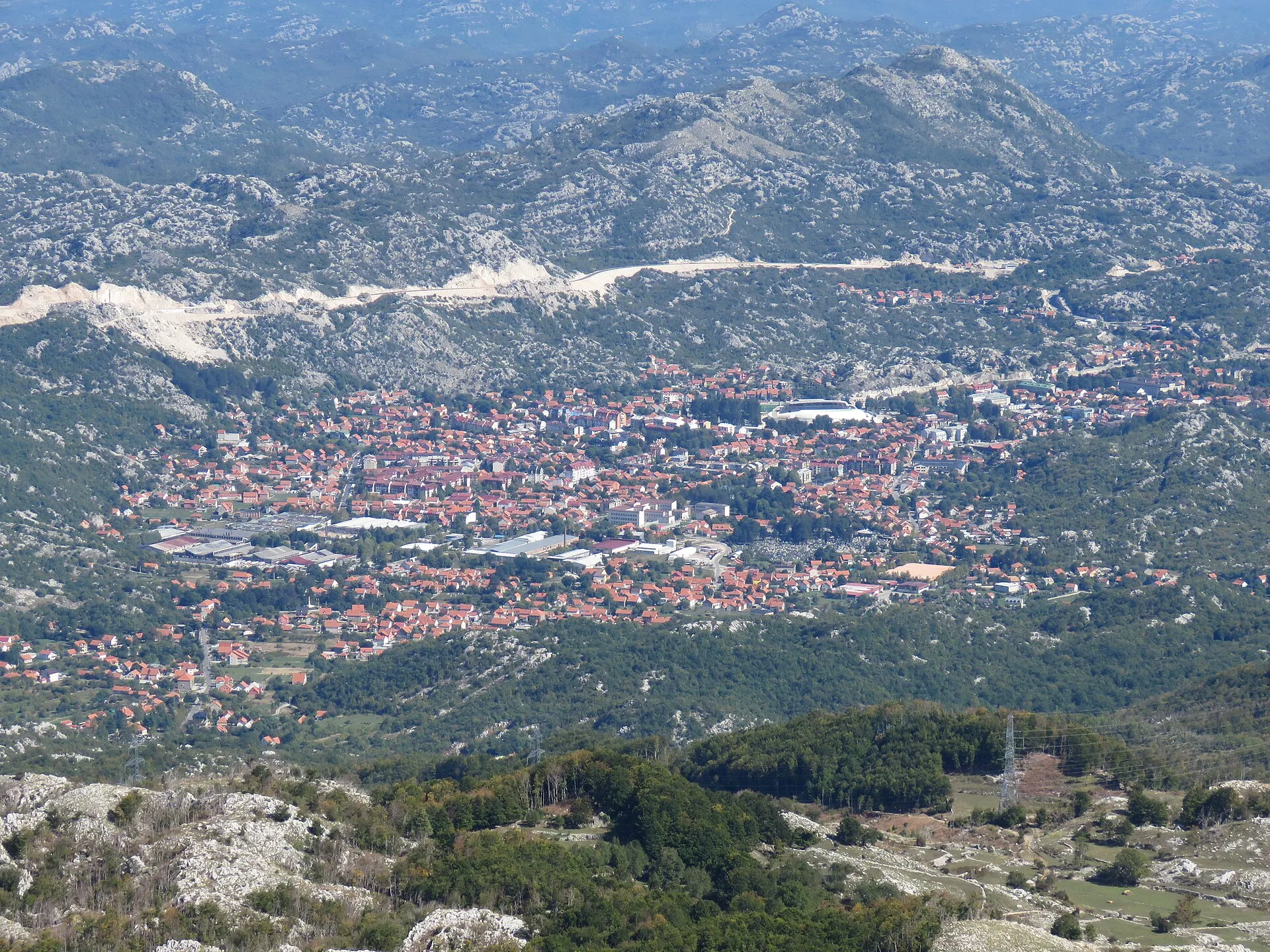
Ask in Montenegro where the first book was printed and you may be told Obod. The name is everywhere: the state printing works founded in Cetinje after the Second World War was called Obod, and so was the town's largest factory. Obod is the hill above the river port of Rijeka Crnojevića, about fifteen kilometres from Cetinje, where Ivan Crnojević had his fortified seat before he moved up to the Cetinje field, and a strong nineteenth-century tradition held that Đurađ's press worked there. The four-hundredth anniversary, celebrated with great ceremony in 1893, was the anniversary of the ‘Obod printing house’.
The difficulty is that the books do not say so. The Psalter of 1495 states that it was printed in Cetinje, and scholars who have studied the press closely, among them the philologist Mitar Pešikan, concluded that it worked at Cetinje, in or beside the Crnojević monastery, where the metropolitan under whose blessing it operated had his seat. A compromise view, which you will also meet, is that the press was first set up at Obod in 1493 and moved to Cetinje while the first Oktoih was in progress. The National Library's own account still places the foundation at Obod.
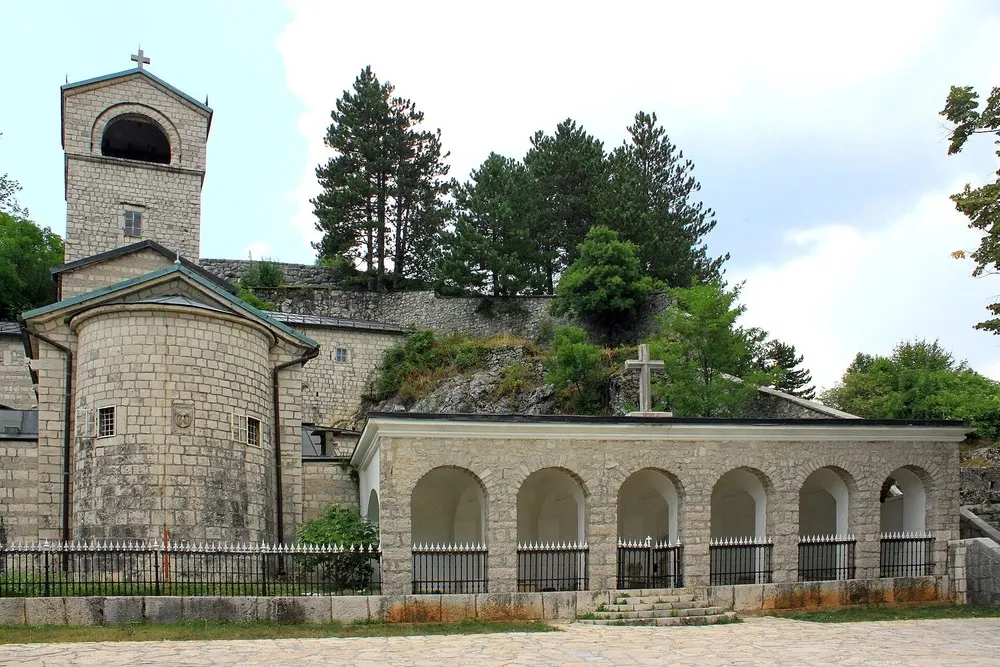
For a visitor the practical consequence is pleasant: both places are worth seeing. The foundations of the monastery where the press most probably stood are laid out on Ćipur in Cetinje, and Obod looks down on one of the prettiest corners of the Lake Skadar basin, described in the guide to Rijeka Crnojevića and, for the lake as a whole, in ExploreMontenegro's Lake Skadar guide.
1496: the end, and Makarije's second career
The press lasted as long as its patron. In 1496, under Ottoman pressure and outmanoeuvred by his own brother, Đurađ Crnojević left Zeta for Venice. He never ruled again; he was imprisoned for a time by the Venetians, wrote a will in 1499 that is admired as a piece of early Serbian prose, and ended his life on an estate granted by the sultan in Anatolia. What happened to the type and the presses is not recorded. They are not heard of again in Montenegro. The often-repeated story of type melted down for bullets belongs to a later press, the one Njegoš installed in 1834, whose lead was indeed cast into ammunition during Omer Pasha's invasion of 1852.
Makarije reappears, or a Makarije does, at Târgoviște in Wallachia, where a hieromonk of that name printed a Liturgikon in 1508, an Octoechos in 1510 and a Gospel book in 1512, the first books printed on the territory of present-day Romania. The typography and ornament are so close to the Cetinje books that most scholars accept that the printer was the same man, though it cannot be proved. A further identification, with a Makarije who was abbot of the Serbian monastery of Hilandar on Mount Athos in the 1520s, is more speculative.
The tradition he began was carried on by another man from the same country. Božidar Vuković of Podgorica set up a Cyrillic press in Venice in 1519, and for most of the sixteenth century Serbian church books were printed there and in a string of short-lived monastic presses across the Balkans, almost all of them using the Cetinje editions as their model. A merchant of Dubrovnik, asking his city's senate in 1514 for leave to print in Cyrillic, promised to use letters like those of the Crnojević books, which he said were praised by everyone.
Why it matters
Three things make four liturgical books from a mountain monastery more than a curiosity. The first is the date. Movable type was barely forty years old; England had had a press for less than twenty; and there would be no press in Belgrade until 1552, none in Moscow until the 1560s.
The second is the quality. These are not provincial imitations. In design, presswork and two-colour register they stand comparison with good Venetian printing of the same years, and they set the look of the Serbian printed book for a century.
The third is what it says about the place. A ruler with a shrinking territory and an army he could not pay chose to spend money on a press. Montenegrins have taken that as a statement about themselves ever since, and each revival of the state has gone back to it: Njegoš's press of 1834, the state printing house of Prince Nikola's time, the jubilee of 1893 at which the national library was founded, and the library itself, which bears Đurađ's name. Whether the press is to be called Serbian, Montenegrin or both is part of the wider argument described in the guide to language and identity. The books are in the Serbian recension of Church Slavonic, the liturgical language of the Orthodox South Slavs, and were printed in the state from which modern Montenegro descends; both statements are true.
Where to see the books in Cetinje
Original leaves of the Cetinje incunabula can be seen in three places in the town, all within a few minutes' walk.
- Cetinje Monastery treasury. The monastery's collection of manuscripts and early printed books includes the Oktoih prvoglasnik. The treasury is not always open to individual visitors; ask at the entrance, and see the Cetinje Monastery guide for the dress code.
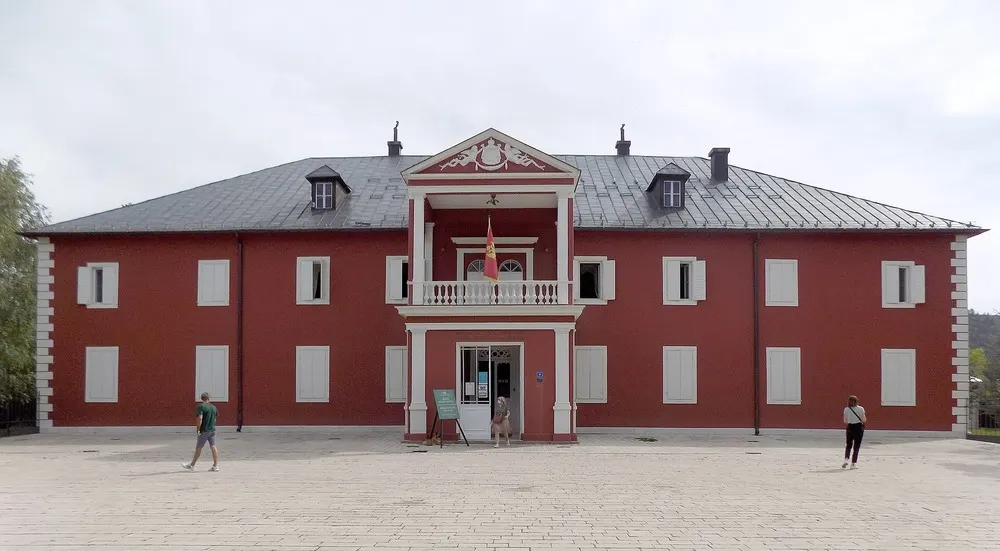
- King Nikola's Palace. The royal library preserved in the museum holds books from the Crnojević press, including the Oktoih prvoglasnik, as the National Museum's own description notes. See King Nikola's Palace.
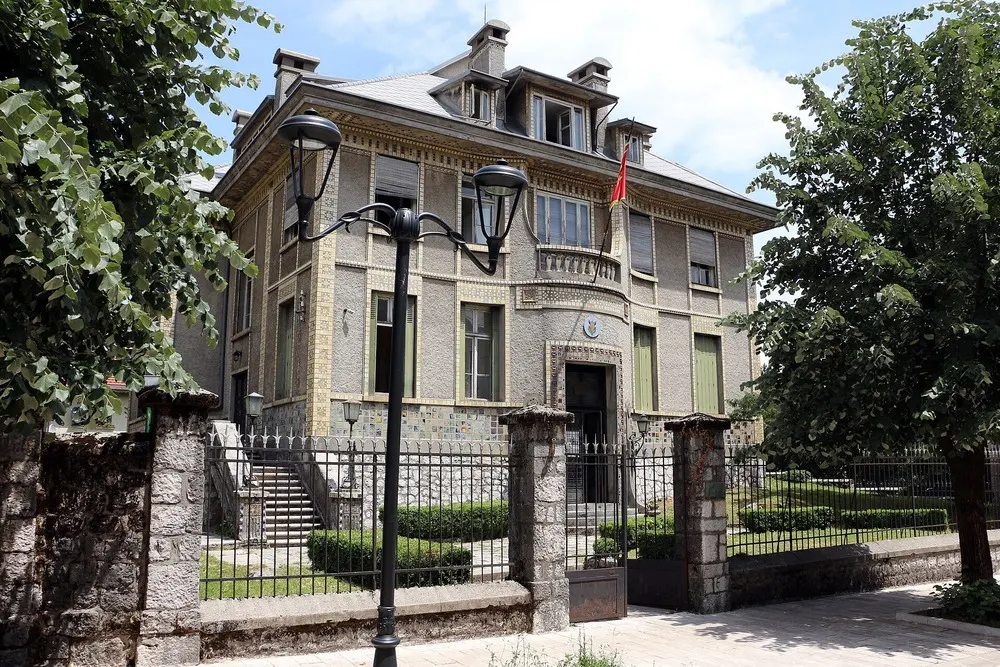
- The National Library of Montenegro ‘Đurđe Crnojević’. The library occupies two former legations, the Italian and the French, and keeps its incunabula in the rare books collection. It is a working library, not a museum, but it mounts exhibitions, and the buildings are worth seeing from outside in any case: they are stops on the embassies walk.
Facsimiles are easier to find. The National Library issued a facsimile of the Oktoih prvoglasnik in 1987 and of the Psalter in 1986. The open book in the photograph at the top of this page is a facsimile edition of the Oktoih petoglasnik, showing one of its woodcuts, photographed in the Educational Museum in Belgrade.
If you take the guided walking tour of Cetinje with museum entry and early printing is your particular interest, say so at the start, as guides will usually point out the relevant cases.
Frequently asked questions
What was the first book printed in Montenegro?
The Oktoih prvoglasnik (Octoechos of the First Tone), a book of Orthodox hymns, completed on 4 January 1494 by the hieromonk Makarije at the press of Đurađ Crnojević. It is the first book printed in Cyrillic among the South Slavs.
Was it the first printing press in the Balkans?
It was the first Cyrillic press in South-Eastern Europe and the first owned by a state. Printing in Latin and Glagolitic letters had begun slightly earlier on the eastern Adriatic: a Glagolitic missal was printed in 1483, though where is disputed, and there was a press at Senj in Croatia in 1494.
Was the press at Obod or in Cetinje?
Tradition, and the National Library of Montenegro, place its foundation at Obod above Rijeka Crnojevića in 1493. The Psalter of 1495 says it was printed in Cetinje, and specialists such as Mitar Pešikan have argued that the press worked at Cetinje. Some suggest it moved from one to the other.
How many books did it print?
Four are known from surviving copies or fragments: two volumes of the Octoechos (1494), a Psalter (1495) and a prayer book (1495–96). A fifth, given in sources as a Gospel book or a Triodion, has not survived.
Who was Makarije?
A priest-monk who describes himself as ‘of Montenegro’ and who directed the press from 1493 to 1496. He is generally identified with the Makarije who printed the first books in Wallachia, at Târgoviște, between 1508 and 1512.
Can I see an original Oktoih in Cetinje?
Copies are held by Cetinje Monastery, by the royal library in King Nikola's Palace and by the National Library of Montenegro. Display varies; the palace is the most reliably accessible of the three.
Why is so much in Cetinje called Obod?
Because for a long time the press was known as the Obod printing house, after the Crnojević stronghold above Rijeka Crnojevića where it was believed to have stood. The name was given to the state printing works and to Cetinje's appliance factory in the twentieth century.
Sources and official information
Facts were checked against these official and scholarly sources in November 2026. Opening hours, ticket prices, park fees and timetables change, so confirm before you go.
- nb-cg.me
- rastko.rs
- narodnimuzej.me
- en.wikipedia.org
- en.wikipedia.org
- en.wikipedia.org
- en.wikipedia.org
- maticacrnogorska.me
- njegos.org
Cetinje.com is an independent guide, not the official site of the Old Royal Capital Cetinje, the National Museum of Montenegro, any tour operator, hotel or the government of Montenegro. Some links are affiliate links: tours go to GetYourGuide and accommodation goes to Booking.com, and we may earn a commission at no extra cost to you.