In short
- Built 1863–1867 for a widow, not a king. The house was begun for Princess Darinka, widow of the murdered Prince Danilo; when she left Montenegro in 1867 her nephew by marriage, Prince Nikola, moved in from Biljarda and stayed for forty-nine years.
- It is deliberately plain. Two storeys, a hipped roof and a porch added in 1910: the palace of a European sovereign that is smaller than many of his ministers’ embassies.
- A museum since 1926, it shows the court as it was lived in: study, library, dining rooms, the diplomatic salon, the bedrooms of the king, the queen and the princesses.
- Do not miss the library with a Crnojević Oktoih of 1493–94, the portraits of Nikola’s daughters, and the gifts that map Montenegro’s alliances.
- Adults 8 euro, students 4 euro (as checked 22 November 2026); daily in summer, weekdays only in winter. Allow about an hour.
A palace the size of a house
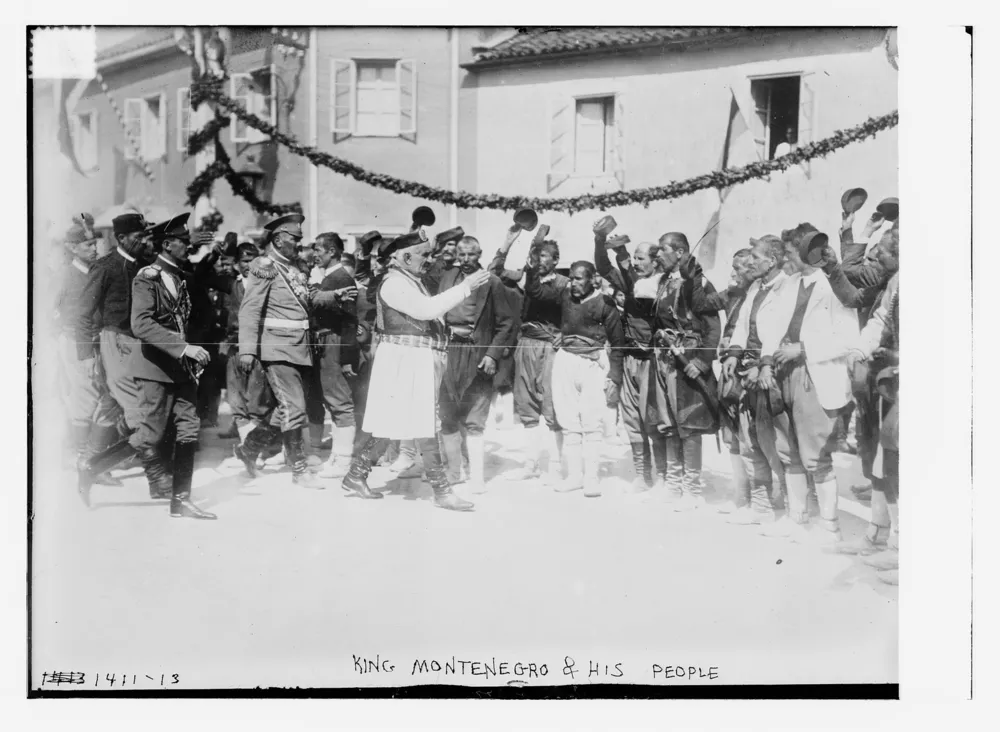
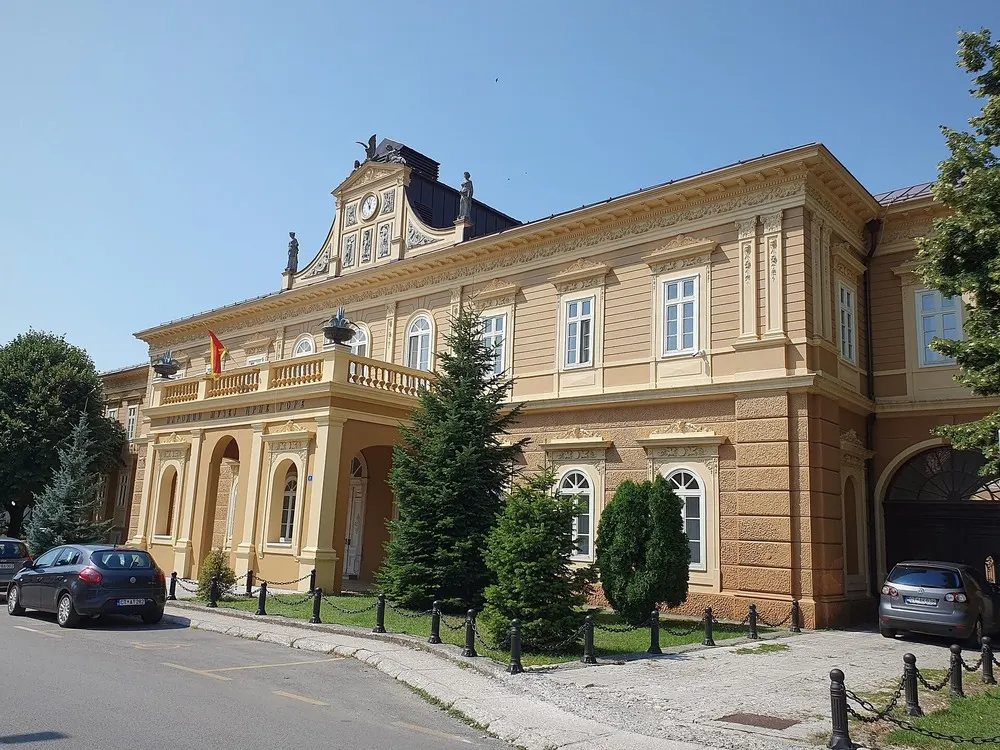
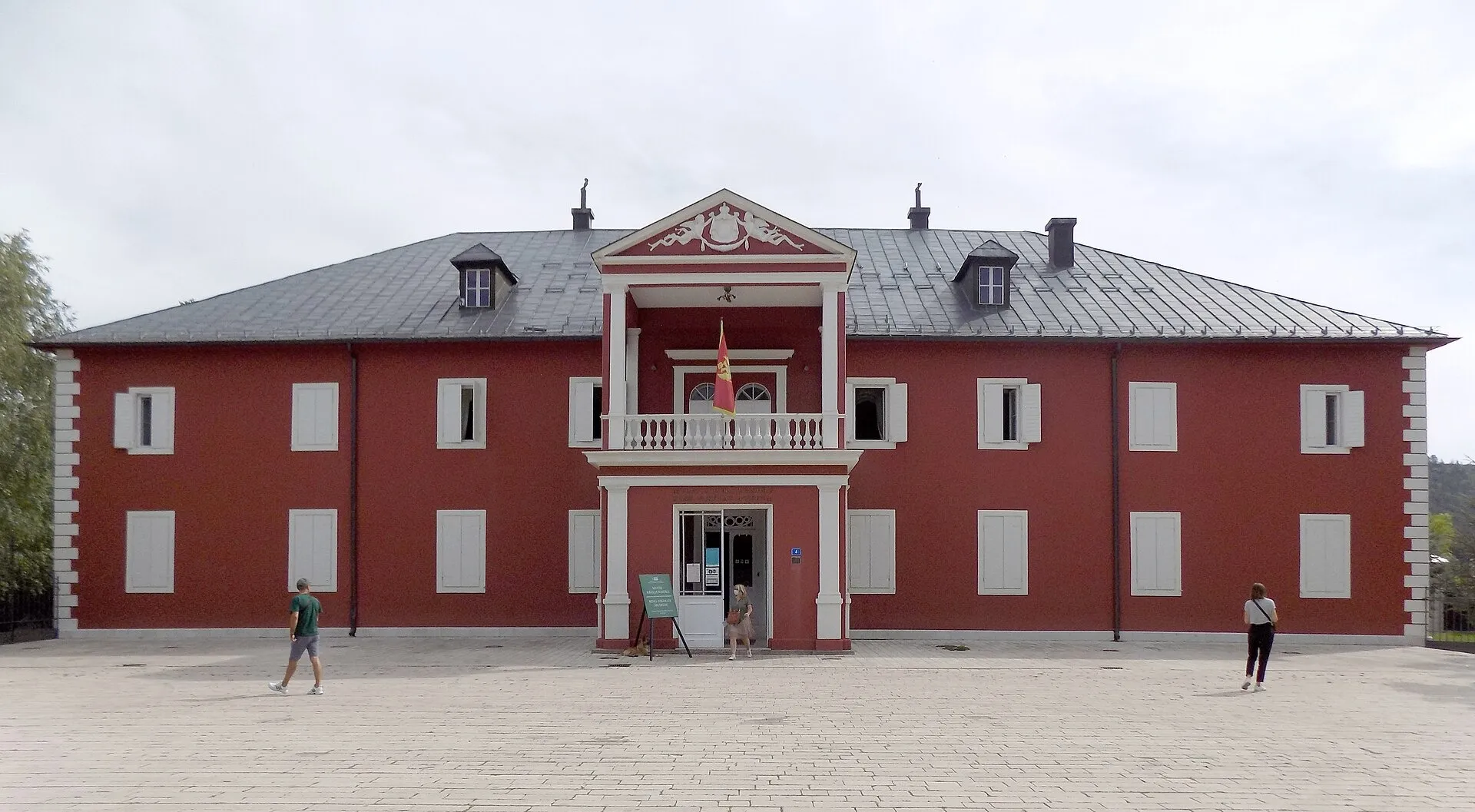
Visitors expecting a palace walk past it. On Dvorski trg, the court square, stands a long two-storey house painted dark red, with white shutters, a low hipped roof of grey metal and, in the middle, a two-level porch with a pediment that looks as if it was added for an occasion. It was. This is the building the people of Cetinje called simply Palac, where Nikola I Petrović-Njegoš ruled as prince from 1867 and as king from 1910, received the ministers of six great powers, saw five of his daughters marry into the ruling houses of Europe, and from which he left for exile in January 1916.
The modesty is the point. Montenegro in the 1860s was a small, poor mountain principality without a real town, and its prince lived as a rich highland chieftain might, in a house on the main square with his guards at the door and petitioners under the elm tree outside. What the exterior lacks the interior supplies: when the dynasty’s marriages brought it into the family of European royalty, the rooms filled with Viennese furniture, Sèvres porcelain, Bohemian glass and the signed photographs of monarchs.
It has been a museum since 1926, which means that it has now been a museum for twice as long as it was a court. It is the most visited museum in Montenegro, and if you see one interior in Cetinje it should be this one.
- Built
- 1863–1867; wings 1871; porch and final form 1910
- Built for
- Princess Darinka, widow of Prince Danilo I
- Royal residence
- 1867–1916 (Nikola I, prince and from 1910 king)
- Museum since
- 1926; a unit of the National Museum of Montenegro
- Address
- Dvorski trg, Cetinje
- Adult ticket
- 8 euro; pupils and students 4 euro (as checked 22 November 2026)
- Time needed
- 60–75 minutes
How it was built
Prince Danilo I was shot in Kotor in August 1860 and died the next day. He left a young widow, Darinka Kvekić, the daughter of a Serbian merchant family of Trieste, and an infant daughter, Olga. Darinka had brought French, a governess, a doctor and Western manners to a court that until then had been a bishop’s household, and she had no intention of spending her widowhood in Biljarda. In 1863 the new prince, Nikola, then in his early twenties, ordered a house to be built for her; she wanted, a later account says, ‘a palace with every comfort, as in Paris’.
The English clergyman William Denton, who was in Cetinje in 1865 and saw it unfinished, wrote that it was ‘quite in the form of German houses’ but had ‘something of the Venetian style’ on the outside. It was completed in 1867, the year in which Darinka left Montenegro for Venice. Nikola, who had been living in Biljarda, moved into the new house with his wife Milena, and it became the court.
It was never rebuilt, only added to. The Austrian engineer Wolfgang Pakler, already working in Cetinje, was engaged to enlarge it for its new role; two wings were added in 1871. Later alterations involved foreign and Montenegrin builders, among them Marko Đukanović and Andrija Radović, who are counted among the first Montenegrin engineers. The last campaign came for the jubilee of 1910, when Nikola celebrated fifty years on the throne and his golden wedding and was proclaimed king: the façade was remodelled to a design credited to Ferdinand Balak (written Fernando Balak in some sources), the entrance porch was built, and electric light was installed. In 1911 a new staircase with a glazed veranda was added on the garden front to a plan by a French architect named in the sources as Safrey, and carried out by the Czech builder Karlo Belada.
The colour has changed more often than the structure. A restoration in 2008 returned the walls to the shade recorded for 1910, ‘something between white and grey’; a few years later they were repainted the red you see now, which is how most Cetinje people remember the building.
Half a century of court life
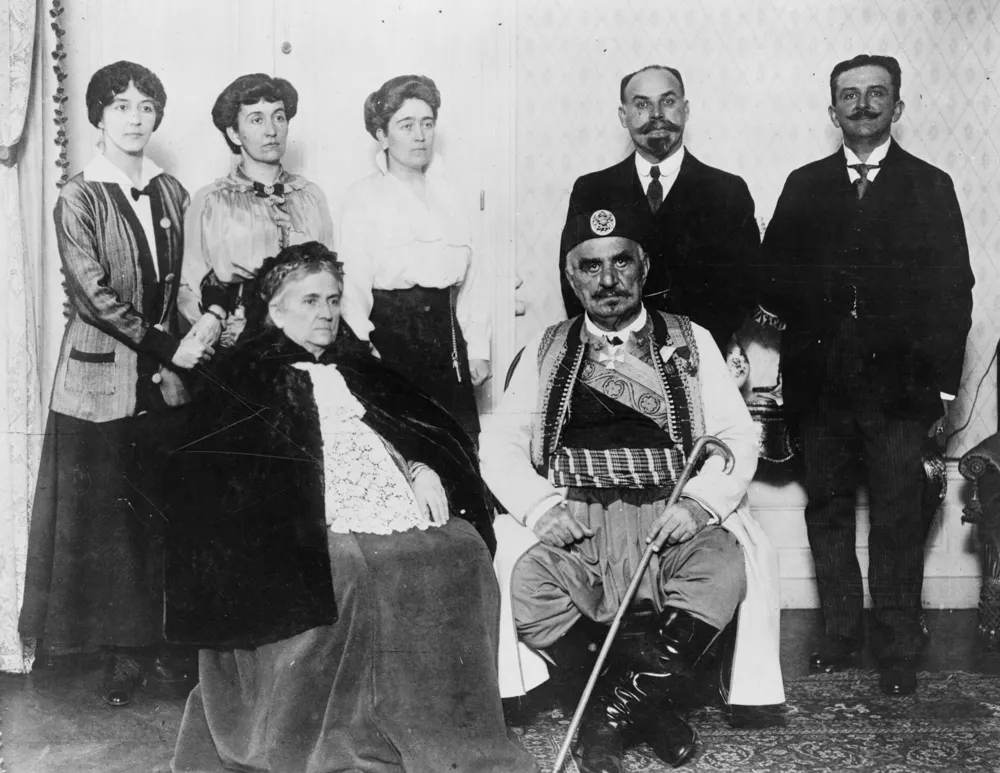
Twelve children were born to Nikola and Milena, nine daughters and three sons, and most of them grew up in these rooms. The marriages of the daughters are the reason a prince of a tiny state was called the father-in-law of Europe: Zorka married Petar Karađorđević, later King of Serbia; Milica and Anastasija (Stana) married Russian grand dukes; Jelena married the heir to the Italian throne and was Queen of Italy from 1900 to 1946; Ana married Prince Franz Joseph of Battenberg. The full story is told in the Petrović-Njegoš dynasty and King Nikola.
The house was also the working centre of the state. The prince received his ministers in the room with the fireplace, the diplomatic corps in the salon upstairs, and ordinary Montenegrins outside. He wrote here as well: Nikola was a poet and dramatist, and his play The Balkan Empress was first staged in Cetinje in the 1880s.
Court life ended abruptly. After the Austro-Hungarian army took Lovćen in January 1916 the king left for Italy and then France, and he never returned; he died at Antibes in 1921. Enough was saved from this and the other royal houses for a State Museum to open in it in 1926. Since then it has passed, with its collections, into the National Museum of Montenegro.
Room by room
The display follows the museum’s own numbering of nineteen rooms. Not every room keeps its original furniture, and the labels say so honestly; where the authentic contents were lost, period pieces from other royal residences fill the gap.
- The king’s study (1). The desk at which Nikola wrote his letters, proclamations and verse, with cases of war trophies, hunting weapons, foreign orders and commemorative volumes. The portraits of the royal couple are by the Italian painter Domenico Failutti, 1910; the bronze of a Montenegrin on guard is by Marko Brežanin.
- The room with the fireplace (2). Where the prince met his governors. The carom billiard table is by the Viennese maker Heinrich Seifert & Söhne. Here are the first Montenegrin postage stamps, from 1874, the coins of the first national currency, minted in Vienna, battalion flags and captured Ottoman standards, the king’s uniforms and the court dress of the queen and princesses.
- The library (3–6). About 10,000 volumes: encyclopaedias, travel books, music, and the classics in Russian, French, English and German. The treasure is a copy of the Oktoih prvoglasnik, printed by the Crnojević press in 1493–94, with a leaf of the Oktoih of the fifth tone. Around a thousand books carry their authors’ dedications to members of the family.
- The Indonesian sitting room and Prince Petar’s room (7–8). Carved black-wood oriental furniture in the first; in the second, Italian neo-Renaissance pieces, Japanese vases and glass by Émile Gallé.
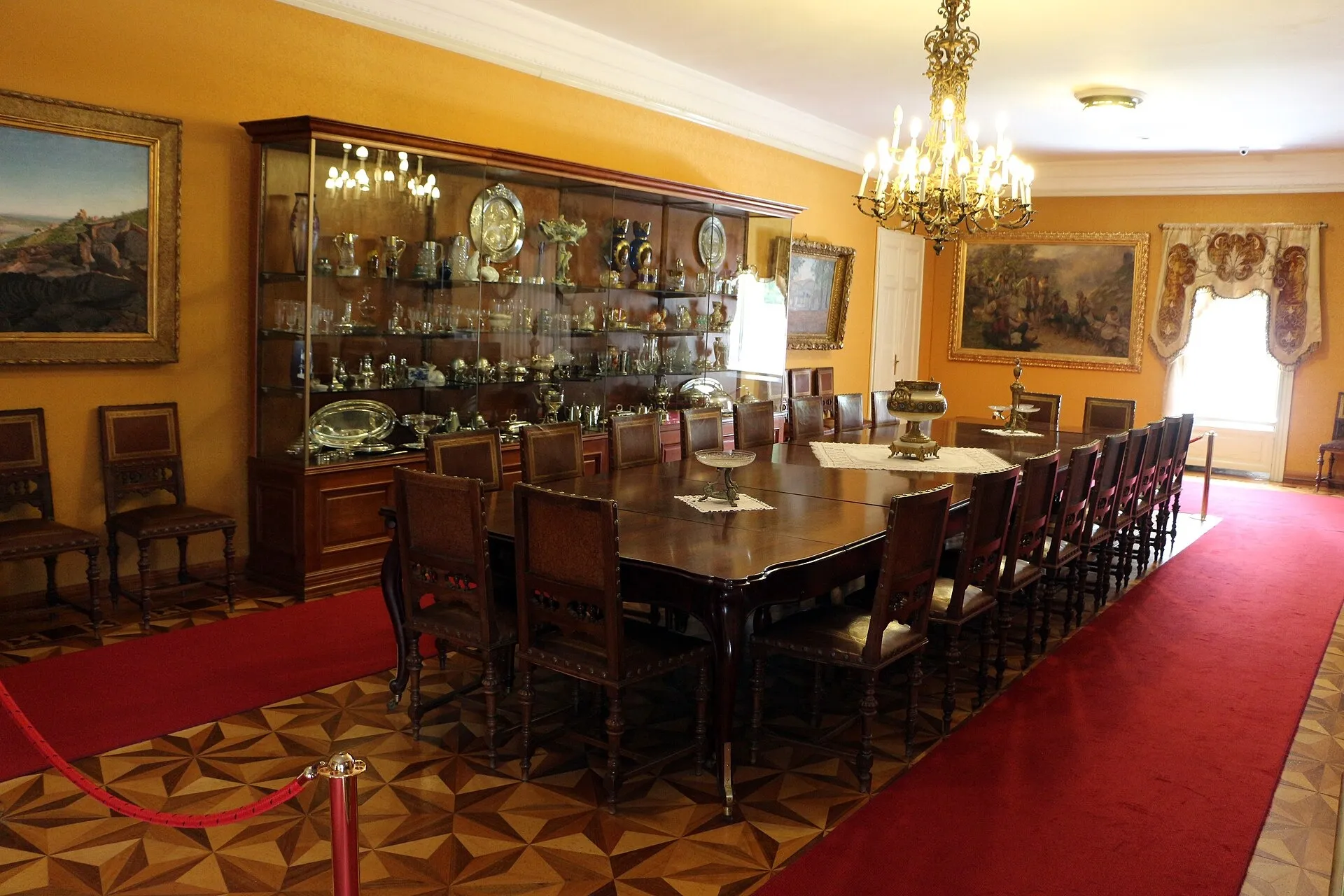
- The large dining room (9). The original extending table with thirty legs and thirty-six neo-Rococo chairs. In the cases: crystal engraved N I M, Art Nouveau glass, silver ordered from Berndorf in Austria, and a Sèvres set with portraits of Napoleon and Josephine, given by Napoleon III and Eugénie to Danilo and Darinka in Paris in 1858. On the walls, Vlaho Bukovac’s Guslar.
- The family dining room (10). Chippendale-style furniture, Bohemian glass, Meissen porcelain, and a carpet from Sultan Abdul Hamid II with the year 1898 woven into it.
- The king’s reception room (11). Louis XV-style furniture and a gallery of the dynasty: Bishop Danilo, Njegoš, Prince Danilo, Grand Duke Mirko by Jaroslav Čermák, Prince Nikola by Paja Jovanović, Princess Milena by Vlaho Bukovac.
- The diplomatic room (12). Where ministers presented their credentials. Portraits of Alexander II, Alexander III and Nicholas II of Russia with their empresses, Franz Joseph and Elisabeth of Austria, Napoleon III and Eugénie.
- The queen’s reception room (13). Portraits of Queen Jelena of Italy, of Crown Prince Danilo and his wife Jutta of Mecklenburg-Strelitz, who took the name Milica, and of Prince Mirko.
- The king’s bedroom (14). His bed and a Savonarola chair painted with the Montenegrin arms. The model ship was a gift from the British admiral Seymour, who commanded the international naval demonstration of 1880 that obliged the Ottoman Empire to hand Ulcinj to Montenegro. Signed photographs of Queen Victoria and George V.
- The tea room, the queen’s bedroom and the rooms of Princesses Ksenija and Vjera (15–19). Family portraits of all the children, several by Bukovac; ball gowns; a Blüthner piano; and Ksenija’s typewriter and Kodak camera. She was her father’s secretary and a keen photographer.
Two things are worth looking for beyond the furniture. One is the paintings: the Czech artist Jaroslav Čermák, who spent time in Montenegro in the 1860s, the Croatian Vlaho Bukovac and the Serbian Paja Jovanović were among the best-known painters of the Slav world in their day. The other is the pattern of gifts, which reads like a diplomatic chart: Russia, Austria, France, the Ottoman Empire, Britain and Italy are each present in a carpet, a ship, a porcelain service or a signed photograph.
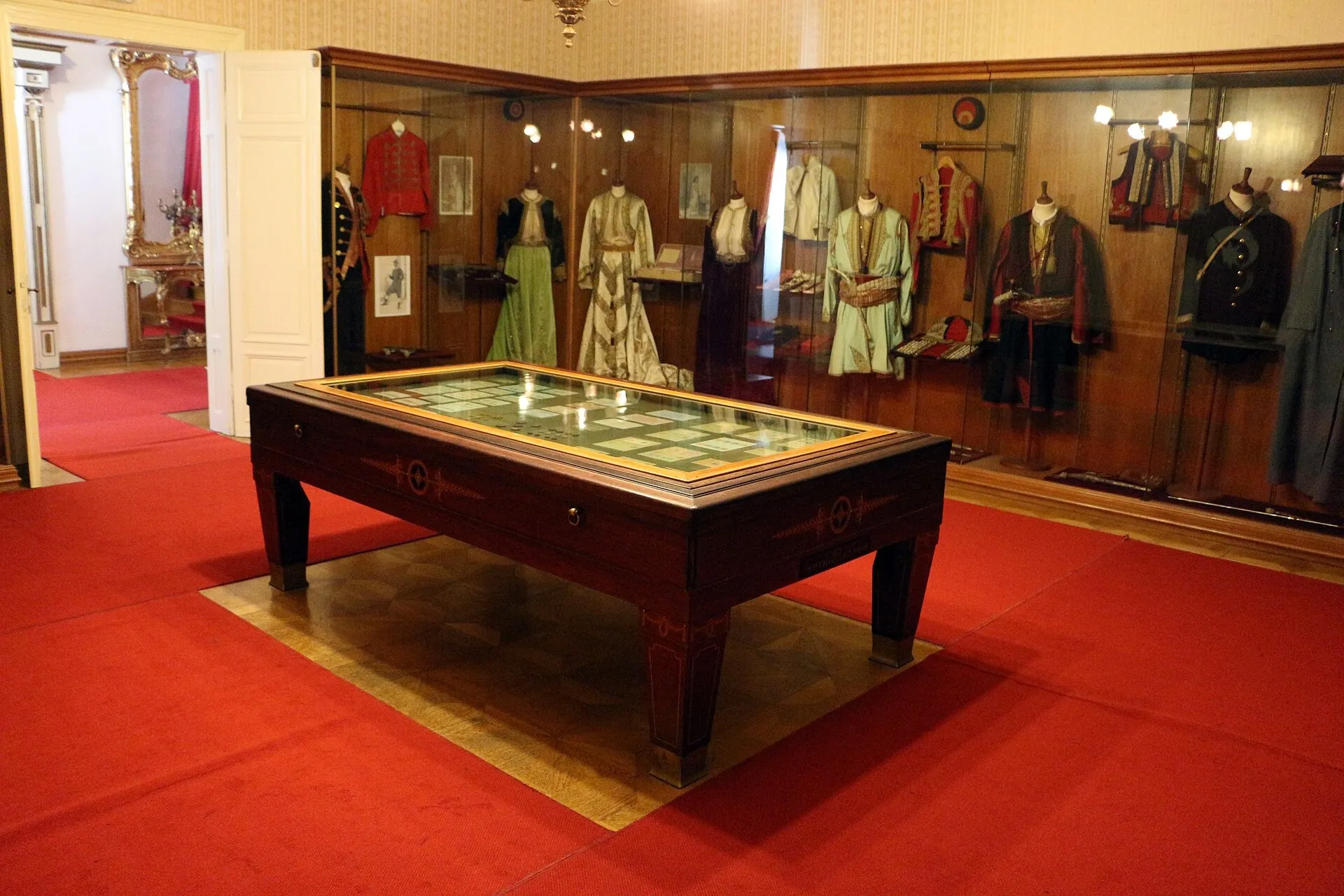
The room with the fireplace: the Viennese billiard table and cases of court and military dress.
The square, the garden and the statue
Dvorski trg, the court square, is the centre of the historic core. Around it stand the former Bulgarian legation, now a hotel with a café terrace, and the former Serbian legation, now the Ethnographic Museum; a few steps away are Biljarda and the State Archives. On the paved space between the palace and the archives is the bronze statue of Ivan Crnojević, the town’s founder, with a sword over his shoulder and a shield at his side. It is by the sculptor Anto Gržetić and was put up in 1983 for the five-hundredth anniversary of Cetinje.
Behind the palace lay the royal garden, first planted with an avenue of pines in 1870. Between 1891 and 1894 it was laid out as the Palace Park in the French manner, with the English-style City Park across Njegoševa Street. A small villa in the garden served as a guest house for visiting royalty.
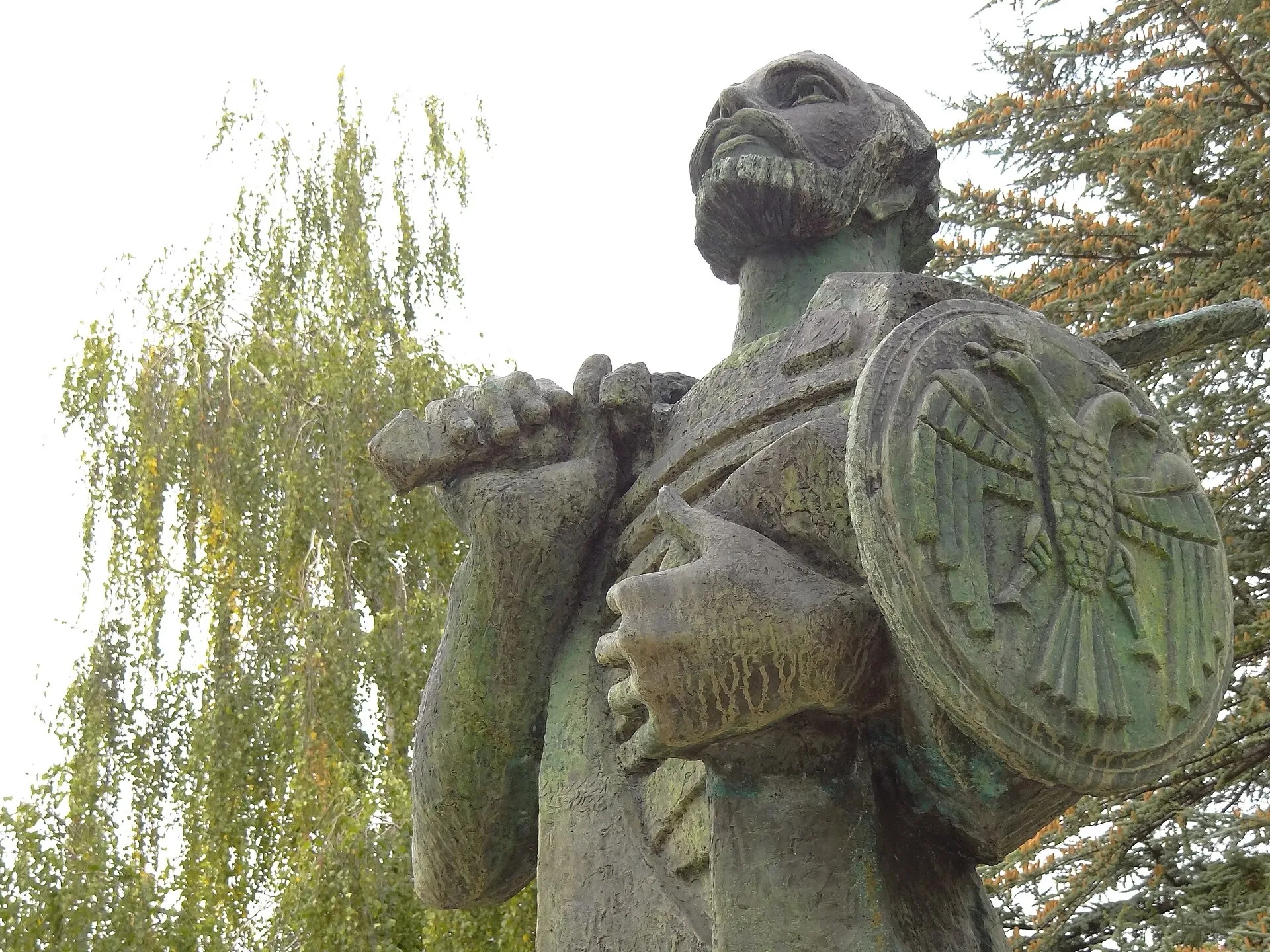
Ivan Crnojević, founder of Cetinje, by Anto Gržetić (1983), on the square beside the palace.
Visiting
The entrance is under the porch on the square. Tickets are sold inside; the combined ticket for all National Museum units is also available here (see museums for prices and for the conflicting versions of the timetable).
- Hours, as published in November 2026: 15 April to 15 November, every day from 9:00 AM, closing at 5:00 PM according to the museum’s timetable and 6:00 PM according to this unit’s own page, while the English versions of both give 4:00 PM (and a start on 11 April), so plan on 4:00 PM; 16 November to 14 April, Monday to Friday 9:00 AM to 3:00 PM. Last admission 30 minutes before closing. Local time.
- Tickets: adults 8 euro, pupils and students 4 euro, children under 12 free.
- Time: an hour is enough; an hour and a quarter if you read the labels.
- Language: labels in Montenegrin and English; the museum publishes a room-by-room guide in English that you can download before you come.
- Getting there: the car park with the tourist information point is about 100 m away; the bus station is a five-minute walk.
In high summer the palace is busiest between about 10:30 AM and 1:00 PM, when excursions from Kotor and Budva arrive together. Come at opening time or after 2:00 PM. In winter remember that it is closed at weekends.
Tours and a place to stay on the square
The Cetinje guided walking tour with museum entry is the simplest way to see the court quarter with someone who can explain it; check the listing for which museum the entry covers. Day tours from the coast that include Cetinje usually stop on this square as well.
If you would like to wake up opposite the palace, the hotel in the former Bulgarian legation is the only one on Dvorski trg. More choices are on our where to stay page.
Hotel Gradska Cetinje
CetinjeHotel in the former Bulgarian legation on Dvorski trg, facing King Nikola’s Palace, with a restaurant, bar and family rooms.
9.0Booking.com guest score · as checked in November 2026
See on Booking.comSee all stays in Cetinje on Booking.com
Accommodation links go to Booking.com, where you see live prices and availability. We do not list prices because they change daily; Cetinje.com may earn a commission.
Frequently asked questions
Is King Nikola’s Palace worth visiting?
Yes. It is the best-preserved royal interior in Montenegro and the clearest way to understand the country’s years as an independent principality and kingdom. Allow about an hour.
How much is the ticket for King Nikola’s Museum?
8 euro for adults and 4 euro for pupils and students, according to the National Museum’s price list as checked on 22 November 2026. Children under 12 are free. A combined ticket for all the museum’s units costs 20 euro.
When was the palace built?
Between 1863 and 1867, originally for Princess Darinka, the widow of Prince Danilo. Wings were added in 1871 and the building took its present form, with the entrance porch, in 1910.
Why is King Nikola’s Palace red?
It has been repainted several times. A restoration in 2008 used the pale grey-white recorded for 1910; a few years later the building was painted red again, the colour most people associate with it.
Did King Nikola die in the palace?
No. He left Montenegro in January 1916 and died in exile at Antibes, France, in 1921. His remains and those of Queen Milena were brought to Cetinje in 1989 and lie in the Court Church at Ćipur, two minutes from the palace.
Is the palace open in winter?
Yes, but only Monday to Friday, 9:00 AM to 3:00 PM, from 16 November to 14 April according to the museum’s timetable.
Sources and official information
Facts were checked against these official and scholarly sources in November 2026. Opening hours, ticket prices, park fees and timetables change, so confirm before you go.
- narodnimuzej.me
- narodnimuzej.me
- narodnimuzej.me
- narodnimuzej.me
- stari.maticacrnogorska.me
- cetinje.travel
- cetinje.travel
- cetinje.travel
- en.wikipedia.org
- narodnimuzej.me
Cetinje.com is an independent guide, not the official site of the Old Royal Capital Cetinje, the National Museum of Montenegro, any tour operator, hotel or the government of Montenegro. Some links are affiliate links: tours go to GetYourGuide and accommodation goes to Booking.com, and we may earn a commission at no extra cost to you.