In short
- There have been two Cetinje monasteries. Ivan Crnojević built the first at Ćipur in 1484; it was blown up in 1692. The one you visit was founded by Metropolitan Danilo in 1701–1704 on the site of the Crnojević court, a few minutes’ walk away.
- It is a working monastery and the seat of the Metropolitanate of Montenegro and the Littoral of the Serbian Orthodox Church, and for more than two centuries it was also the seat of government: Montenegro’s prince-bishops ruled from these cells.
- The church holds three relics that draw pilgrims from across the Orthodox world: the body of St Peter of Cetinje, a hand venerated as the right hand of St John the Baptist, and a fragment of the True Cross.
- Who owns the monastery is disputed between the Metropolitanate, the state and the town, and the Montenegrin Orthodox Church also claims it. Both positions are set out below.
- Entry to the church is free; dress modestly. The Court Church at Ćipur, with the tombs of King Nikola and Queen Milena, is a separate building two minutes away.
Where it is and what you are looking at
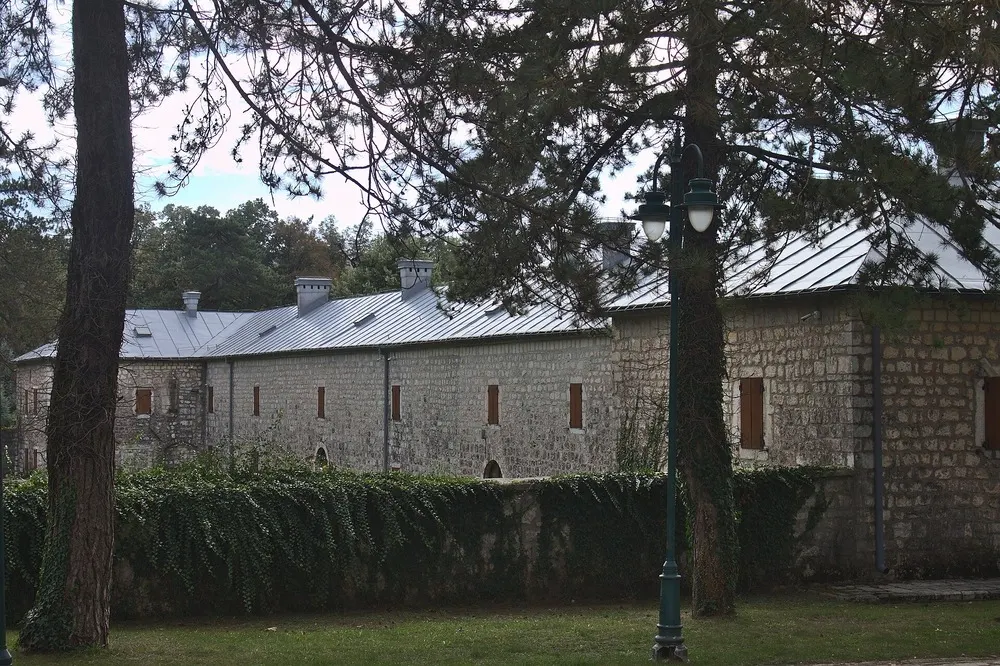
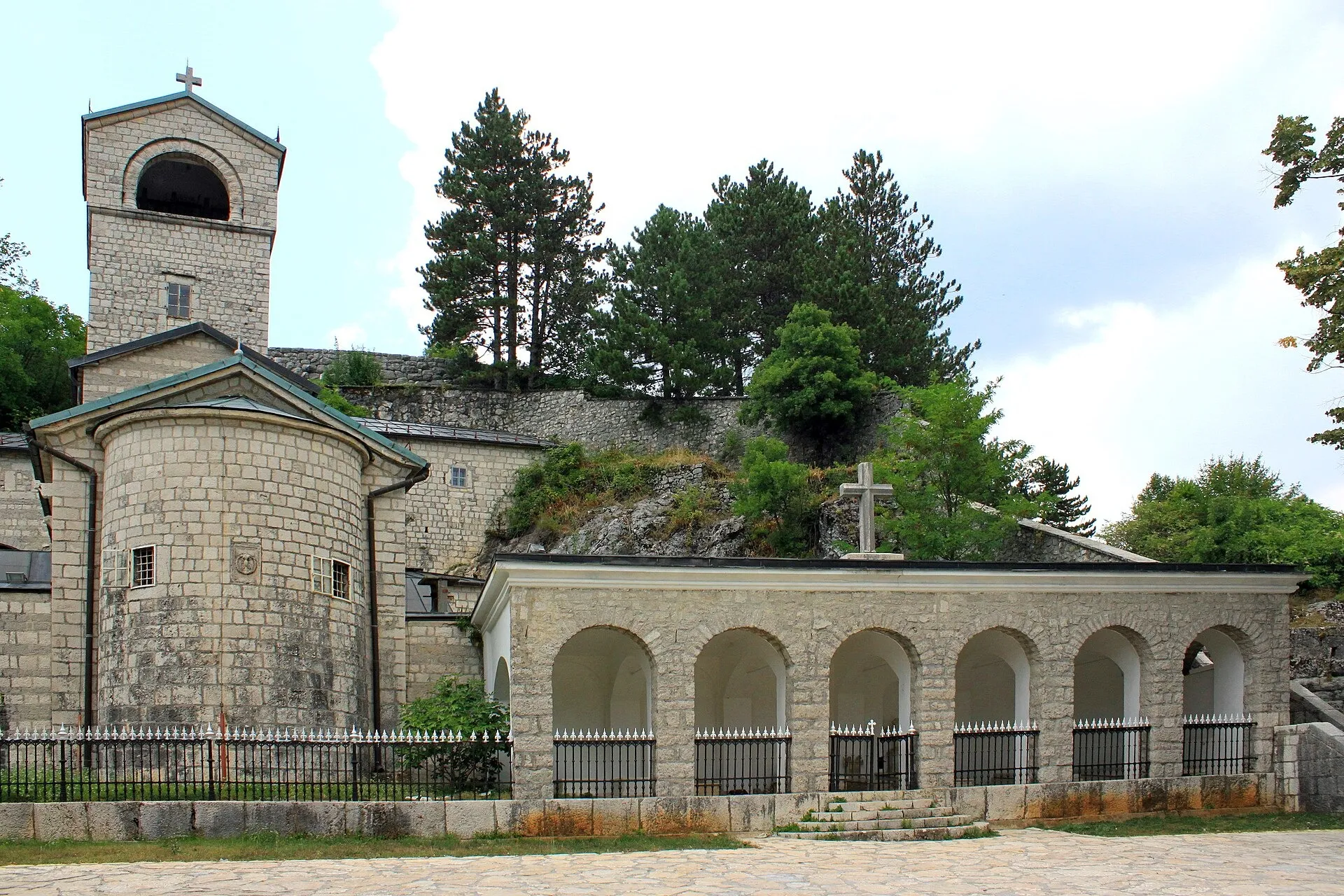
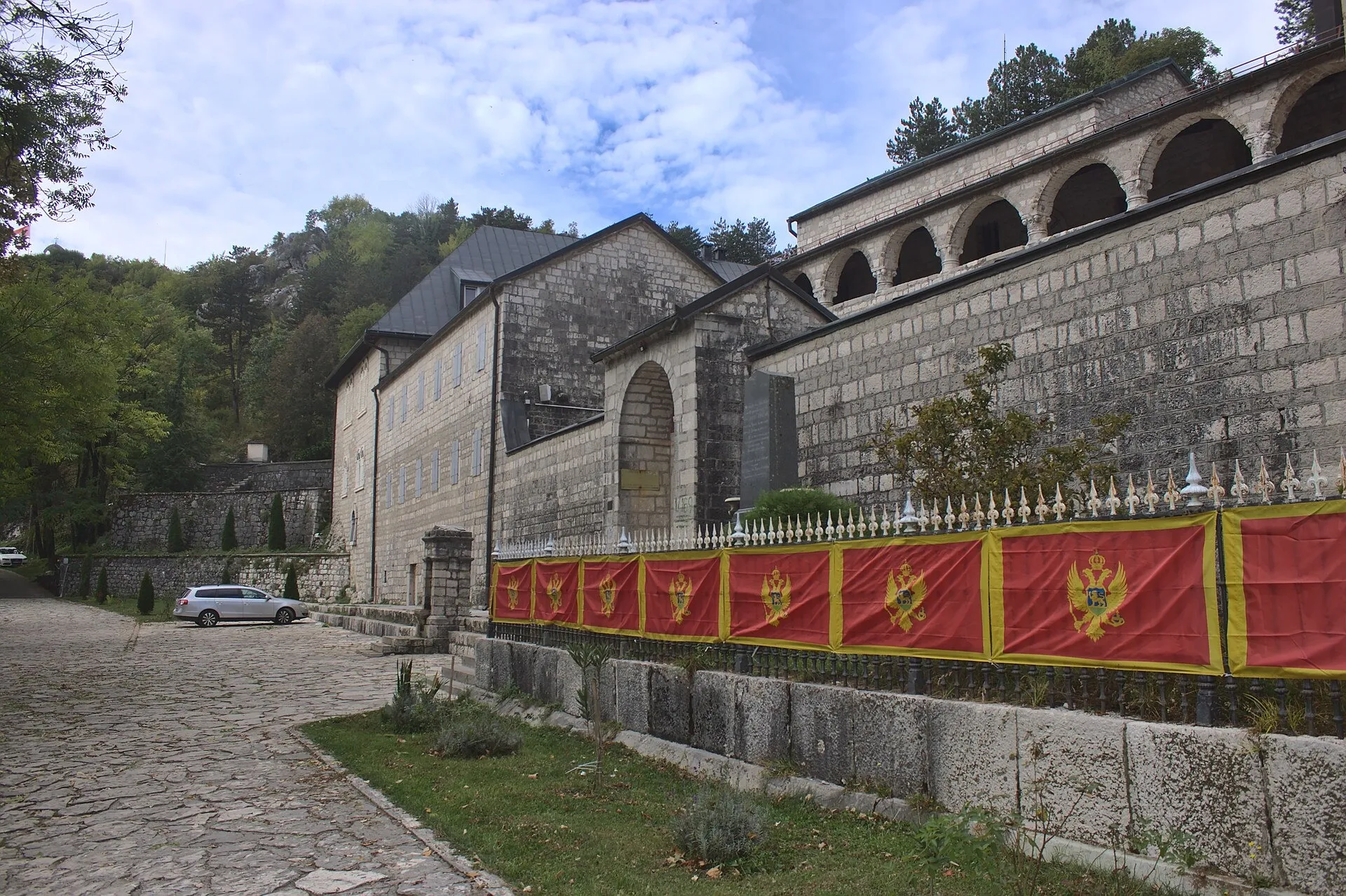
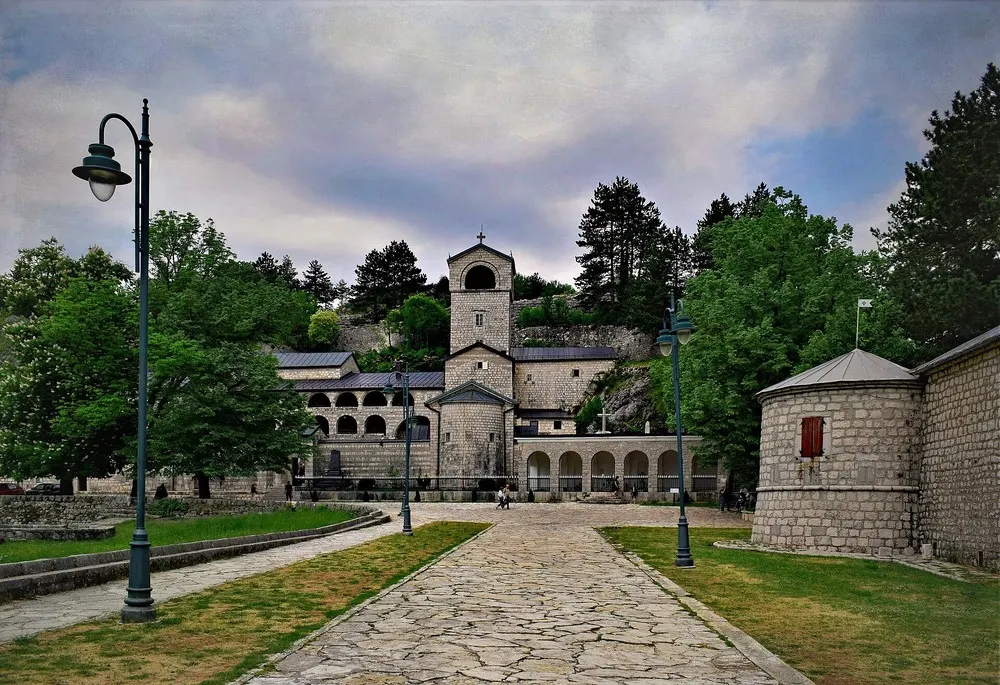
The monastery stands at the south-western edge of the historic core, pressed against the foot of Orlov krš (Eagle’s Rock), the limestone bluff that closes the Cetinje field on that side. From the palace square it is a walk of three or four minutes past Biljarda and the lawn of Ćipur. You see it first as a pale wall of stone rising in steps: a low church at the centre, two and three storeys of monks’ cells behind arcaded galleries to either side, a square bell tower, and above it the bare rock with the small canopy of Bishop Danilo’s mausoleum on top.
Its formal dedication is to the Nativity of the Mother of God; it is more often called the monastery of St Peter of Cetinje, after the prince-bishop whose body lies in the church. It is not a museum that happens to have monks. It is the seat of the Metropolitan and the home of a brotherhood, and the town’s Orthodox seminary bears the same saint’s name. Visitors are welcome, but on the monastery’s terms.
For a traveller it does three things at once. It is the oldest institution in the town and the reason the town exists; it is the building from which Montenegro was governed until 1838; and it holds relics whose journey here, by way of Rhodes, Malta, St Petersburg, Copenhagen and Belgrade, is one of the stranger stories of the twentieth century.
- Dedication
- Nativity of the Mother of God; known as the Monastery of St Peter of Cetinje
- First monastery
- Built 1484 at Ćipur by Ivan Crnojević; destroyed 1692
- Present monastery
- Founded 1701–1704 by Metropolitan Danilo; burnt in the Ottoman campaigns of 1712–1714 and in 1785; present outline 1927
- Used by
- Metropolitanate of Montenegro and the Littoral (Serbian Orthodox Church)
- Relics
- St Peter of Cetinje; right hand of St John the Baptist; fragment of the True Cross
- Entry
- Free; modest dress required
- From the palace square
- About 300 m on foot
The first monastery: Ivan Crnojević at Ćipur, 1484
When Ivan Crnojević withdrew his court from Lake Skadar to the Cetinje field he built first a residence, in 1482, and then, in 1484, a monastery. Tradition, repeated by the town’s own tourist office, holds that he had made a vow to do so before the icon of the Virgin in her shrine at Loreto while he was an exile in Italy. His founding charter is dated 4 January 1485, and with it the seat of the bishops of Zeta moved up from the lake to the new church. That transfer is why a bishop came to rule Montenegro: when the Crnojević line left the country at the end of the century, the metropolitan in this monastery was the one authority that remained.
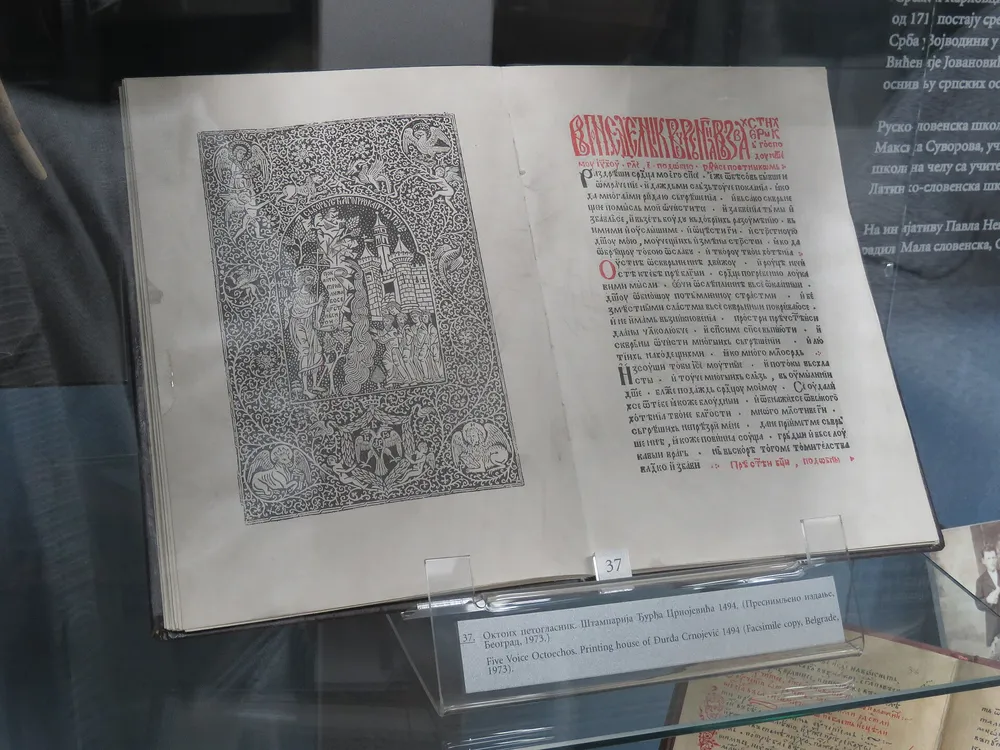
The church stood at Ćipur, the flat ground east of the present monastery. A woodcut in the Oktoih printed here in the 1490s, and plans drawn by a Venetian engineer before the destruction, suggest a three-aisled church with a dome over the central nave and Renaissance detail, inside a walled precinct of about 1,400 square metres with two smaller churches and lodgings. It was here, between 1493 and 1496, that the hieromonk Makarije worked the press of Đurađ Crnojević, the first state printing house among the South Slavs (see the Crnojević printing house).
The end came in the Morean War. A Venetian garrison held the monastery from 1689; on 25 September 1692 it negotiated its withdrawal before the army of Süleyman Pasha Bushati of Shkodër, having first mined the building. The charge went off as the Ottoman troops entered. For a long time the destruction was blamed on the Ottomans; the historian Lazar Tomanović established from Venetian documents that the garrison laid the mine. What was left was levelled.
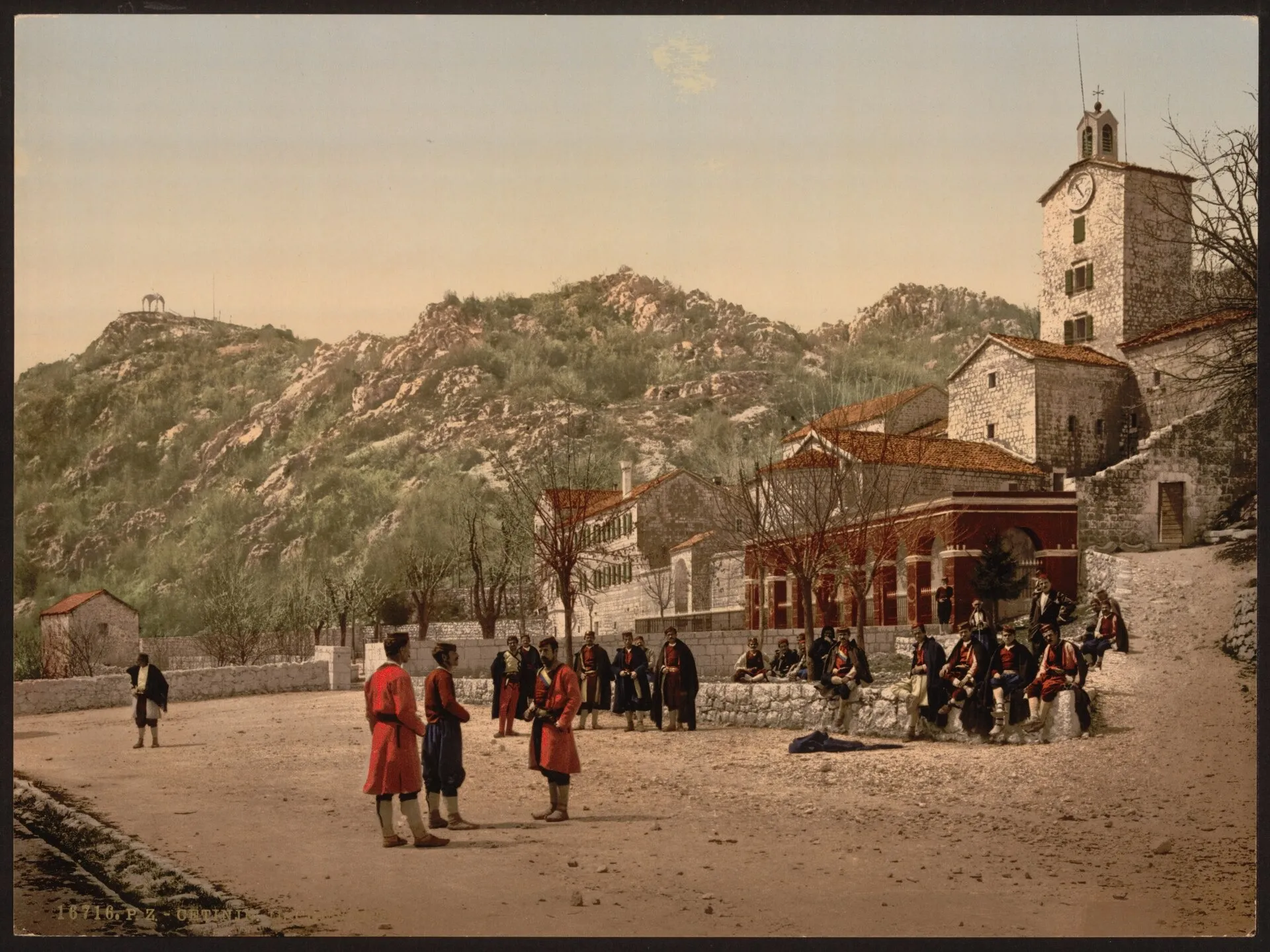
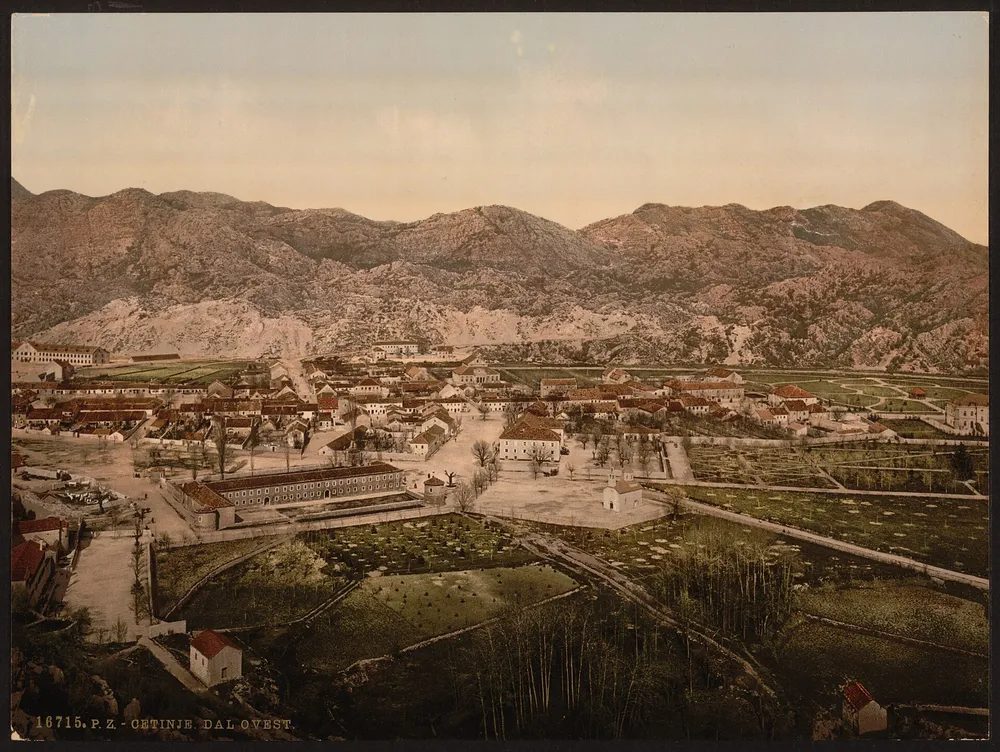
The monastery and the open ground in front of it in a photochrom print of the 1890s. Photochrom Print Collection, Library of Congress.
The second monastery: Danilo, the Petrović bishops and three burnings
The man who rebuilt it was Danilo Šćepčević Petrović, elected bishop in 1697 and the founder of the dynasty that ruled Montenegro until 1918. He did not build on the old site. Between 1701 and 1704 (sources give both years, and it is likely the work took the whole interval) he raised a new monastery a little to the west, on the ruins of Ivan Crnojević’s court, using stone from the old church and fixing into the new wall a slab carved with the Crnojević double-headed eagle and Ivan’s dedication. You can still find it.
The eighteenth century was hard on it. It was burnt during the Ottoman punitive campaigns of 1712–1714, restored by Metropolitan Sava around 1743, and burnt again in 1785 by Mahmud Pasha Bushati, after which Metropolitan Petar I restored it. Vladika Vasilije, writing a history of Montenegro in Russia in the 1750s, claimed that before its destruction it had been among the most beautiful monasteries in Europe, which says more about his purpose than about the building.
Through all of this the monastery was the state. The assembly of clan heads met on the threshing floor in front of it; the Senate sat inside; envoys from Venice, Vienna and St Petersburg were received in its guest rooms; and when Petar II Petrović-Njegoš set up a press in 1834, it was installed here. One of its cellars served as a prison, called Guvernadurica after the last holder of the rival civil office of guvernadur, who was confined in it after the office was abolished in 1830. Only in 1838, when Njegoš moved into Biljarda next door, did government leave the cloister.
The monastery went on being enlarged through the nineteenth century and after: the ranges of cells were raised, a residence for the metropolitan was added, and most accounts date the outline you see today to works completed in 1927. The 1979 earthquake damaged it and it was repaired in the following decade.
- 1484
Ivan Crnojević builds the first monastery
At Ćipur, dedicated to the Nativity of the Mother of God. The charter is dated 4 January 1485 and the bishops of Zeta move their seat here.
- 1493–1496
The Crnojević press
Hieromonk Makarije prints the Oktoih and other liturgical books at the monastery.
- 1692
Destruction
A withdrawing Venetian garrison mines the church on 25 September; it explodes as Süleyman Pasha’s troops enter.
- 1701–1704
Danilo’s new monastery
Built on the site of the Crnojević court with stone from the old church.
- 1712–1714
First burning
Burnt in the Ottoman campaigns against Montenegro; restored around 1743 under Metropolitan Sava.
- 1785
Second burning
Mahmud Pasha Bushati sacks Cetinje; Petar I restores the monastery.
- 1830
Death of Petar I
He dies in the monastery on 30 October (18 October, old style) and is proclaimed a saint four years later.
- 1838
Government moves out
Njegoš transfers his residence and the Senate to Biljarda.
- 1890
Court Church at Ćipur
Prince Nikola completes a church on the foundations of the 1484 one.
- 1927
Present appearance
The complex reaches the outline it has today.
- 1989
Return of the king
The remains of King Nikola and Queen Milena are brought from San Remo and buried in the Court Church.
Inside: the church, St Peter of Cetinje and the two relics
The church is small, single-naved and dim, closer in scale to a village church than to a cathedral. The carved and gilded iconostasis is nineteenth-century work by Greek masters. In the church lies the reliquary of St Peter of Cetinje: Petar I Petrović-Njegoš, metropolitan from 1784 to 1830, who twice defeated Mahmud Pasha in 1796, gave Montenegro its first written law and spent much of his life reconciling feuding clans. He died in his cell here and his nephew and successor Njegoš proclaimed him a saint in 1834. His feast, Lučindan, falls on 31 October (18 October in the church calendar, shared with St Luke) and is the monastery’s great day.
Also in the church is the tomb of Prince Danilo, the first secular ruler of modern Montenegro, who was shot in Kotor in 1860.
The relics that most visitors come for are kept in a side chapel and are shown by a monk, usually to groups and at set moments rather than on demand. They are a mummified hand in a gold casing, venerated as the right hand of St John the Baptist, and a fragment of the True Cross. Whatever view one takes of relics, their documented modern history is solid and remarkable, and it is told in the next section.
The monastery also has a treasury, formed over five centuries and described by the tourist organisation as one of the richest collections of its kind in the Balkans, with manuscripts and early printed books, icons, embroidery, goldsmiths’ work and carved wood from the thirteenth to the twentieth century. Among the pieces traditionally shown are a stole associated with St Sava, a crown attributed to the Serbian king Stefan Dečanski that was used at the proclamation of the kingdom in 1910, and the staff of Ivan Crnojević. Access is not guaranteed: ask at the gate whether it can be seen on the day.
From Malta to Cetinje: the journey of the relics
Three objects travelled together: the hand, the cross fragment and the icon of Our Lady of Philermos, a Byzantine image of the Virgin’s face that the Knights Hospitaller had venerated on Rhodes since the Middle Ages and carried to Malta in 1530. When Napoleon expelled the Order from Malta in 1798, the knights took the three relics with them, and the following year they were presented to Tsar Paul I, whom a group of knights had elected Grand Master. They were kept in the imperial chapels, latterly at Gatchina.
After the Revolution the Dowager Empress Maria Feodorovna brought them out of Russia to her native Denmark. Her daughters entrusted them to the Russian Church Abroad, and in 1932 they were given to King Alexander of Yugoslavia, who placed them in the palace chapel at Dedinje in Belgrade. In April 1941, as the kingdom collapsed, they were taken with the fleeing court as far as Montenegro and left for safekeeping at Ostrog. (For that cliff-face monastery, see the Ostrog Monastery guide on ExploreMontenegro.)
What happened next is less tidy, and published accounts differ on the dates. In the early 1950s (1951 according to some accounts, 1952 according to others) the Yugoslav security service removed the relics from Ostrog, and they disappeared into state custody. Accounts in the Serbian and Montenegrin press say that in 1978 the hand and the cross fragment were handed to the Cetinje Monastery while the icon went to the museum. Their presence in Cetinje was made public in 1993, during a visit by Patriarch Alexy II of Moscow.
The icon is not in the monastery. It is displayed by the National Museum in the Blue Chapel of the Art Museum in the Government House, five minutes’ walk away, and is one of the great objects of the museum collections.
Ćipur and the Court Church: the tombs of King Nikola and Queen Milena
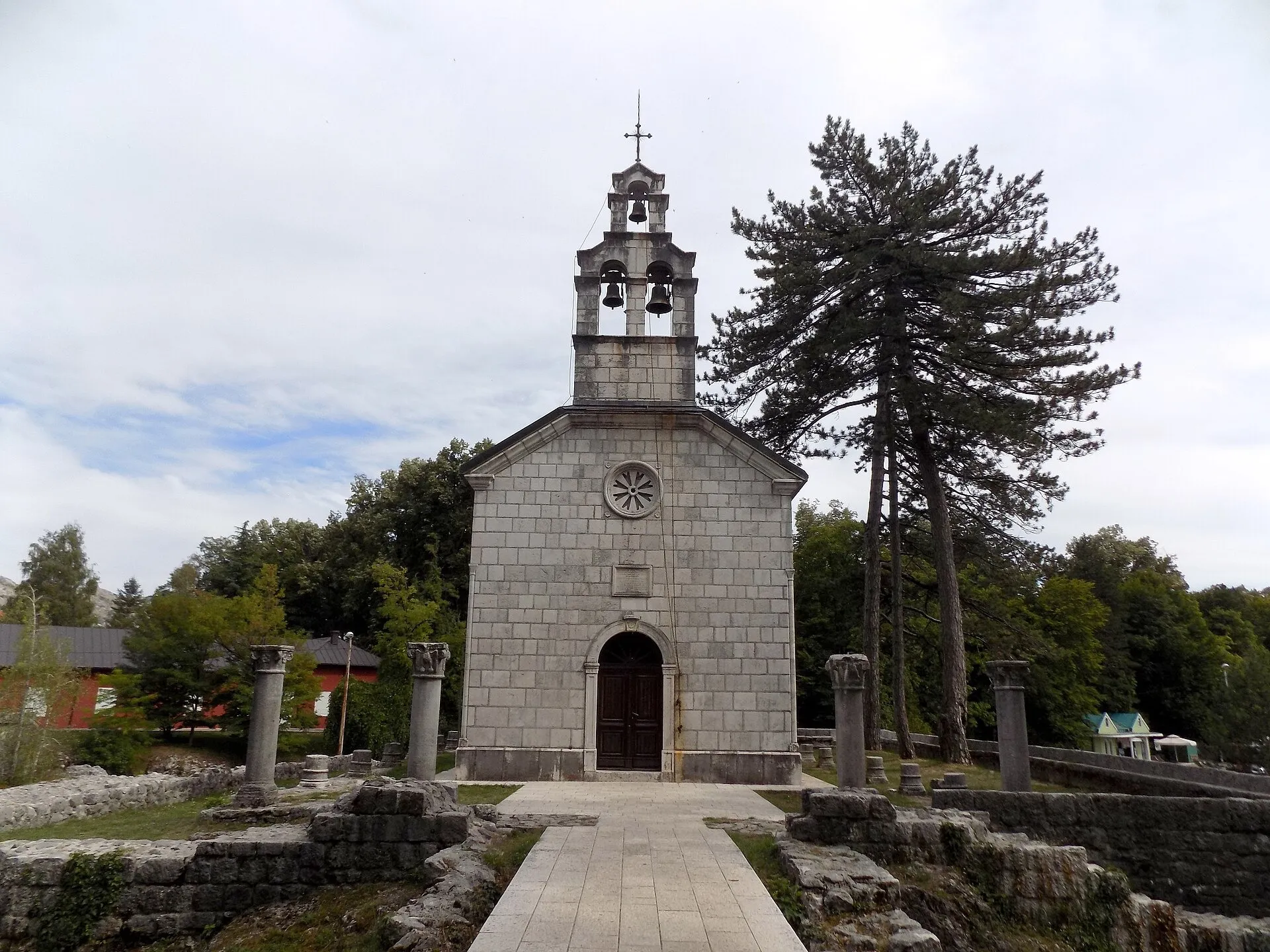
Walk back from the monastery gate towards Biljarda and you cross Ćipur. The low walls and the row of columns in the grass are the conserved foundations of Ivan Crnojević’s monastery, excavated in the late 1980s; the columns are replicas, the originals being in the History Museum. Rising from the middle of them is a small church of white dressed stone with a single dome: the Court Church, also dedicated to the Nativity of the Mother of God.
Prince Nikola began it in 1886 as a chapel for court ceremonies; that first structure was so poorly built that it had to be taken down, and the church was rebuilt under his eye in 1890, the works being entrusted to Miloš Lepotić. An inscription over the west door records that it stands, with minimal deviation, on the foundations of the main church of 1484. The iconostasis was painted by Russian artists at the end of the nineteenth century.
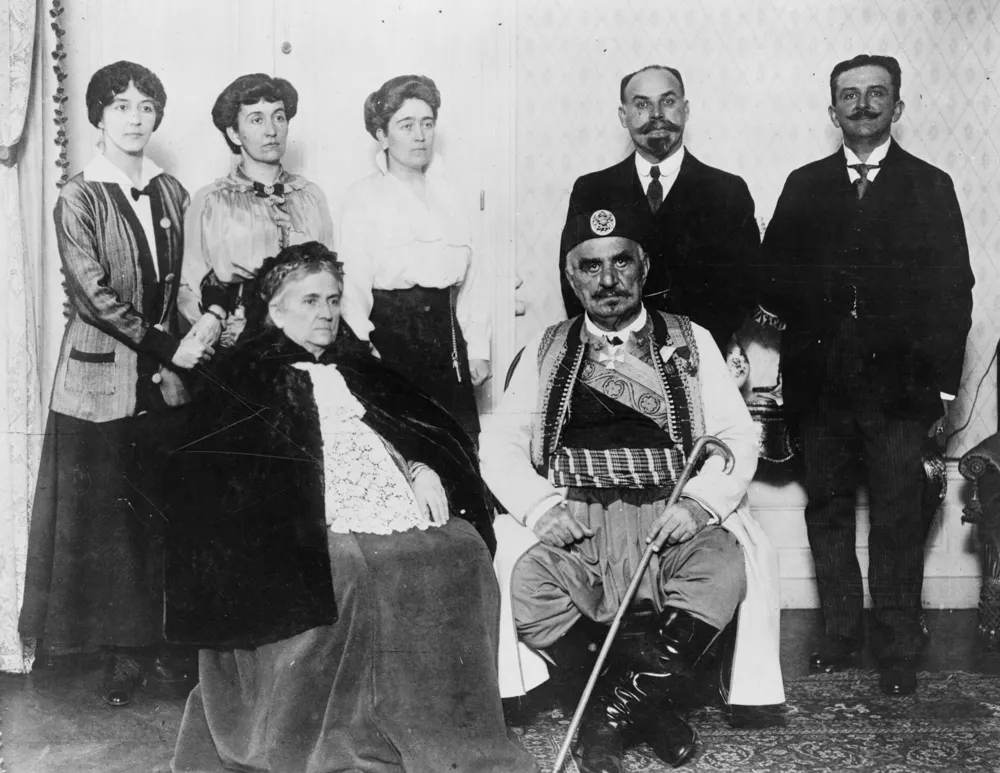
Just inside the door are two marble tombs. King Nikola I died in exile at Antibes in 1921 and Queen Milena in 1923; they were buried in the Russian church at San Remo. In 1989 their remains, with those of the princesses Ksenija and Vjera, were brought to Cetinje and laid here in a ceremony that drew a very large crowd to the town. The story of the exile is told on the page about King Nikola.
The church has a third royal burial. During the excavations of 1986 a fifteenth-century grave was found in the nave of the old church containing a finely made casket with what are believed to be the remains of Ivan Crnojević himself. After years in a bank vault and then in the museum store they were reinterred in a restored tomb in the Court Church in 2010. The church was declared a protected monument in 1961 and since 2012 has been administered as part of the History Museum; it is opened by the museum or for services, so you may find it locked.
Whose monastery? The ownership dispute, stated plainly
You do not need to take a view on church politics to visit, but you will understand the town better if you know that the monastery is at the centre of Montenegro’s sharpest public argument.
The position of the Serbian Orthodox Church. The Metropolitanate of Montenegro and the Littoral regards itself as the unbroken continuation of the bishopric that Ivan Crnojević installed here in 1484, holds that the monastery was built by its metropolitans and has always been church property, and has used it without interruption. It rejects the idea that church property in Montenegro ever belonged to the state.
The position of the Montenegrin Orthodox Church and its supporters. The Montenegrin Orthodox Church, established in 1993 and led from Cetinje, is not recognised by the other canonical Orthodox churches. It holds that an autocephalous church of Montenegro existed until it was absorbed into the unified Serbian Orthodox Church in 1920, after the loss of Montenegrin statehood, and that monasteries built by Montenegro’s rulers, this one above all, are the heritage of the Montenegrin state and should be available to it. Many people in Cetinje, where Montenegrin national feeling is strongest, share that view.
The record. The land register showed the Municipality of Cetinje as owner from 2005, which the Metropolitanate contested. A law on religious freedom passed in December 2019, which would have required religious communities to prove title to property built before 1918, set off months of protest processions and was amended after the change of government in 2020. On 5 September 2021 the new Metropolitan, Joanikije, was enthroned in the monastery under heavy police protection while protesters tried to block the roads into the town. On 13 September 2021 the government instructed the cadastre to enter the state as owner in place of the municipality; on 15 October the cadastre instead registered the Metropolitanate, which prompted protests in Podgorica. The matter has remained contested since, in administrative and court proceedings and in politics. This guide takes no side; for the wider question see language and identity.
On Orthodox Christmas Eve, 6 January, the two communities have for years lit their Yule logs separately, one in front of the monastery and one on the palace square. On that evening and on major feast days expect a police presence and treat the place as you would any contested shrine: quietly.
Visiting: dress, timing and manners
There is no ticket for the church. The monastery does not publish visiting hours in a form that we could confirm, and they follow the daily services; as a working rule the gate is open through the day and the reliquary chapel is opened when a monk is free, most reliably for groups in the morning and mid-afternoon. If seeing the relics matters to you, come early, ask at the gate and be prepared to wait.
- Dress: shoulders and knees covered for everyone; no shorts or sleeveless tops. Wraps are commonly lent at the entrance in summer, but do not count on it.
- Photography: fine in the courtyard; not inside the church or the reliquary chapel unless you are told otherwise.
- Behaviour: this is a monastery in use. Keep your voice down, do not walk in front of people who are praying, and do not enter the cells or the upper galleries.
- Time needed: 30 to 45 minutes for the monastery; add 20 minutes for Ćipur and the Court Church, and 30 minutes if you climb Orlov krš to Bishop Danilo’s mausoleum for the view over the roofs.
- Access: the forecourt is level and paved; there are steps into the church.
The best light on the façade is in the afternoon, when the sun comes round onto the stone. In July and August coach groups from the coast arrive between about 10:00 AM and 1:00 PM; before or after that you may have the courtyard to yourself.
Tours that include the monastery
Almost every organised visit to Cetinje stops here. In town, the guided walking tour with museum entry is the natural choice; from the coast, the listing titled Monastery tour: Cetinje, Dajbabe and Ostrog links the three shrines in a day. You can see everything GetYourGuide lists for the site on its Cetinje Monastery page. Read each listing for what is included; we do not quote prices or ratings.
Monastery tour: Cetinje Monastery, Dajbabe and Ostrog
Three Orthodox monasteries in one day: Cetinje, the cave church of Dajbabe near Podgorica and Ostrog in its cliff. Dress for church visits; check the listing for the starting point and timings.
Check availabilityBook via GetYourGuide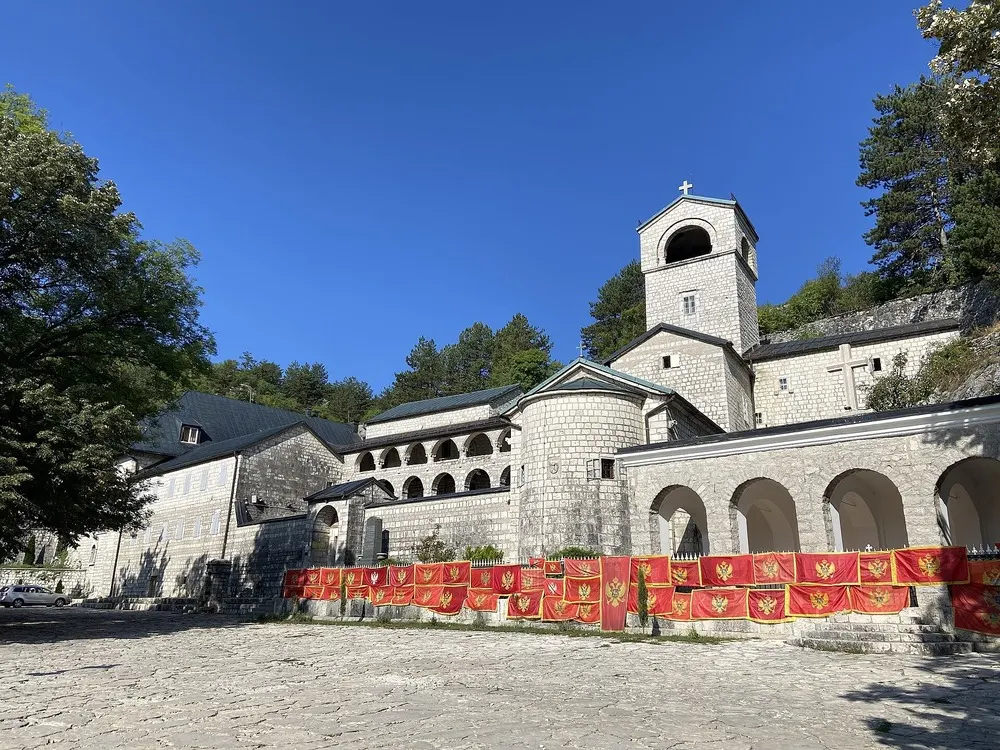
Montenegro tour: history, tradition, culture
A culture-led tour listed under Njeguši, the home village of the Petrović dynasty on the old road between Kotor and Cetinje. The title names history, tradition and culture; read the listing for the route and what is included.
Check availabilityBook via GetYourGuideTour listings are on GetYourGuide. Prices, dates and cancellation terms are shown live on each listing and can change; Cetinje.com may earn a commission at no extra cost to you.
Frequently asked questions
Is there an entrance fee for Cetinje Monastery?
No. Entry to the monastery church is free; donations are welcome.
What relics are kept in Cetinje Monastery?
The body of St Peter of Cetinje (Metropolitan Petar I, died 1830), a hand venerated as the right hand of St John the Baptist, and a fragment of the True Cross. The hand and the cross fragment came from the treasury of the Knights of St John by way of the Russian imperial family and the Yugoslav royal court.
Can you always see the hand of St John the Baptist?
No. The relics are kept in a side chapel and shown by a monk, most often to groups. Ask at the gate; you may need to wait, and on some days it is not possible.
What should I wear?
Clothing that covers shoulders and knees, for men and women. Shorts and sleeveless tops are not accepted inside.
Where is the icon of Our Lady of Philermos?
Not in the monastery. It is displayed by the National Museum of Montenegro in the Blue Chapel of the Art Museum in the Government House (Vladin dom), about five minutes’ walk away.
Where are King Nikola and Queen Milena buried?
In the Court Church at Ćipur, the small white church between the monastery and Biljarda. Their remains were brought from San Remo in 1989.
Who owns Cetinje Monastery?
It is used by the Metropolitanate of Montenegro and the Littoral of the Serbian Orthodox Church. Title has been disputed between the Metropolitanate, the state and the Municipality of Cetinje, and the Montenegrin Orthodox Church also claims the monastery; in October 2021 the cadastre registered the Metropolitanate as owner, a decision that was publicly contested.
Sources and official information
Facts were checked against these official and scholarly sources in November 2026. Opening hours, ticket prices, park fees and timetables change, so confirm before you go.
- cetinje.travel
- en.wikipedia.org
- sr.wikipedia.org
- en.wikipedia.org
- narodnimuzej.me
- en.wikipedia.org
- sr.wikipedia.org
- slobodnaevropa.org
- slobodnaevropa.org
- mitropolija.com
- whc.unesco.org
Cetinje.com is an independent guide, not the official site of the Old Royal Capital Cetinje, the National Museum of Montenegro, any tour operator, hotel or the government of Montenegro. Some links are affiliate links: tours go to GetYourGuide and accommodation goes to Booking.com, and we may earn a commission at no extra cost to you.