In short
- Nikola I (1841–1921) succeeded his murdered uncle as Prince of Montenegro in 1860 and reigned until 1918, one of the longest reigns in modern European history.
- His wars of 1876–78 won international recognition at the Congress of Berlin and more than doubled the country, giving it Podgorica, Nikšić and a coastline at Bar and Ulcinj.
- He ruled as a patriarchal autocrat, granted a constitution in 1905 and was proclaimed king on 28 August 1910.
- He was also a poet and playwright: the song ‘Onamo, 'namo!’ and the drama Balkanska carica (The Balkan Empress) are his.
- Driven out by the Austro-Hungarian occupation in 1916 and deposed in 1918, he died at Cap d'Antibes in 1921; his remains were brought home to Cetinje in 1989.
The man under the tree
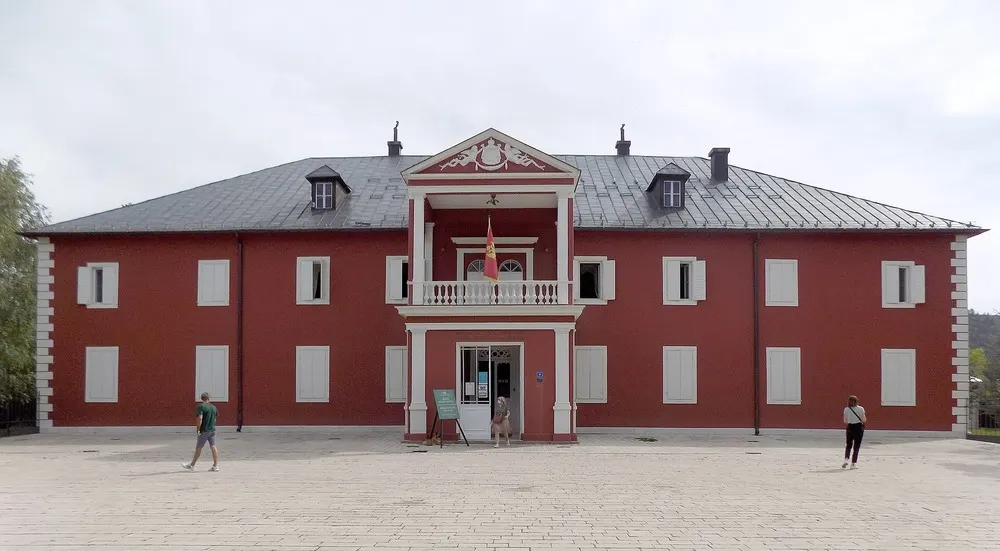
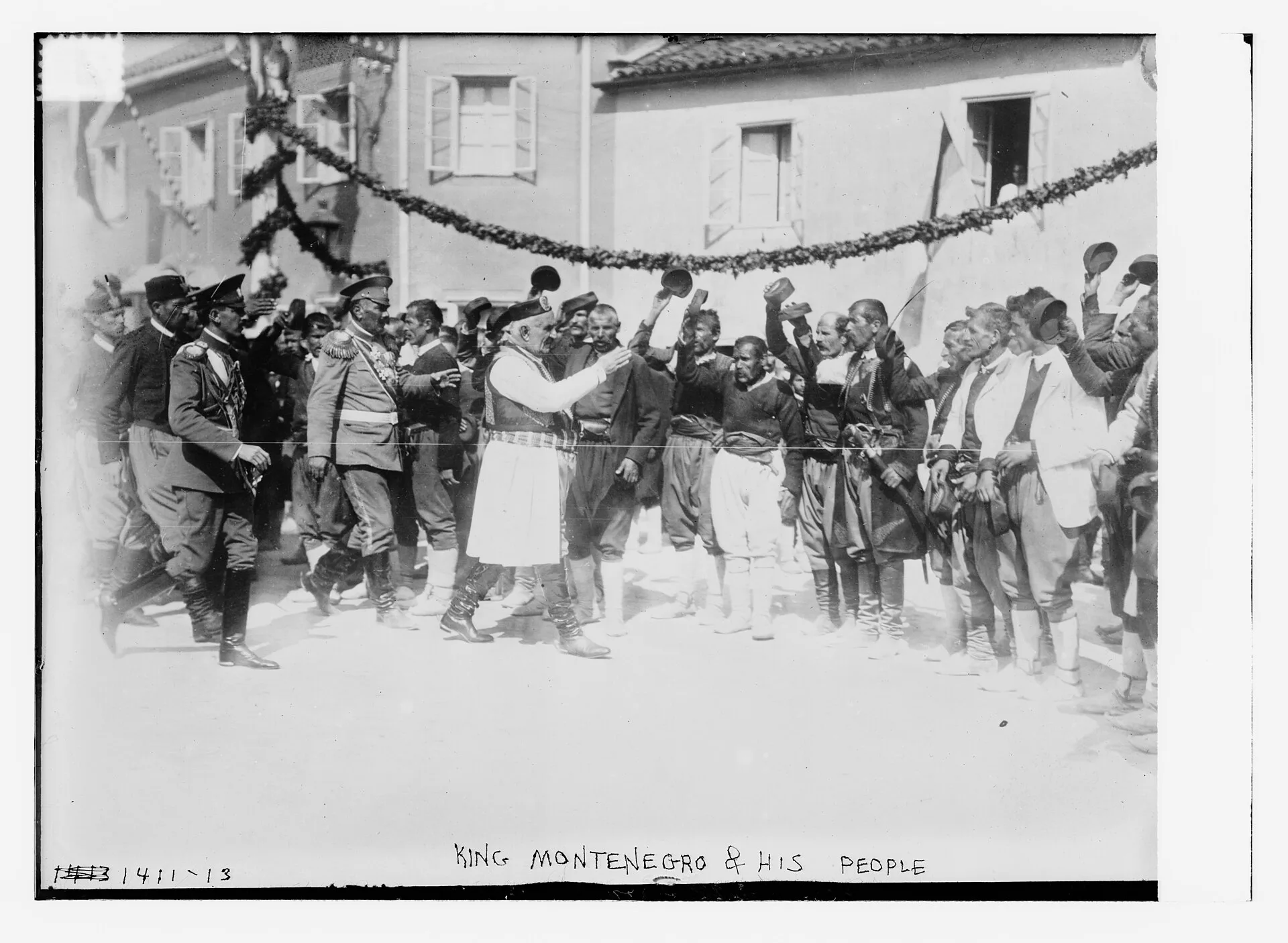
Travellers who came to Cetinje in the 1870s and 1880s all described the same scene. In front of a plain two-storey house that passed for a palace stood an old elm, and under it, on most days, sat a large, handsome man in the national costume, the gold-embroidered jacket, blue breeches and red cap, hearing whoever wished to speak to him. A widow with a boundary dispute, a clan chief with a grievance and a foreign consul with a note from his government might wait in the same queue. This was the Prince of Montenegro, and it was how he governed.
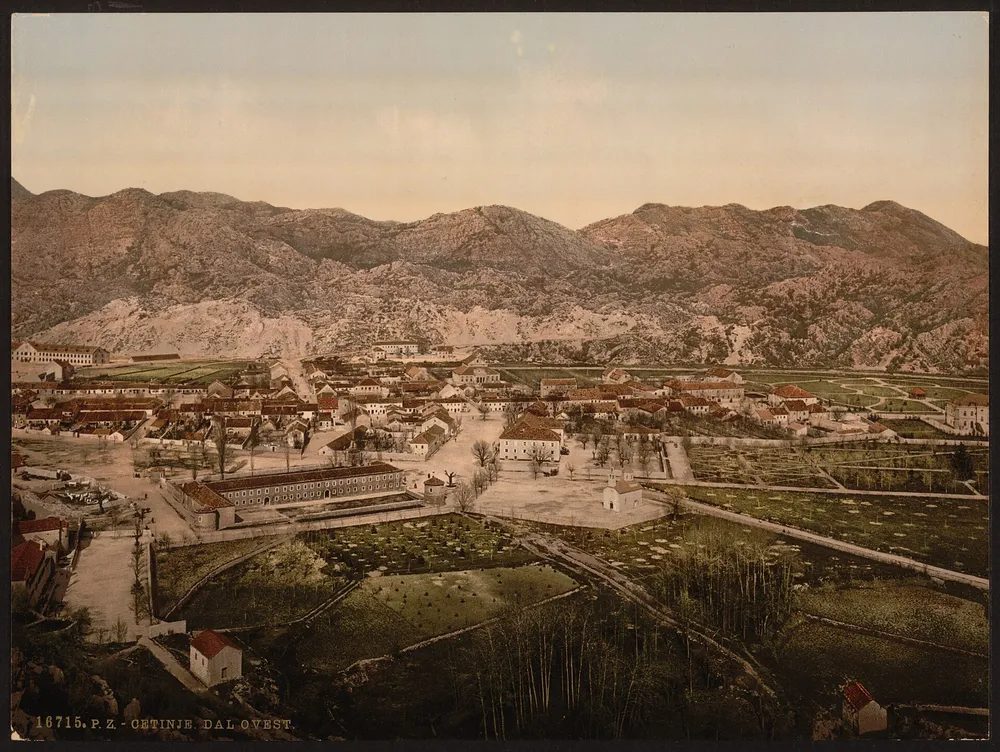
Nikola Petrović-Njegoš ruled for fifty-eight years. When he came to the throne Montenegro was an unrecognised highland principality with a contested frontier and a capital of a few dozen houses. When he lost it, it was a kingdom twice enlarged, with a constitution, a parliament, a currency, a seaport and a daughter on the throne of Italy. He was by turns a guerrilla commander, a shrewd diplomat who played Russia, Austria and Italy against one another, a poet of real popular gifts and an old man who would not share power and misjudged the last crisis of his reign. In Cetinje, which he effectively built, opinion of him is warmer than anywhere else. This guide tries to give the whole of him.
Njeguši, Trieste, Paris
He was born in Njeguši on 7 October 1841 (25 September old style), the son of Mirko Petrović, the elder brother of the future Prince Danilo and the most feared soldier in the country. Since Danilo had no son, the boy was treated from early on as the likely heir and was given something no Montenegrin ruler before him had had: a European schooling. He was sent first to Trieste, where he lived in the household of the Kvekić family, the relations of Danilo's wife Darinka, and then to the Lycée Louis-le-Grand in Paris.
He was still in Paris, aged eighteen, when Danilo was shot in Kotor in August 1860. Nikola was proclaimed prince and came home. On 8 November 1860, in Cetinje, he married Milena Vukotić, to whom he had been betrothed as a child; she was thirteen. The marriage lasted sixty years and produced twelve children, whose marriages are a story in themselves, told in the guide to the Petrović-Njegoš dynasty.
He came back speaking French, Italian and German, with a taste for Western literature and a clear sense of how backward his country was. He never became a Westerner. To the end of his life he dressed as a Montenegrin chieftain, wrote in the idiom of the folk epics and thought of politics in terms of personal loyalty.
The wars that made Montenegro, 1862–1878
His reign began badly. In 1862 he was drawn into a war in support of rebels in Herzegovina, and an Ottoman army under Omer Pasha fought its way up the valleys towards Cetinje. His father Mirko commanded a stubborn defence, and the war ended with the Convention of Scutari, whose terms, including a ban on Mirko's presence in the country that was never enforced, were a humiliation.
He spent the next fourteen years preparing a different result. Russian subsidies and Serbian officers turned the clan levies into something like an army with modern rifles. He visited St Petersburg, Vienna and Paris and made himself known. When the Christians of Herzegovina rose again in 1875 he was ready, and in July 1876 Montenegro and Serbia declared war on the Ottoman Empire together.
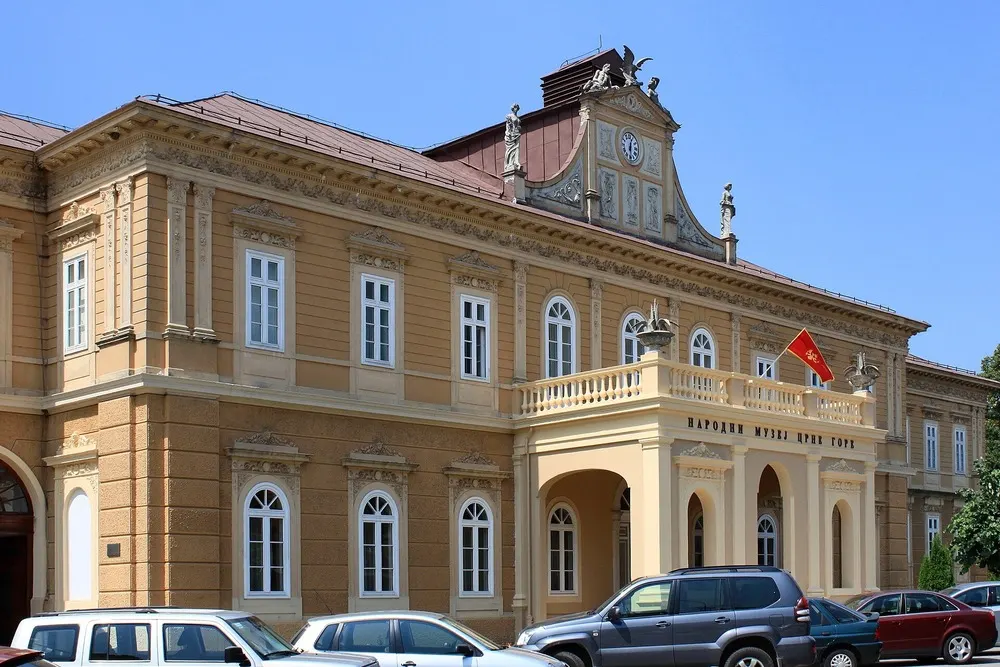
Serbia's campaign failed. Montenegro's did not. On 28 July 1876 at Vučji Do, on the Herzegovinian border, Nikola's army destroyed an Ottoman column and captured one of its pashas; a fortnight later his cousin Božo Petrović and the voivode Marko Miljanov beat a second army at Fundina, near Podgorica. When Russia entered the war in 1877 the Montenegrins went over to the offensive, taking Nikšić in September of that year and the coastal towns of Bar and Ulcinj in January 1878. The banners and weapons taken in these battles hang in King Nikola's Palace, and the fence of the Vlach Church is made from captured rifle barrels.
The Congress of Berlin trimmed the gains Russia had promised but confirmed the essentials. On 13 July 1878 the great powers recognised Montenegro as an independent state. Its territory more than doubled, to include Nikšić, Kolašin, Podgorica, Žabljak on the lake and the port of Bar; Ulcinj was added in 1880 in exchange for districts in the north-east. There were strings attached: Montenegro might keep no warships, and Austria-Hungary policed its short coast. But the highland principality now had fertile land, towns and a harbour. The old port and its ruined citadel are covered in the guide to Bar and Stari Bar on ExploreMontenegro.
The victories made him famous. Gladstone praised the Montenegrins in print, Tennyson wrote a sonnet on them, and Tsar Alexander III, at a dinner in 1889, toasted the Prince of Montenegro as Russia's only sincere and faithful friend, a phrase Nikola took care that Europe should hear.
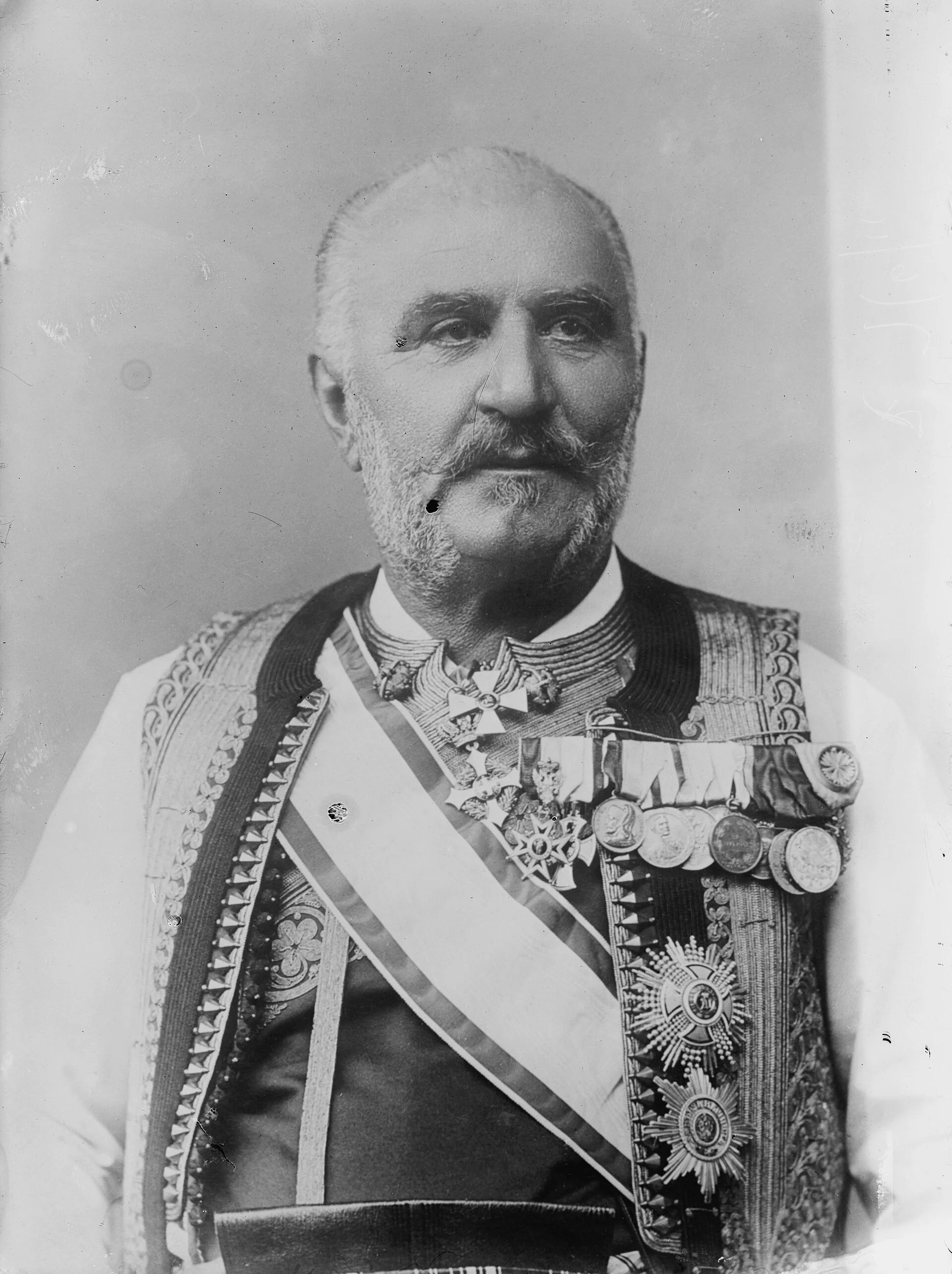
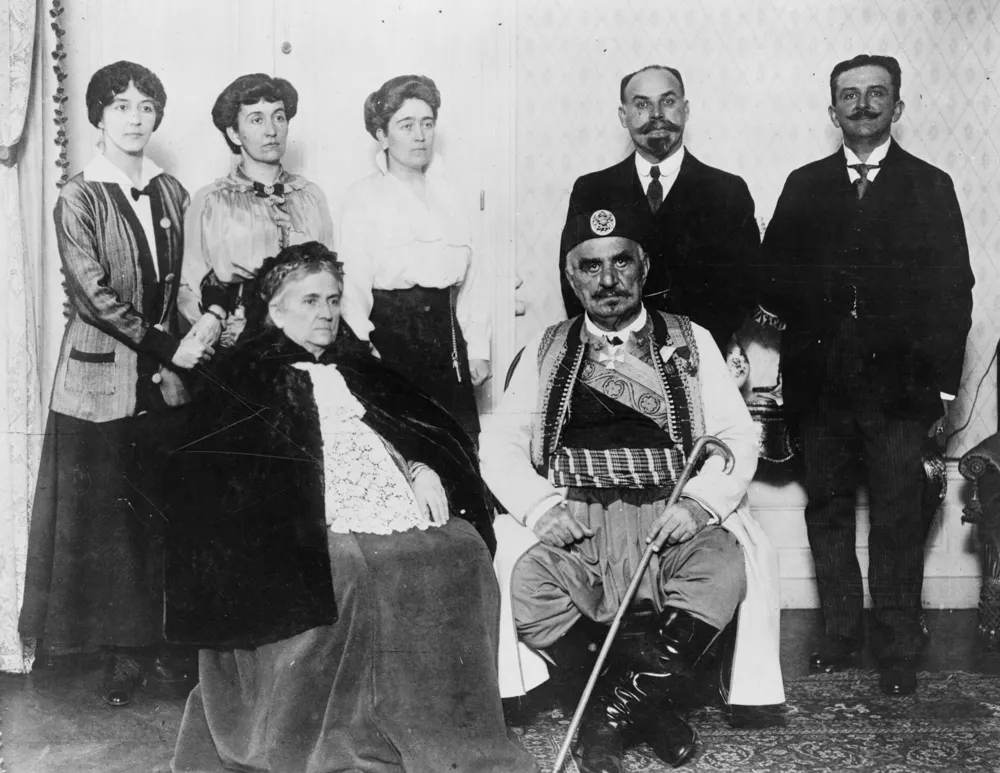
King Nikola photographed in 1911, the year after the proclamation of the kingdom, wearing Montenegrin dress with his decorations. Photograph distributed by the Bain News Service.
Building a state, and a capital
Peace gave him forty years to govern, and he used the first twenty energetically. In 1879 he replaced Njegoš's Senate with a Council of State, a set of ministries and a High Court. He commissioned from the jurist Valtazar Bogišić a General Property Code, promulgated in 1888 and admired by lawyers across Europe for the way it wrote customary law in plain language. A grammar school opened in Cetinje in 1880. A carriage road was built down to Kotor and another to Rijeka Crnojevića and Podgorica; a narrow-gauge railway linked Bar with Virpazar on Lake Skadar in 1908; a telegraph, a postal service with its own stamps and, in 1904, a Marconi wireless station near Bar connected the country with the world.
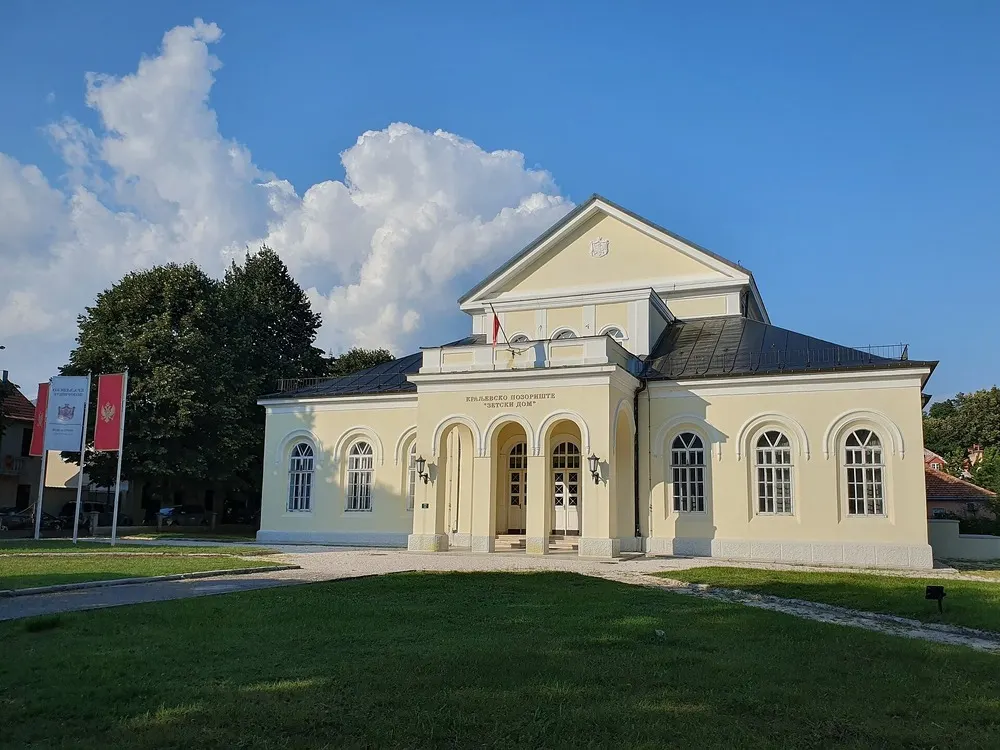
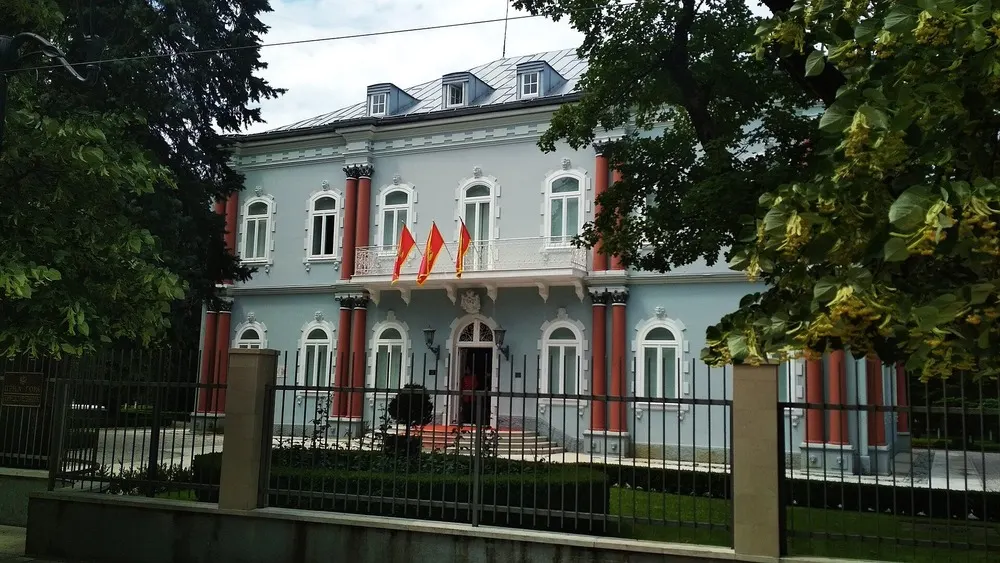
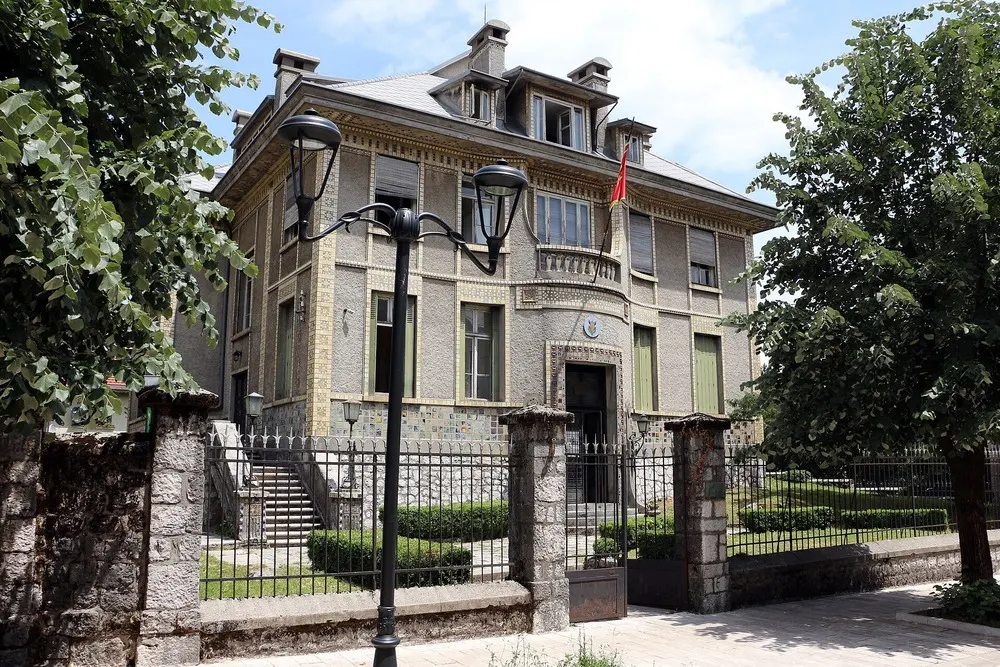
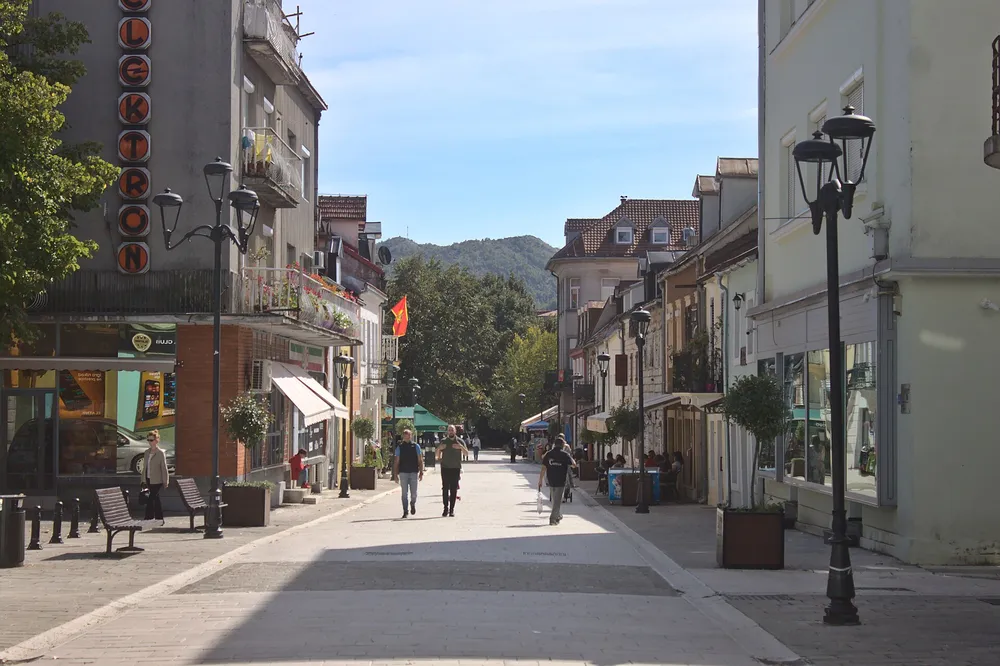
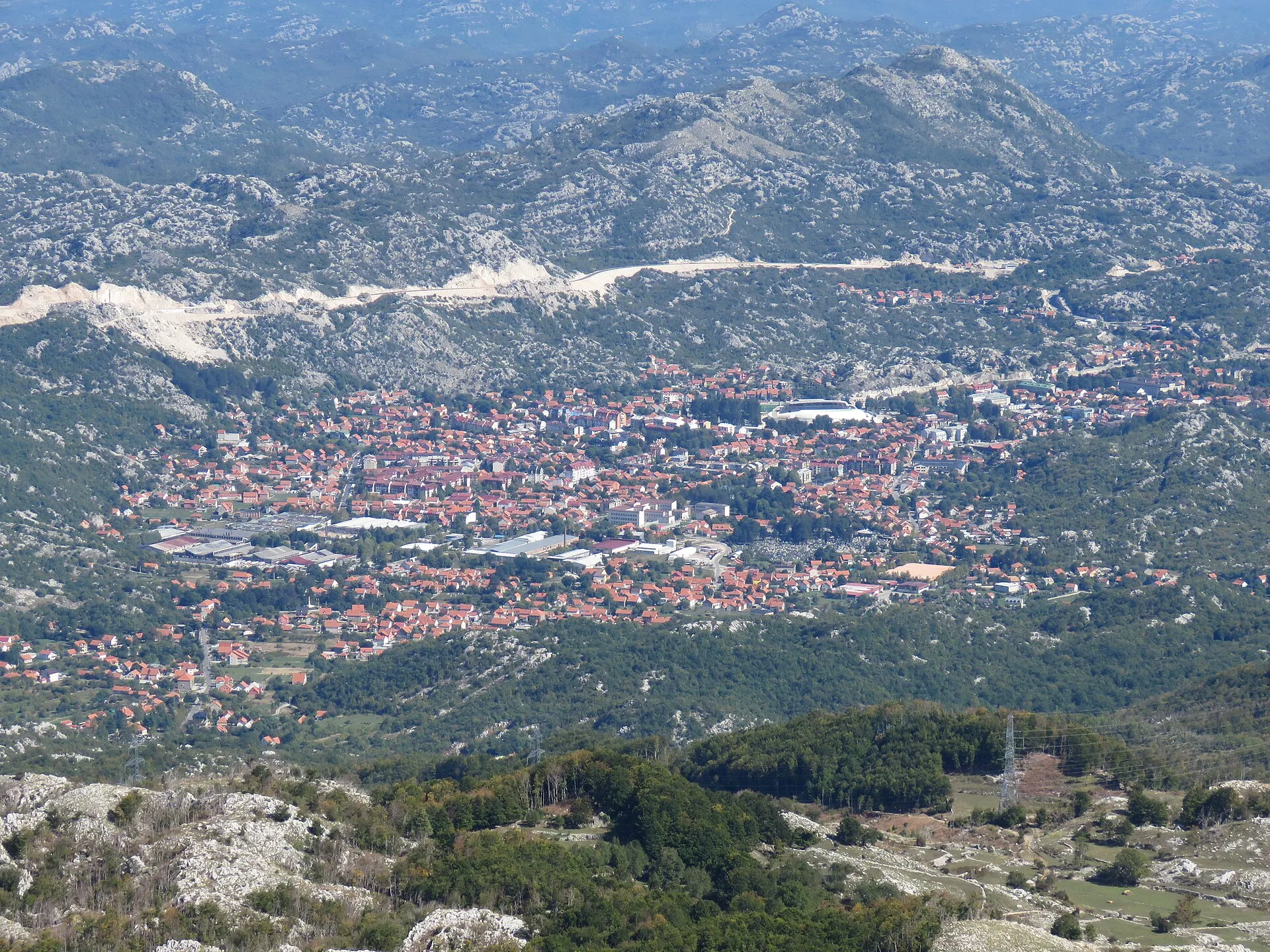
Cetinje was the showcase. Almost every historic building in the town dates from his reign: the palace (1867), the Girls' Institute and the seminary (both founded in 1869), the hospital (1873), the theatre called Zetski dom (begun 1884), the Blue Palace for his heir (1890s), the Court Church on Ćipur, which he had rebuilt on the foundations of the Crnojević monastery, the foreign legations that followed recognition, and finally the Government House of 1910. He had the streets laid out and the lime trees planted. The result, a capital on the scale of a market town, is what visitors come to see today, and the architecture guide goes through it building by building.
His method remained personal. Ministers were his servants, the budget was not clearly separate from his own purse, and the Russian subsidy that paid for the army and the schools passed through his hands. For a generation this suited a country of clans that trusted a gospodar more than an office. By 1900 it suited it less.
Constitution and crown, 1905–1910
The pressure came from the young men he had sent abroad to study, most of them to Belgrade, who came home with ideas about parliaments and about the unity of the Serbian people. After the Russian revolution of 1905 shook his patron, Nikola decided to move first. On 19 December 1905, St Nicholas's Day by the old calendar, he granted a constitution. It created an elected National Assembly, but ministers answered to the prince, who kept a veto and the command of the army.
The first elections in 1906 produced something he had not expected: an organised opposition, the People's Party, known as the klubaši, which wanted real parliamentary government and closer union with Serbia. He dissolved the assembly. In 1907 a consignment of bombs was discovered, allegedly meant for the prince, and in 1909 an attempted rising at Kolašin; the trials that followed sent opposition leaders to prison and several men to the firing squad, and poisoned relations with Belgrade, which Cetinje accused of complicity. Historians still disagree about how much of a plot there really was.
The jubilee of 1910 was meant to draw a line under all this. On 28 August (15 August old style), fifty years after his accession, the Assembly proclaimed Montenegro a kingdom. The King of Italy and his queen, Nikola's daughter Jelena, the Crown Prince of Serbia, who was his grandson, and Russian grand dukes, his sons-in-law, came up the mountain road to the new Government House. The tsar made him a field marshal. It was the high point of Cetinje's history as a capital, and the town was lit by electricity for the occasion.
The poet-prince
Nikola wrote all his life, and unlike most royal authors he was read. His verse is direct, patriotic and close to the folk tradition, a long way from the philosophical density of his great-uncle Njegoš, and that was its strength.
His best-known piece is the song Onamo, 'namo! (There, over there!), written in 1867: a call to liberate the old Serbian lands of Kosovo and Prizren. It was sung as an unofficial anthem in Montenegro and Serbia alike, and it is usually said to have been thought too provocative towards the Ottoman Empire to be adopted as the official one.
His most ambitious work is the verse drama Balkanska carica (The Balkan Empress), written in 1884 and published two years later. Set in the fifteenth-century Zeta of Ivan Crnojević, it turns on the choice of Danica, a nobleman's daughter, between love for the ruler's son Stanko, who goes over to the Turks, and loyalty to her country. It was the first play performed in the Zetski dom, in 1888, by amateurs from the town's reading society, and it is still revived there. He also wrote the dramas Knjaz Arvanit and Husein-beg Gradaščević, the long poem Pjesnik i vila (The Poet and the Fairy) and several volumes of lyric and epic verse, as well as memoirs.
The state he created did have an official anthem by another hand, Ubavoj nam Crnoj Gori (To Our Beautiful Montenegro), with words by his secretary, the priest-poet Jovan Sundečić.
The Balkan Wars and Shkodër
He was seventy-one when he went to war for the last time. Under the alliance of 1912 Montenegro opened hostilities against the Ottoman Empire on 8 October, days ahead of Serbia, Bulgaria and Greece, with a ceremonial first shot. His troops overran the districts to the east, meeting the Serbian army in the Sandžak and Metohija, but the main effort, and his personal obsession, was the city of Shkodër (Scutari), the old seat of the pashas who had burned Cetinje three times.
The siege lasted six months and was conducted with great courage and little skill; frontal assaults on fortified heights cost the small Montenegrin army losses it could not afford. The city capitulated on 23 April 1913. The great powers had already decided that it should belong to the new state of Albania, and a naval blockade and an Austrian ultimatum forced Nikola to evacuate it within three weeks. The peace settlement still gave Montenegro Peć, Đakovica, Bijelo Polje, Berane and Pljevlja, its last and largest enlargement, and for the first time a common frontier with Serbia. It also sharpened the question that would undo him: if the two Serbian kingdoms now touched, why should there be two?
1914–1916: war and flight
When Austria-Hungary attacked Serbia in the summer of 1914, Nikola declared war on the Habsburg monarchy within days. His army, under a largely Serbian staff, held the western frontier for seventeen months and at one point pushed towards Sarajevo. The collapse came with Serbia's. In the last weeks of 1915 the Montenegrins covered the Serbian army's retreat to the Adriatic; on 6–7 January 1916 they won at Mojkovac; on 11 January Lovćen, shelled from the Bay of Kotor, fell, and on 13 January the Austrians entered Cetinje.
What Nikola did in those days has been argued over ever since. He asked the Austrians for terms, found them unacceptable and left the country, travelling by way of Shkodër and the Albanian coast to Italy and then France. The army, which he ordered to follow the Serbs into exile, was instead disbanded by the ministers who stayed behind, and capitulated on 25 January. His opponents, then and later, accused him of having sought a separate peace to save his throne and of abandoning his soldiers; his defenders reply that he refused to sign a surrender and that the army was already cut off. The episode cost him much of his standing with the Allies and gave the advocates of union with Serbia their strongest argument.
He spent the rest of the war at Neuilly-sur-Seine, outside Paris, with a government-in-exile that the Allies subsidised and increasingly ignored.
1918–1921: deposed, and dying abroad
When the war ended he was not permitted to return. On 26 November 1918 the Podgorica Assembly declared him and his dynasty deposed and united Montenegro with Serbia; the circumstances, and the uprising of his supporters that followed at Christmas, are set out in the history of Cetinje. He never recognised the decision. He protested to the Peace Conference, where no Montenegrin delegate was seated, issued proclamations to a country he could not reach, and refused to abdicate.
He died at Cap d'Antibes on the French Riviera on 1 March 1921, aged seventy-nine, and was buried in the Russian Orthodox church at Sanremo, just across the Italian border. Queen Milena died two years later and was buried beside him. For almost seventy years, under two Yugoslavias, their graves stayed there.
Coming home: the reburial of 1989
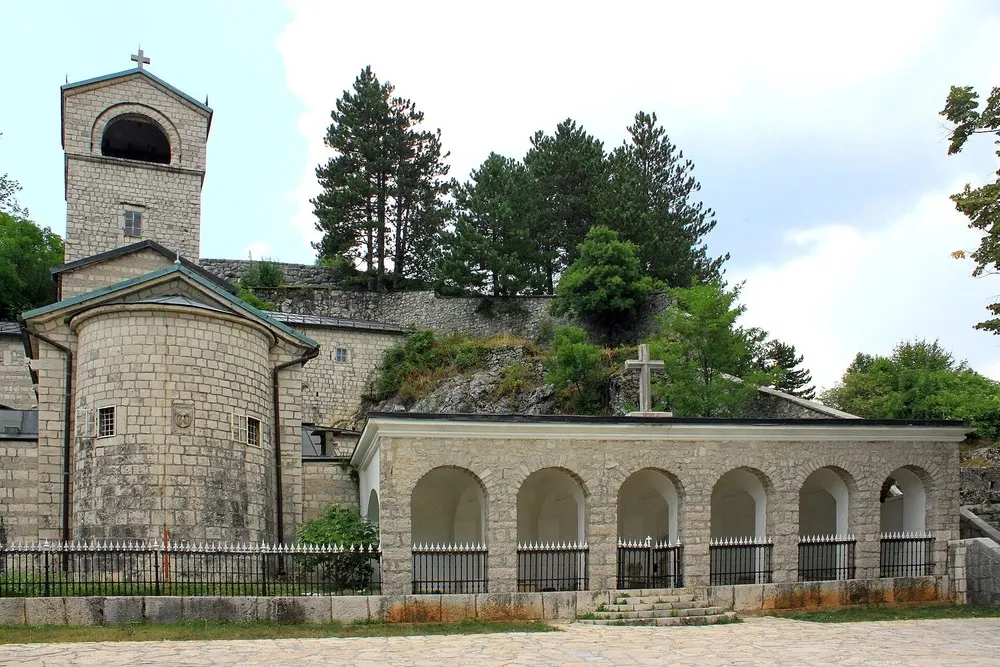
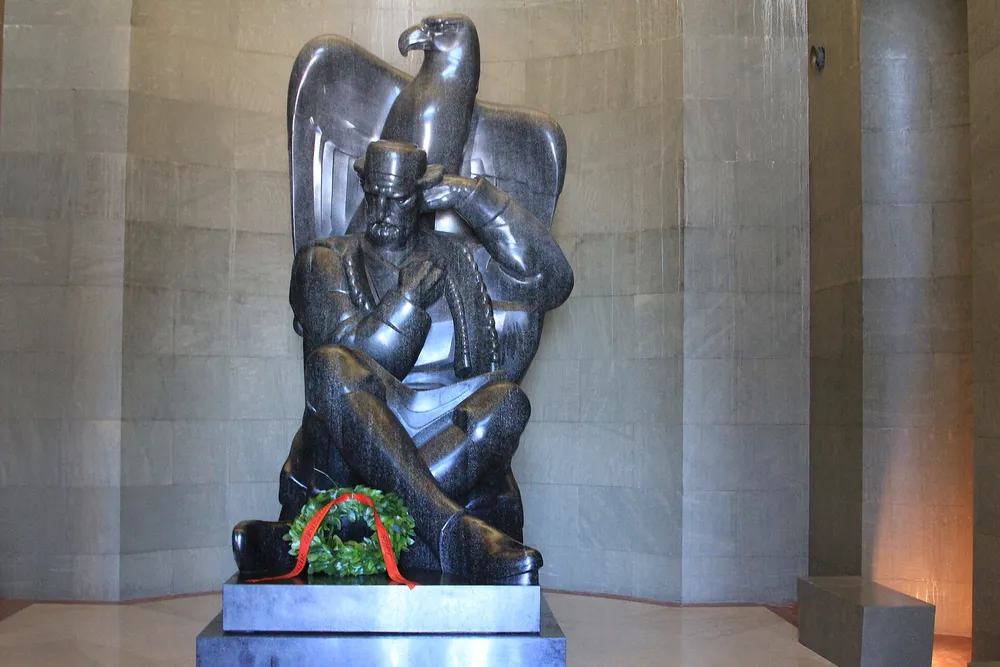
On 1 October 1989 the remains of King Nikola, Queen Milena and their daughters Ksenija and Vjera were brought back and buried in the Court Church on Ćipur, the small church he himself had built on the site of Ivan Crnojević's monastery. The state funeral, held while Yugoslavia still existed, drew one of the largest crowds Cetinje has ever seen and is remembered as the moment when the old capital began to recover its voice.
The church stands in the park a few minutes from the palace. The two tombs of white marble lie on either side of the nave, and the foundations of the fifteenth-century monastery are marked out in the grass around the building. Entry is free when the church is open; the Cetinje Monastery guide has the details.
How he is remembered
Judgements of Nikola follow the fault line of Montenegrin politics. To those who cherish Montenegro's separate statehood he is the last sovereign, the ruler who won recognition in 1878 and was robbed of his kingdom in 1918. In the Serbian national tradition he is honoured as a poet and soldier of the common cause, the author of Onamo, 'namo!, whose old age was spoiled by dynastic vanity. Both pictures have truth in them. He undoubtedly thought of himself as a Serb ruler and dreamed for decades of leading the unification of the Serbian lands himself; he equally undoubtedly would not accept unification at the price of his crown and his country's name.
His failings were those of a man who ruled too long: suspicion of talent, a habit of treating the state as a household, and the political trials of 1907–09. His achievement is the country itself, as it stood in 1914, and the small capital that survives almost exactly as he left it.
The life in dates
- 1841
Born in Njeguši
7 October (25 September old style), son of Mirko Petrović and Stana Martinović.
- 1860
Prince of Montenegro
Succeeds his uncle Danilo, assassinated in Kotor in August; marries Milena Vukotić on 8 November.
- 1862
War with the Ottoman Empire
Omer Pasha's invasion ends with the Convention of Scutari.
- 1867
The palace and the song
The new residence in Cetinje is completed; he writes ‘Onamo, 'namo!’.
- 1876
Vučji Do
Victory over an Ottoman army on 28 July in the first weeks of the war.
- 1878
Congress of Berlin
Independence recognised on 13 July; territory more than doubled.
- 1884–1888
Balkanska carica
He writes the drama in 1884; it opens the Zetski dom in 1888, the year the General Property Code is promulgated.
- 1896
Bicentenary of the dynasty
His daughter Jelena marries the heir to the Italian throne.
- 1905
Constitution
Granted on 19 December (6 December old style).
- 1910
King
Proclaimed on 28 August at the fiftieth jubilee of his reign.
- 1912–1913
Balkan Wars
Montenegro declares war first; Shkodër is taken in April 1913 and surrendered in May.
- 1916
Exile
Leaves Montenegro after the fall of Lovćen and Cetinje in January.
- 1918
Deposed
The Podgorica Assembly votes to dethrone him on 26 November.
- 1921
Death
Dies at Cap d'Antibes on 1 March; buried at Sanremo.
- 1989
Reburial
Laid to rest in the Court Church at Cetinje on 1 October.
In his footsteps in Cetinje
The place to start is his house. King Nikola's Palace has been a museum since 1926, and its rooms, the study, the reception salon, the bedrooms, the library and the armoury, are furnished largely with the family's own belongings. The National Museum's price list gives the adult ticket as 8 euro, or 20 euro for a combined ticket to all its units, with the museum open daily from mid-April to 15 November and 9:00–15:00 on weekdays in winter (local time; as checked November 2026). Its summer hours differ between the museum's own pages: 9:00–18:00 from 15 April on the museum's Montenegrin page, 9:00–17:00 in the Montenegrin timetable and 9:00–16:00 from 11 April on the English pages, so plan on the shorter.
From the palace it is two minutes to the Court Church and his tomb, five to the Zetski dom, where his plays were staged, and ten to Government House, built for his parliament. The Blue Palace, his son's residence, is now the President's and can be seen from the park. A guided walking tour with museum entry is the easiest way to make sense of the portraits and trophies (the listing says which museum is included); a private city tour lets you set the pace.
To see where he was born, and the mountain that fell in January 1916, continue to Njeguši and Lovćen.
Frequently asked questions
How long did King Nikola reign?
Fifty-eight years: he became Prince of Montenegro in August 1860 and was declared deposed in November 1918. He bore the title of king only from 28 August 1910. He left the country in January 1916 and never returned.
Why did he become a king only in 1910?
Montenegro had been a principality since 1852. The elevation to a kingdom was timed for the fiftieth anniversary of his accession and reflected both his own prestige and a rivalry with the Karađorđević dynasty of Serbia, which had been a kingdom since 1882.
What did he write?
The patriotic song ‘Onamo, 'namo!’ (1867), the verse drama Balkanska carica (The Balkan Empress, written 1884), other plays and several volumes of poetry. Balkanska carica was the first play staged in Cetinje's Zetski dom theatre, in 1888.
Where did King Nikola die and where is he buried?
He died at Cap d'Antibes, France, on 1 March 1921 and was buried in the Russian church at Sanremo, Italy. Since 1 October 1989 he and Queen Milena have lain in the Court Church on Ćipur in Cetinje.
Did he abdicate?
No. He rejected the decision of the Podgorica Assembly to depose him and maintained his claim until his death. His son Danilo, who succeeded as titular king, renounced the claim after a week in favour of his nephew Michael.
Can you visit his palace?
Yes. It is the King Nikola Museum, a unit of the National Museum of Montenegro on Dvorski trg in Cetinje, open year-round with shorter hours and weekend closure in winter. Allow about an hour.
Was Nikola a Serb or a Montenegrin?
He described himself and his people as Serbs and worked for the unification of the Serbian lands, and he was at the same time the sovereign of a separate Montenegrin state that he refused to give up. Modern Montenegrin and Serbian national traditions both claim him, with different emphases.
Sources and official information
Facts were checked against these official and scholarly sources in November 2026. Opening hours, ticket prices, park fees and timetables change, so confirm before you go.
- narodnimuzej.me
- en.wikipedia.org
- en.wikipedia.org
- en.wikipedia.org
- en.wikipedia.org
- en.wikipedia.org
- encyclopedia.1914-1918-online.net
- cetinje.me
Cetinje.com is an independent guide, not the official site of the Old Royal Capital Cetinje, the National Museum of Montenegro, any tour operator, hotel or the government of Montenegro. Some links are affiliate links: tours go to GetYourGuide and accommodation goes to Booking.com, and we may earn a commission at no extra cost to you.