In short
- Montenegrin (crnogorski) has been the official language of Montenegro since the 2007 constitution; Serbian, Bosnian, Albanian and Croatian are also in official use.
- It is one of the standard varieties of the language once called Serbo-Croatian, and is fully mutually intelligible with Serbian, Croatian and Bosnian.
- It is written in both the Latin and the Cyrillic alphabet, which are equal in law; the 2009 standard added two letters, ś and ź.
- In the 2023 census 43.2% of people in Montenegro named Serbian as their mother tongue and 34.5% Montenegrin; in Cetinje the great majority named Montenegrin.
- Whether Montenegrins are a nation distinct from Serbs, and which Orthodox church is the rightful one, are live and sensitive questions. Visitors are not expected to take a side.
What you will hear and read
A visitor who knows any Serbian, Croatian or Bosnian will understand everything said in Cetinje at once, and will be understood. A visitor who knows none will find that younger people, and almost everyone who works with tourists, speak English, that older people often have some Russian, Italian or German, and that a greeting and a thank-you in the local language are received with real warmth.
The language is called Montenegrin, crnogorski, in the constitution, in schools and by most people in this town. It is one of four national standards, with Serbian, Croatian and Bosnian, that grew out of the same spoken base, the Shtokavian dialect, and that linguists generally describe as varieties of one polycentric language, in the way that British, American and Australian English are varieties of one language. The differences between the standards are small: some vocabulary, a few points of spelling, and above all the name. The name is where the feeling lies.
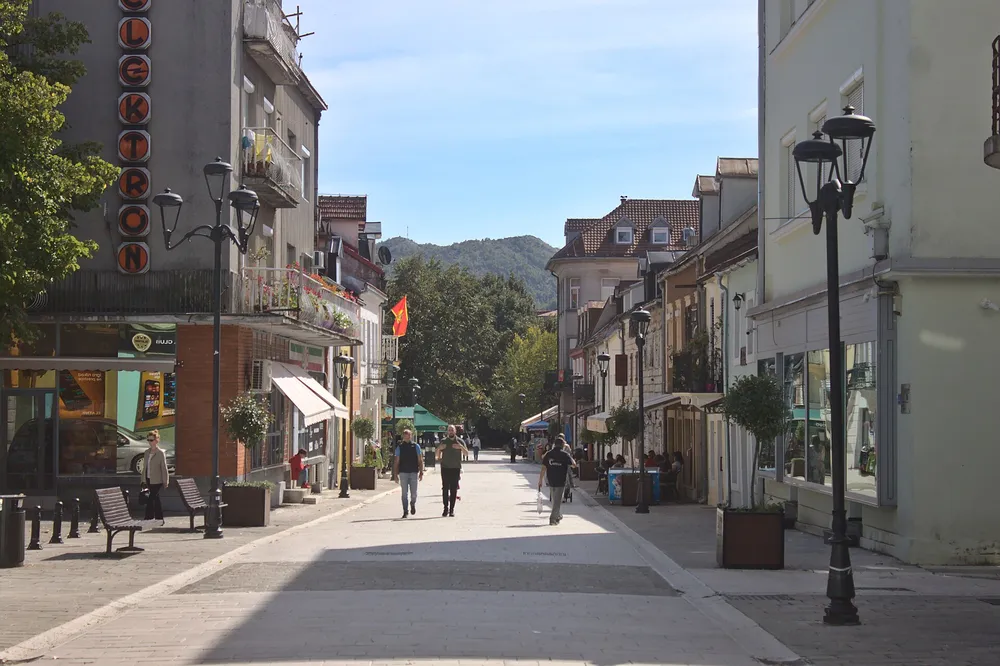
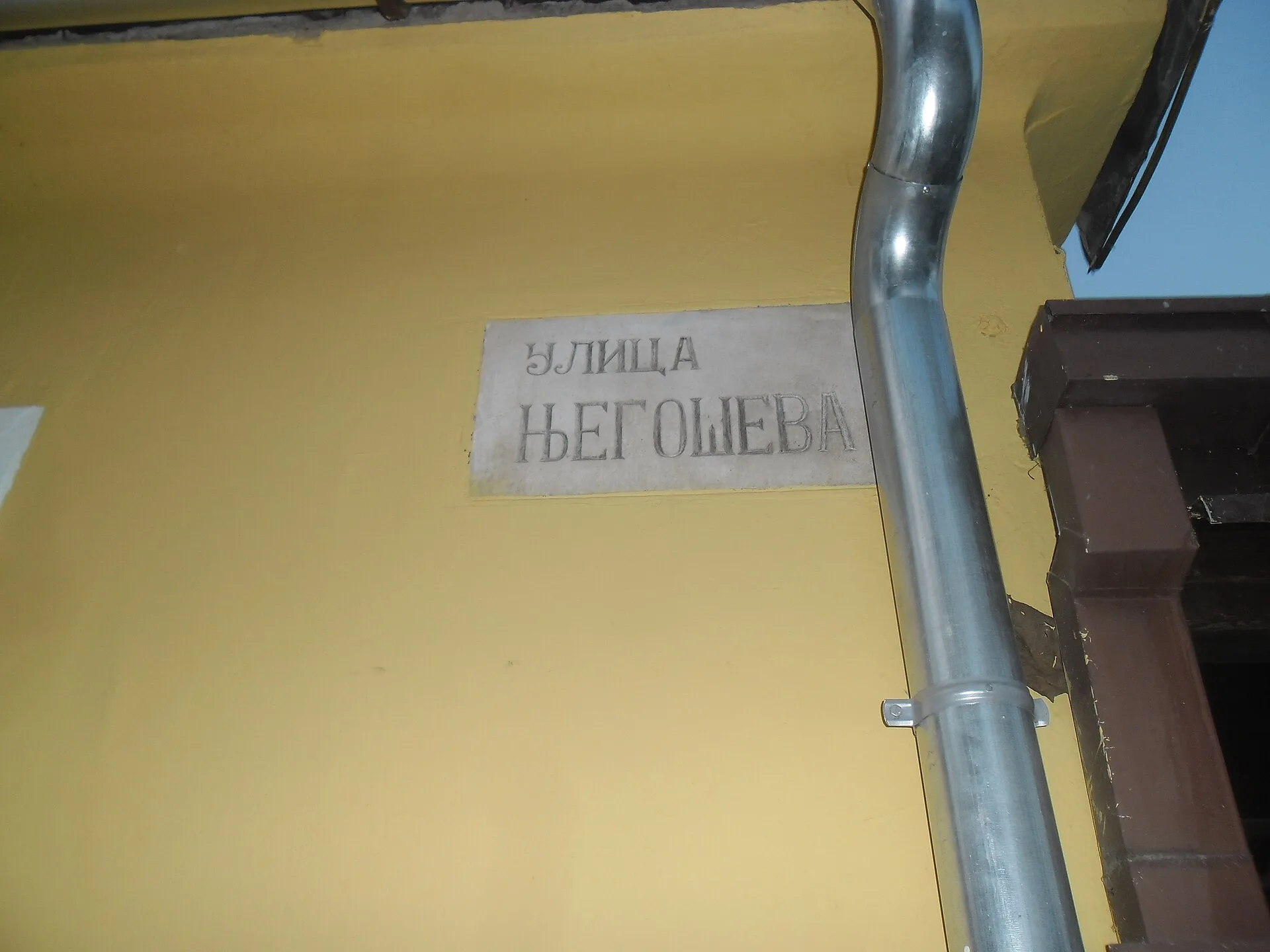
In writing you will meet two alphabets. Street signs in the old town are often in Cyrillic, like the plaque for Njegoševa Street shown at the top of this page; shop fronts, menus, timetables and most printed matter are in Latin. Both are correct and every literate Montenegrin reads both without thinking about it.
The official position
The constitution of 2007, the first after independence, made Montenegrin the official language. The earlier constitution of 1992 had named the language Serbian of the ijekavian pronunciation, and before that it was officially Serbo-Croatian. The 2007 text was a compromise reached after long negotiation, and it shows: it names one official language, declares the two alphabets equal and adds four further languages in official use.
Standardisation followed. A government-appointed council produced an orthography in 2009 and a grammar in 2010. An international language code, cnr, was assigned by the ISO 639 registration authority in December 2017, after a first application in 2008. Teaching and research on the standard are centred in Cetinje, at the Faculty for Montenegrin Language and Literature. In schools the subject is taught under the compromise title ‘Montenegrin–Serbian, Bosnian, Croatian language and literature’.
What makes Montenegrin Montenegrin
Ijekavian. Where the Serbian of Belgrade says mleko (milk), lepo (beautiful) and reka (river), Montenegrin, like Croatian and Bosnian, says mlijeko, lijepo and rijeka. The town's own name for itself shows it: prijestonica, where a Belgrade speaker would say prestonica. The river port below Cetinje is Rijeka Crnojevića, the Crnojević River.
Ś and ź. In the speech of Old Montenegro the sequences sj and zj are pronounced as single soft consonants, something like a soft English ‘sh’ and the ‘s’ in ‘measure’. The 2009 orthography gave them letters of their own: ś and ź in the Latin alphabet, с́ and з́ in Cyrillic, bringing each alphabet to thirty-two letters. So sjutra (tomorrow) may be written śutra, sjekira (axe) śekira, and izjesti (to eat up) iźesti. The older spellings remain correct, the new letters are optional, and in practice you will see them rarely: on a few official documents, in some books and in the name of the letters themselves, which became a symbol of the whole debate. Supporters see them as recording how people here actually speak; critics see an attempt to manufacture a difference.
Vocabulary and tone. Everyday speech has its own colour: đe for ‘where’ (standard gdje), nijesam for ‘I am not’ (nisam), a store of Italian and Turkish loanwords, and a taste for understatement and proverb that owes a good deal to Njegoš, who is quoted in ordinary conversation the way English speakers quote Shakespeare without noticing.
Two alphabets
Both scripts have thirty letters in their basic form, and they correspond one to one: every Cyrillic letter has a single Latin equivalent, so a text can be converted mechanically in either direction. The Cyrillic alphabet is the one reformed by Vuk Karadžić in the early nineteenth century on the principle of one letter for one sound; it was adopted in Montenegrin schools from the 1860s. The Latin alphabet is the one devised for Croatian by Ljudevit Gaj.
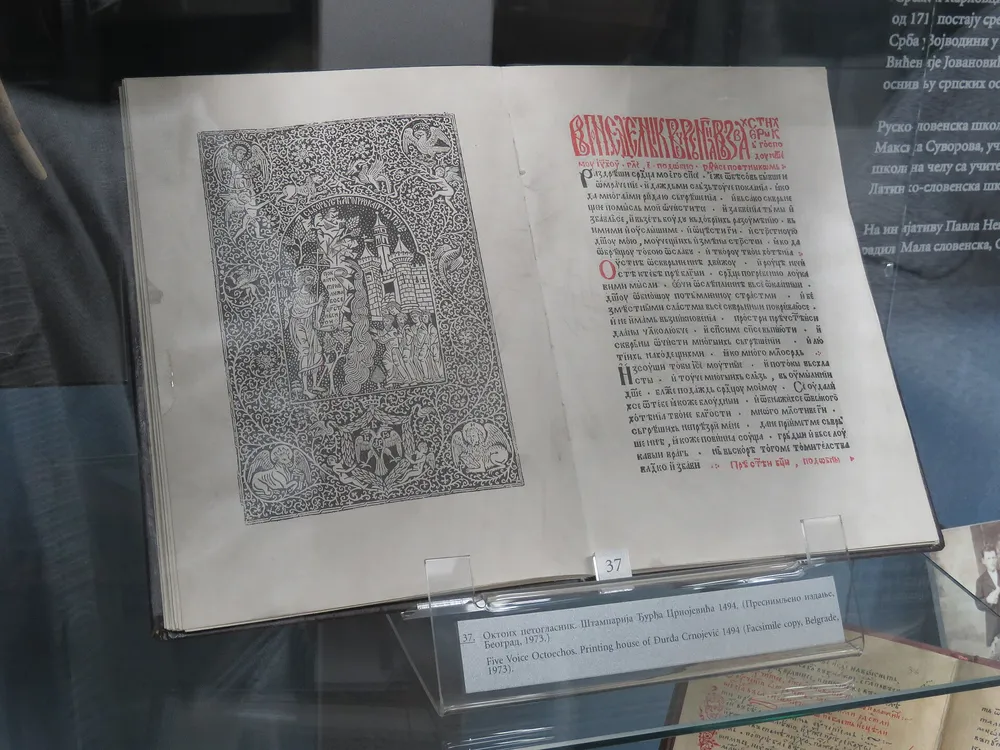
Cyrillic is the older script here. The books of the Crnojević printing house of 1494 are in Cyrillic, Njegoš wrote in it, and the kingdom's laws and newspapers were printed in it. Latin spread in the Yugoslav period and now dominates commerce, the media and the internet. The choice between them carries a faint political charge, Cyrillic being more closely associated with the Orthodox Church and with Serbian identity, but most people use both without a second thought, and the law treats them as equal.
It is worth half an hour to learn the Cyrillic letters before you come. Several look like Latin letters but are not: В is v, Н is n, Р is r, С is s, У is u, Х is h. With those in hand you can read ЦЕТИЊЕ (Cetinje), МУЗЕЈ (muzej, museum), УЛИЦА (ulica, street) and ЊЕГОШЕВА (Njegoševa).
| Latin | Cyrillic | Sounds like |
|---|---|---|
| C c | Ц ц | ts in ‘cats’ (Cetinje = TSE-ti-nye) |
| Č č | Ч ч | ch in ‘church’ |
| Ć ć | Ћ ћ | a softer ch, as in Italian ‘ciao’ (Lovćen, Ćipur) |
| Đ đ | Ђ ђ | a soft j, as in ‘jeans’ (Đurađ) |
| Dž dž | Џ џ | j in ‘jam’ |
| J j | Ј ј | y in ‘yes’ (Njegoš = NYE-gosh) |
| Lj lj | Љ љ | lli in ‘million’ |
| Nj nj | Њ њ | ny in ‘canyon’ (Njeguši) |
| Š š | Ш ш | sh in ‘ship’ |
| Ž ž | Ж ж | s in ‘measure’ (Žabljak) |
| Ś ś | С́ с́ | a soft sh; optional letter of the 2009 standard |
| Ź ź | З́ з́ | a soft zh; optional letter of the 2009 standard |
Words worth knowing in Cetinje
Two courtesies go a long way. Greet people when you enter a small shop or café, and use the formal vi with strangers and anyone older. If you are offered a coffee or a small glass of rakija in someone's home or workshop, accepting is the polite answer. Wider practical matters, money, tipping, opening days, are covered in practical information, and for the country as a whole in ExploreMontenegro's practical information page.
| English | Montenegrin | Say it |
|---|---|---|
| Hello (formal, daytime) | Dobar dan | DOH-bar dahn |
| Hi / bye (informal) | Zdravo / Ćao | ZDRAH-voh / chow |
| Good morning / good evening | Dobro jutro / Dobro veče | DOH-broh YOO-troh / VEH-cheh |
| Goodbye | Doviđenja | doh-vee-JEH-nya |
| Please / you're welcome | Molim | MOH-leem |
| Thank you | Hvala | HVAH-lah |
| Yes / no | Da / Ne | dah / neh |
| Excuse me / sorry | Izvinite | eez-VEE-nee-teh |
| Do you speak English? | Govorite li engleski? | goh-VOH-ree-teh lee EN-gles-kee |
| I don't understand | Ne razumijem | neh rah-ZOO-mee-yem |
| How much is it? | Koliko košta? | KOH-lee-koh KOSH-tah |
| One ticket, please | Jednu kartu, molim | YED-noo KAR-too MOH-leem |
| Where is the monastery? | Đe je manastir? | jeh yeh mah-NAH-steer |
| Museum / church / palace | Muzej / crkva / dvor | MOO-zey / TSRK-vah / dvor |
| Open / closed | Otvoreno / zatvoreno | OT-voh-reh-noh / ZAT-voh-reh-noh |
| Cheers! | Živjeli! | ZHEE-vyeh-lee |
The identity question, stated plainly
Sooner or later in Cetinje someone will tell you who the Montenegrins are, and the next person may tell you something different. It helps to know the outline of the disagreement, and to know that both positions are held by serious, decent people, sometimes in the same family.
The shared ground. Montenegro has been a distinct political community for centuries: a self-governing highland society under its bishops, a principality, a kingdom, a Yugoslav republic, and since 2006 an independent state. Its people are overwhelmingly South Slavs, Orthodox Christians by tradition, speaking the same language as their neighbours. No one disputes any of this.
One view is that Montenegrins are a nation of their own, formed by that long separate history, with their own state tradition, culture and language, related to the Serbs as, say, Austrians are to Germans. On this view the union with Serbia in 1918 was an annexation, and the independence vote of 2006 the recovery of something taken away. This view is strongest in Old Montenegro, and nowhere stronger than in Cetinje.
The other view is that Montenegrins are historically part of the Serbian people, a regional branch with its own state, as Bavarians or Tuscans once had theirs, and that the rulers of Montenegro themselves said so: Njegoš and King Nikola wrote of their people as Serbs and of Montenegro as the surviving fragment of the medieval Serbian realm. On this view a separate Montenegrin nationality is largely a twentieth-century construction, encouraged by the Yugoslav Communists, who recognised a Montenegrin nation in 1945. This view is strongest in the north of the country and among those who voted against independence.
What the numbers show is that people move between the categories. In the Yugoslav census of 1948 some nine in ten inhabitants of Montenegro declared themselves Montenegrin and very few Serb. In 1991 the figures were about 62 and 9 per cent. After the break-up of Yugoslavia many who had called themselves Montenegrins began to declare as Serbs: in the 2023 census 41.1 per cent of the population declared as Montenegrin and 32.9 per cent as Serb, with Bosniaks, Albanians and others making up the rest. The same census recorded 43.2 per cent naming Serbian as their mother tongue and 34.5 per cent Montenegrin, which means that a fair number of people who call themselves Montenegrin by nationality call their language Serbian. In the municipality of Cetinje about nine in ten people declared as Montenegrin and almost as many named Montenegrin as their language, among the highest shares in the country.
Historians point out that the nineteenth-century sources cannot settle the argument, because the words did not then mean what they mean now. A highlander of 1850 could be a Montenegrin by country, a Serb by faith and tradition, and a Njeguš or a Cuca by clan, and feel no contradiction. The contradiction arrived with modern national politics. What a visitor can usefully take from this is a habit of speech: say Montenegrin for the country, its citizens and the language unless your host uses another word, and let people describe themselves.
The church question
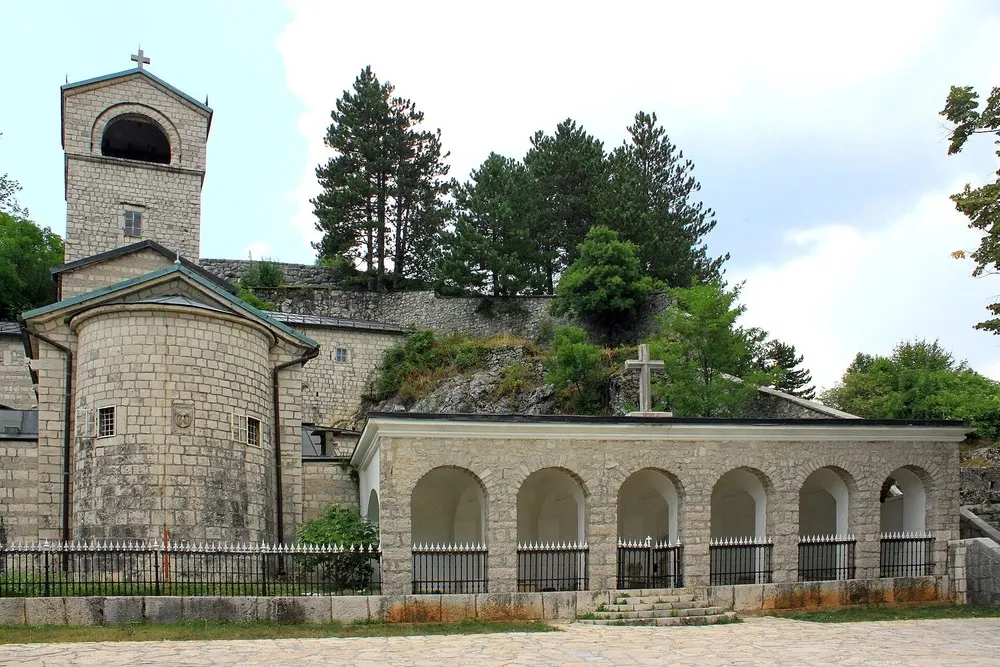
The same division runs through the Orthodox Church, and Cetinje is its centre, because the bishop's throne of Montenegro has stood here since 1484.
The Metropolitanate of Montenegro and the Littoral is a diocese of the Serbian Orthodox Church. It is the church of the great majority of Orthodox believers in the country, it is in communion with the rest of the Orthodox world, and it holds Cetinje Monastery and almost all other churches and monasteries. Its position is that the bishopric of Cetinje was founded as part of the medieval Serbian church and belonged to the Patriarchate of Peć; that after the Ottomans suppressed that patriarchate in 1766 it governed itself by necessity; and that it joined the reunited Serbian Orthodox Church in 1920 by the decision of its own bishops. Its head from 1990 until his death in October 2020 was Metropolitan Amfilohije, a dominant figure in Montenegrin public life; his successor is Metropolitan Joanikije.
The Montenegrin Orthodox Church was proclaimed in Cetinje on 31 October 1993 and was registered with the authorities in 2001. Its position is that the church of Montenegro was autocephalous, that is, fully self-governing: it points to nineteenth-century lists of Orthodox churches that name Montenegro separately and to the constitution of 1905, which described the Montenegrin church as autocephalous. It regards the merger of 1920 as an uncanonical act that followed the political annexation of 1918, and claims the succession, and the property, of the old metropolitanate. It is not recognised by any of the canonical Orthodox churches; the Ecumenical Patriarch has said that it will not be granted autocephaly. It has far fewer clergy and faithful, has its own small places of worship in and around Cetinje, and since 2023 has itself been divided over its leadership.
The state is constitutionally separate from all religious communities, and governments have leaned one way and then the other. A Law on Freedom of Religion passed in December 2019 would have transferred to the state religious buildings built before 1918 for which no proof of ownership could be shown. The Metropolitanate saw it as an attempt to take its monasteries; months of mass processions followed, the government lost the election of August 2020, and the disputed provisions were removed. An agreement regulating relations between the state and the Serbian Orthodox Church was signed in August 2022.
The dispute is at its most visible in Cetinje. On Orthodox Christmas Eve, 6 January, when oak branches (badnjaci) are burned, two crowds gather a few hundred metres apart: the Metropolitanate's in front of the monastery and the Montenegrin Orthodox Church's on the square by King Nikola's Palace, with police between them. And on 5 September 2021, when Metropolitan Joanikije was enthroned in the monastery, protesters who objected to the ceremony being held in Cetinje blocked the roads into town; the police used tear gas, and the bishop and the Serbian patriarch arrived by helicopter.
None of this affects a visit on an ordinary day. The monastery is open to everyone, of any faith or none, who is modestly dressed; the details are in the Cetinje Monastery guide. It is simply courteous not to press an opinion on a subject that people here live with every day.
Njegoš's hand: what the old texts look like
If you want to see the language before the standards and the arguments, look at a page of Njegoš's own writing. The letter reproduced here was sent in 1836 to Vuk Karadžić, the reformer of the Serbian alphabet, who had visited Montenegro and whose collection of folk songs the young bishop admired. It is in the Cyrillic of the time, which still used a few letters that Karadžić's reform later removed. The manuscripts and first editions shown in the Biljarda are the best place in Cetinje to see what written Montenegrin looked like in the 1830s and 1840s; for the poet himself, see Njegoš.
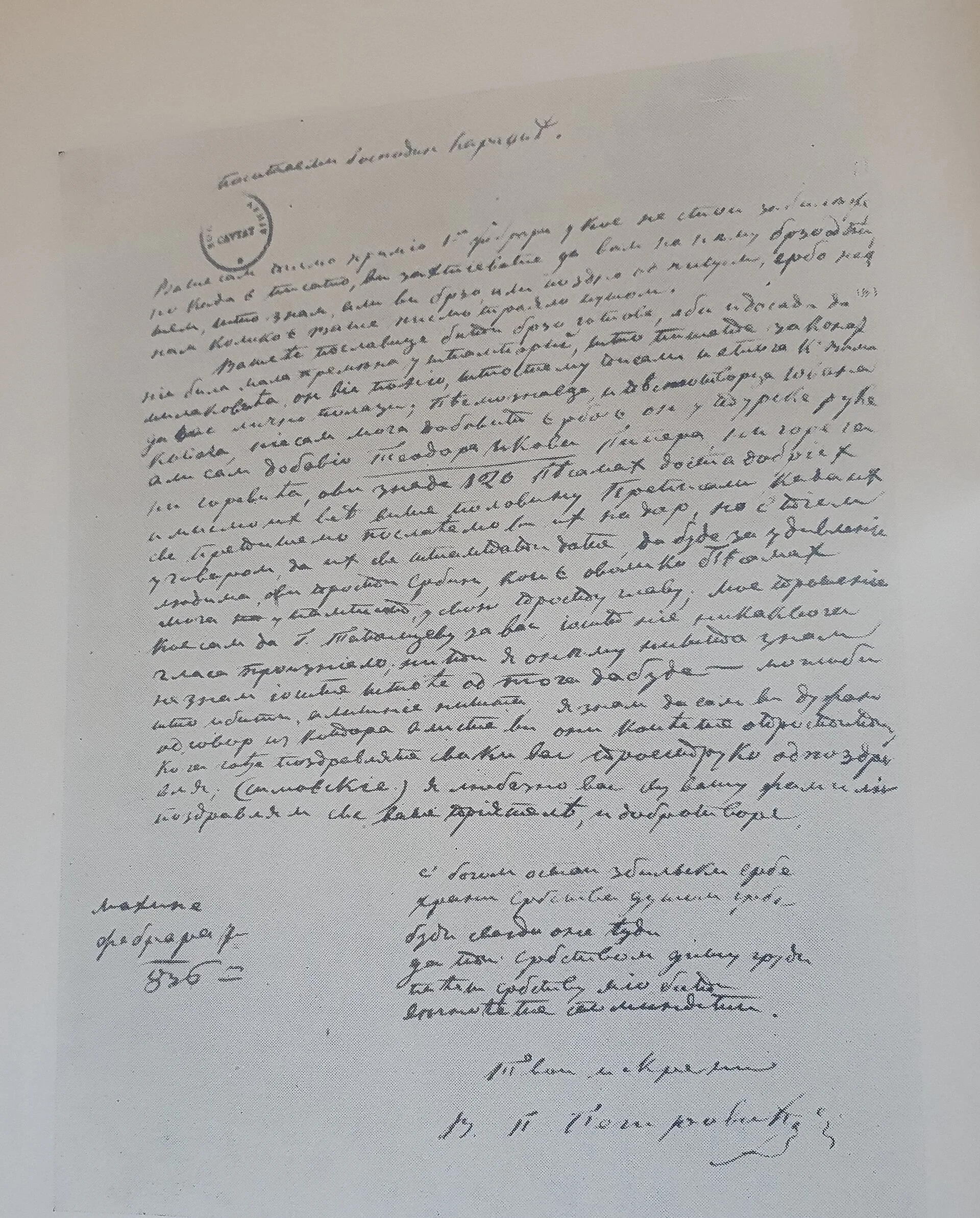
A letter from Njegoš to Vuk Karadžić, 1836, reproduced from a 1967 edition of his selected letters.
A guide helps here
More than anywhere else in Montenegro, Cetinje is a town where what you are looking at depends on who explains it. A local guide will give you the stories behind the plaques, and usually a candid personal view of the questions on this page as well. The guided walking tour with museum entry is the standard introduction.
Frequently asked questions
What language is spoken in Cetinje?
Montenegrin, the official language of Montenegro. It is mutually intelligible with Serbian, Croatian and Bosnian. English is widely understood by younger people and in museums, hotels and restaurants.
Is Montenegrin a different language from Serbian?
Linguists generally treat Montenegrin, Serbian, Croatian and Bosnian as standard varieties of one language, with small differences of vocabulary and spelling. Politically and legally they are four languages. In the 2023 census more people in Montenegro named Serbian as their mother tongue (43.2%) than Montenegrin (34.5%).
Which alphabet does Montenegro use?
Both Latin and Cyrillic, which are equal under the constitution. Latin is more common in everyday use; Cyrillic appears on many street signs, monuments and church inscriptions.
What are the letters ś and ź?
Two letters added by the 2009 Montenegrin orthography for soft sounds found in local speech, as in śutra (tomorrow). They are optional and not often seen.
How do you pronounce Cetinje, Njegoš and Lovćen?
TSE-ti-nye, NYE-gosh and LOV-chen. C is always ts, j is the English y, š is sh and ć is a soft ch.
Are Montenegrins Serbs?
It depends whom you ask, and the question is sensitive. Some people in Montenegro consider themselves Montenegrin by nationality, others Serb, and the proportions have shifted over time (41.1% and 32.9% respectively in the 2023 census). Both identities have long historical roots. Visitors do best to let people describe themselves.
Which church does Cetinje Monastery belong to?
It is held by the Metropolitanate of Montenegro and the Littoral of the Serbian Orthodox Church, whose seat it is. The Montenegrin Orthodox Church, founded in 1993 and not recognised by the canonical Orthodox churches, claims to be the rightful successor of the pre-1920 church of Montenegro and disputes this.
Is it safe to talk about these subjects?
Yes. People in Cetinje discuss them constantly and are usually glad to explain. Listening and asking works better than offering a verdict.
Sources and official information
Facts were checked against these official and scholarly sources in November 2026. Opening hours, ticket prices, park fees and timetables change, so confirm before you go.
- constituteproject.org
- monstat.org
- monstat.org
- citypopulation.de
- en.wikipedia.org
- en.wikipedia.org
- en.wikipedia.org
- en.wikipedia.org
- eurydice.eacea.ec.europa.eu
- euronews.com
Cetinje.com is an independent guide, not the official site of the Old Royal Capital Cetinje, the National Museum of Montenegro, any tour operator, hotel or the government of Montenegro. Some links are affiliate links: tours go to GetYourGuide and accommodation goes to Booking.com, and we may earn a commission at no extra cost to you.