In short
- Lovćen is Cetinje’s own mountain. The national park, declared in 1952, covers about 6,220 hectares of the central massif; its entrance road leaves the western edge of town and climbs to Ivanova korita in about 14 km.
- Two summits: Štirovnik (1,749 m), the highest, and Jezerski vrh (1,657 m), crowned by the Njegoš Mausoleum, about 20 km by road from the centre of Cetinje.
- Park fee: the National Parks of Montenegro price list gives a day ticket of 3 euro per person, which includes the visitor centre and educational trails, plus hourly car parking (as checked November 2026).
- Winter changes everything: the mausoleum closes to visitors from mid-November to mid-April, and snow can close the upper road for days. Check before you drive.
- Best done as a loop: Cetinje, Ivanova korita, the mausoleum, down through Njeguši and either back to Cetinje or over the serpentine road to Kotor.
The mountain that named a country
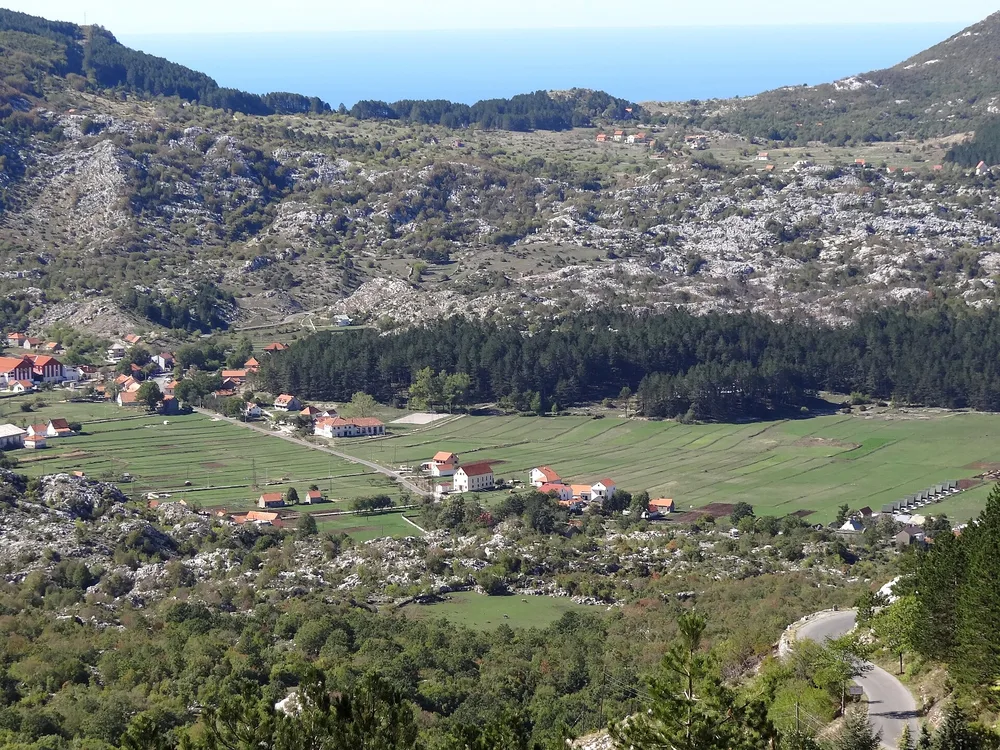
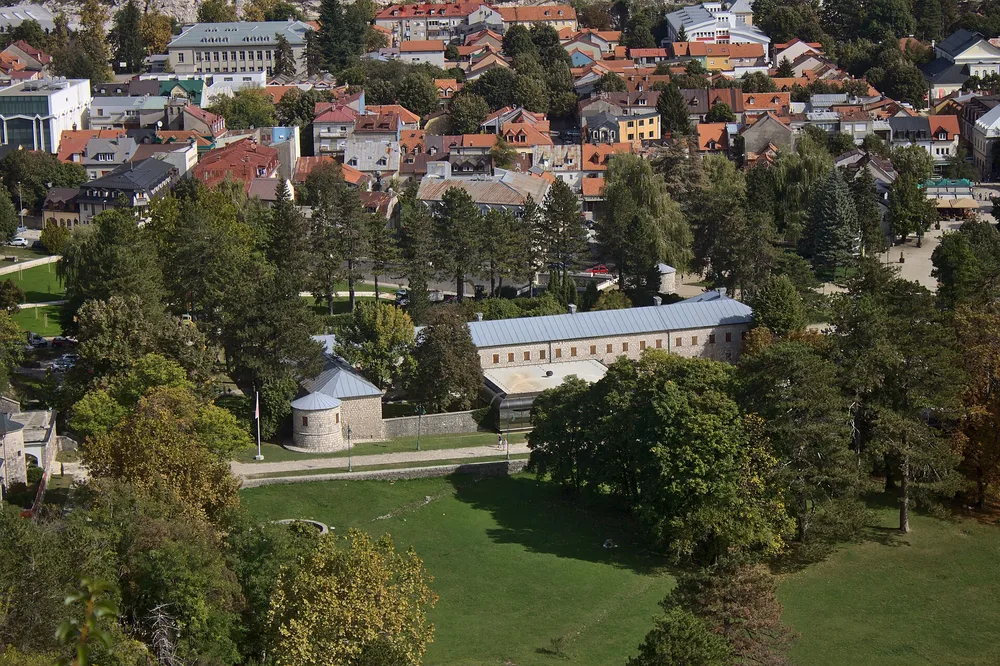
Seen from the sea at Kotor, Lovćen is a wall. Seen from Cetinje it is something gentler: a long grey-green ridge closing the western side of the karst field, with the stepped summit of Jezerski vrh on its crest and, on clear days, a pale speck that is the mausoleum. Everything about the Old Royal Capital, its position, its weather, its history, is a consequence of the mountain. The court Ivan Crnojević founded here in 1482 stood in the shelter of the mountain, out of reach of the coast; the town gets its notorious rainfall because the mountain catches the wet air coming off the Adriatic; and for four centuries the ridge was the frontier between the free highlands and the Bay of Kotor, held by Venice and then by Austria.
The name Crna Gora, Black Mountain, and its Italian translation Montenegro are traditionally explained by the dark forests that once covered Lovćen and the surrounding highlands. The phrase is older and wider than the mountain, it appears in medieval charters for several upland districts, so treat the link as tradition rather than etymology settled beyond argument. What is not in doubt is the mountain’s place in national feeling. It is often called the ‘Montenegrin Olympus’; it is the burial place Njegoš chose for himself; and the chapel on its summit appeared on the coat of arms of the Montenegrin republic from 1945 to 1994.
The national park was proclaimed in 1952 to protect the central and highest part of the massif. It is managed today by the state company Nacionalni parkovi Crne Gore (National Parks of Montenegro), which also runs Durmitor, Biogradska gora, Prokletije and Lake Skadar. Its area is usually given as 6,220 hectares, about 62 square kilometres, and it is classed as IUCN Category II. The protected area is small by Balkan standards but unusually rich in human history: shepherds’ summer settlements (katuni), stone threshing floors (guvna), village churches of the fifteenth to nineteenth centuries, the Austro-Hungarian roads and water works, and the mausoleum. For a country-wide overview of the mountain written for first-time visitors, see ExploreMontenegro’s Lovćen guide.
- Protected since
- 1952
- Area
- About 6,220 ha (62 km²)
- Highest point
- Štirovnik, 1,749 m
- Best-known summit
- Jezerski vrh, 1,657 m, with the Njegoš Mausoleum
- From Cetinje
- About 14 km to Ivanova korita; about 20 km to the mausoleum car park
- Park fee
- 3 euro per person per day (price list as checked November 2026)
- Managed by
- National Parks of Montenegro (Nacionalni parkovi Crne Gore)
Geography: limestone, beech and two climates
Lovćen is built of limestone and dolomite, and it behaves like it. There are no streams on the surface; rain and snowmelt vanish into fissures, sinkholes (vrtače) and shafts, which is why the villages of the massif collected water in cisterns and why the Austro-Hungarian army, when it occupied the mountain during the First World War, built a large water collector at Koritnik. The slopes are scored with grey pavements of bare rock between pockets of soil, and the walk from any car park is over this broken, ankle-turning karst unless you stay on the marked paths.
The mountain stands between two climates. Its seaward face drops in a few kilometres to the Bay of Kotor and catches Mediterranean warmth and enormous winter rainfall; its landward side looks over the high, colder plateau of Old Montenegro. The result is a vegetation that changes with every few hundred metres of height. Lower down you pass through hop-hornbeam, oak and the aromatic scrub of the coast; higher, the park is dominated by beech forest, with Bosnian pine and stands of other conifers on the exposed ridges and a band of mountain pastures and creeping pine near the summits. In autumn the beech woods around Ivanova korita turn copper and gold, and the contrast with the white rock is the best argument for an October visit.
Counts of species vary with the survey. The Parks Dinarides network, of which the park is a member, gives about 1,300 plant species, roughly a third of Montenegro’s flora; other published summaries give a little under 1,200. Two plants, Taraxacum validum and Cardamine montenegrina, are often cited as Montenegrin endemics found here. The same source lists about 200 bird species, a small herpetological reserve, and mammals including wolf, wild boar, fox and the Montenegrin vole. You are unlikely to meet any of the mammals by day, but birds of prey are a regular sight along the ridges.
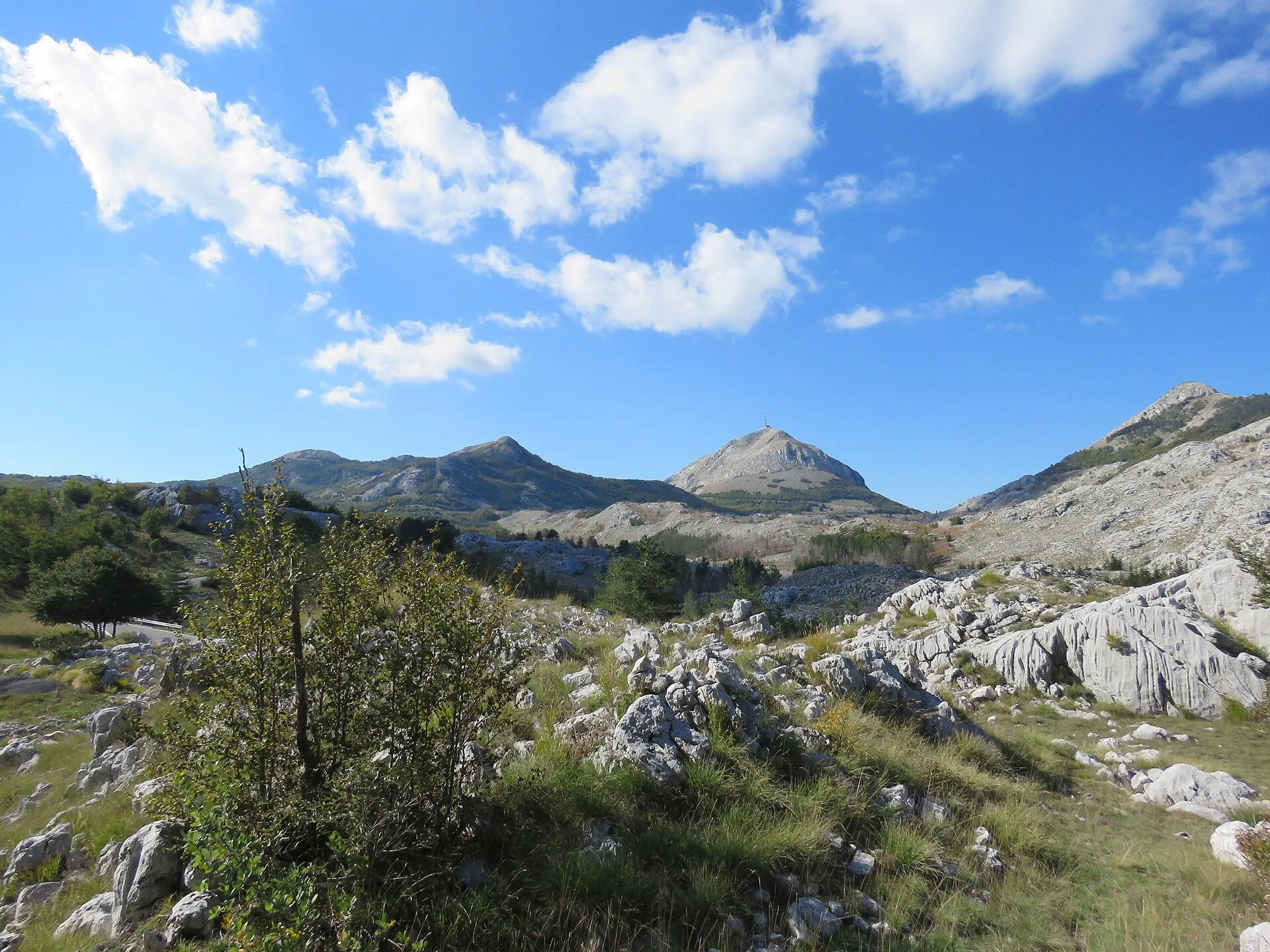
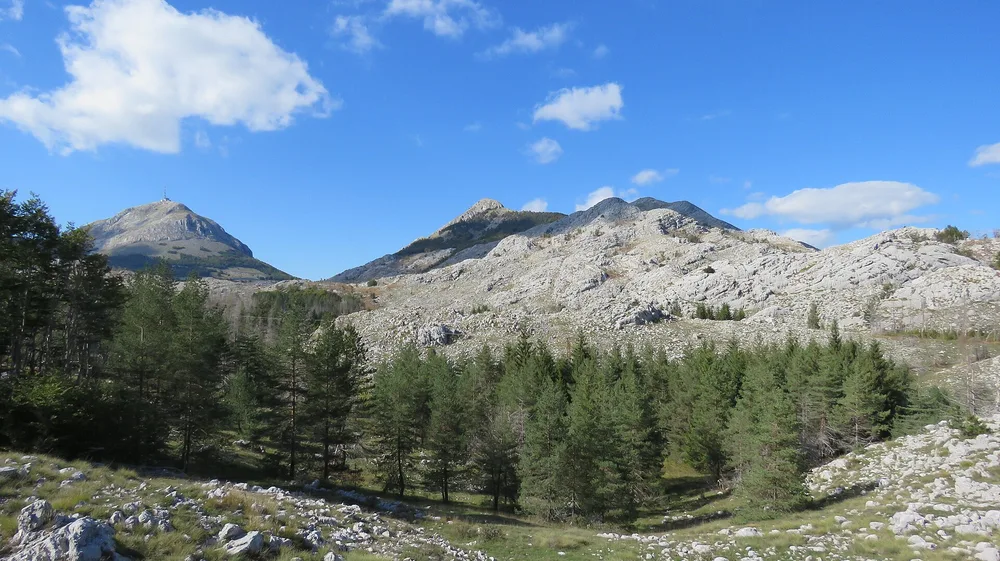
Karst and pine on the high plateau, with Štirovnik, the highest summit of Lovćen, on the horizon.
Getting up from Cetinje
The park road leaves Cetinje at the western end of town, signposted for Lovćen and Ivanova korita, and climbs steadily through woods and clearings. With a car it is the easiest mountain excursion in Montenegro: about 14 km to Ivanova korita and about 20 km to the car park below the mausoleum, roughly half an hour each way in normal conditions (distances by OpenStreetMap routing; the Cetinje Tourist Organisation also gives 20 km to the mausoleum). The road is asphalted throughout but narrow in its upper section, with passing places, blind bends and, in summer, a stream of tour minibuses; drive it slowly and use your horn on the bends as local drivers do.
A park ticket is sold on the road. The National Parks of Montenegro price list, as checked in November 2026, gives the day ticket at 3 euro per person, covering the visitor centre and the educational trails, with parking charged by the hour (1 euro an hour for a car, 0.50 euro for a motorcycle, 2 euro for an off-road vehicle, 3 euro for a van, 5 euro for a bus). Tickets can also be bought online through the park company’s electronic ticket system. The mausoleum ticket is separate and is paid to the National Museum at the top: see the Njegoš Mausoleum.
There is no public bus onto the mountain. Without a car the choices are a taxi from Cetinje (agree the waiting time and fare before you set off), a guided day tour from the coast that includes the mausoleum, or the Kotor cable car to its upper station at Kuk, which stands at 1,348 m on the western edge of the massif, about 6 km by road from the mausoleum car park; there is no scheduled onward transport from Kuk, so plan that leg. The Kotor serpentine and cable car guide covers the cable car, which is closed until spring 2027 according to its operator.
| From Cetinje centre to | Road distance | Typical driving time |
|---|---|---|
| Ivanova korita | About 14 km | About 25 min |
| Njegoš Mausoleum car park (Jezerski vrh) | About 20 km | About 35 min |
| Kuk (upper station of the Kotor cable car) | About 21 km | About 35 min |
| Njeguši (via the old road) | About 20 km | About 25 min |
| Mausoleum car park to Njeguši | About 13 km | About 15–20 min |
Ivanova korita: the park’s front room
Ivanova korita, ‘Ivan’s troughs’, is a wide clearing in the beech forest on the Cetinje side of the mountain, the first place the road levels out and the natural base for everything else. Tradition links the name to Ivan Crnojević, the founder of Cetinje, and to the stone water troughs that once served the summer herds; the troughs and a spring are still there. Today it is the park’s recreational centre: picnic meadows, a children’s adventure park in the trees (the Parks Dinarides profile describes about two hectares and ten courses of varying difficulty), the start of several marked trails, and a handful of places to eat and stay, including Hotel Monte Rosa.
In the shade by the road stands a memorial to the Petrović-Njegoš dynasty, a row of busts of the prince-bishops and princes from Vladika Danilo to King Nikola, a quiet open-air companion to the portraits in King Nikola’s Museum. On summer weekends Ivanova korita fills with families from Cetinje and Podgorica escaping the heat; on a weekday in May or late September you may have the woods almost to yourself.
From the clearing the road continues another few kilometres to the junction for Jezerski vrh, then climbs the last hairpins to the mausoleum car park. A minor road also links the area with Kuk and the Kotor cable car on the western side of the massif, and with Njeguši to the north.
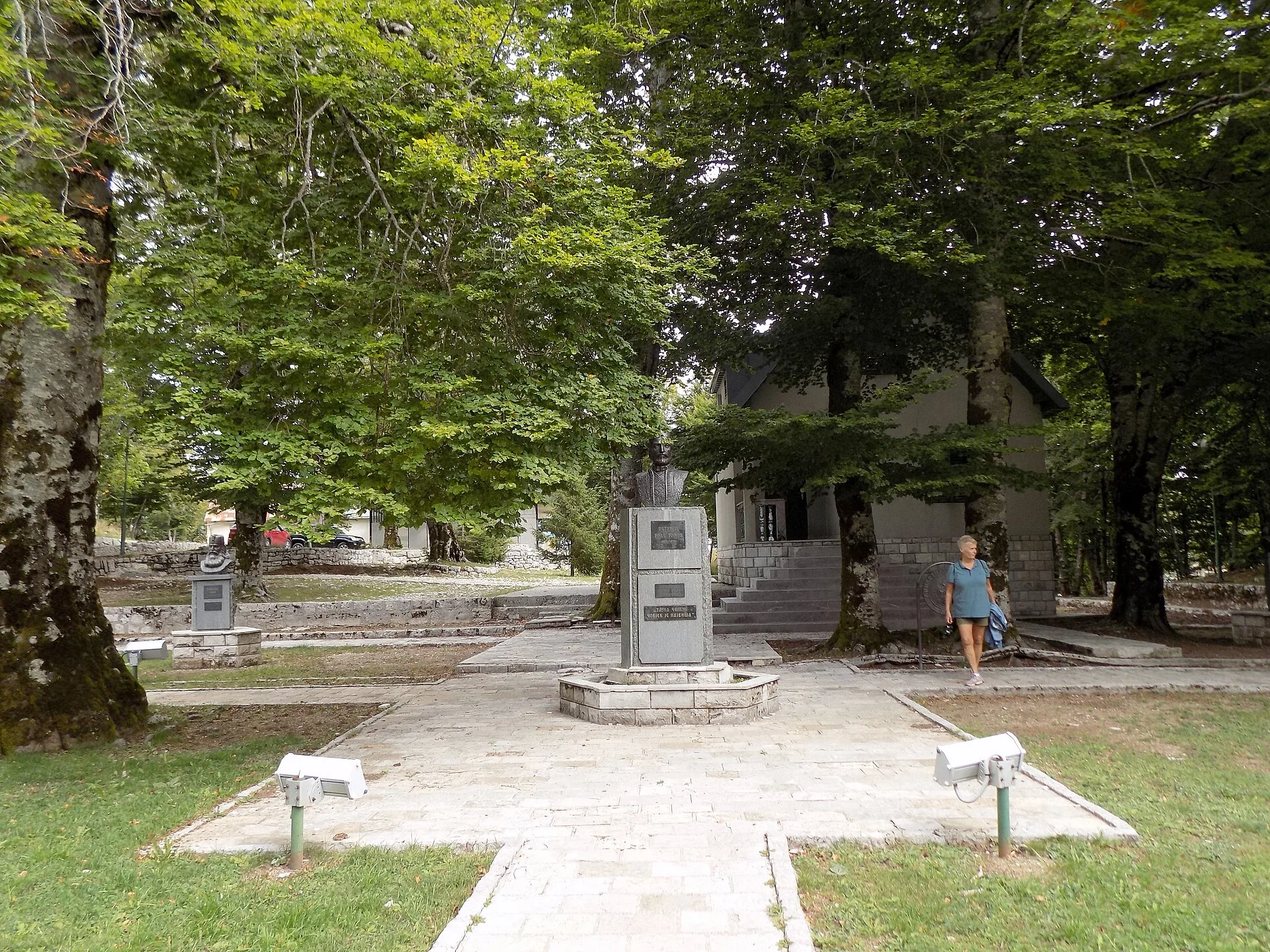
The square at Ivanova korita, with the memorial to the Petrović-Njegoš dynasty among the beech trees.
Jezerski vrh and the mausoleum
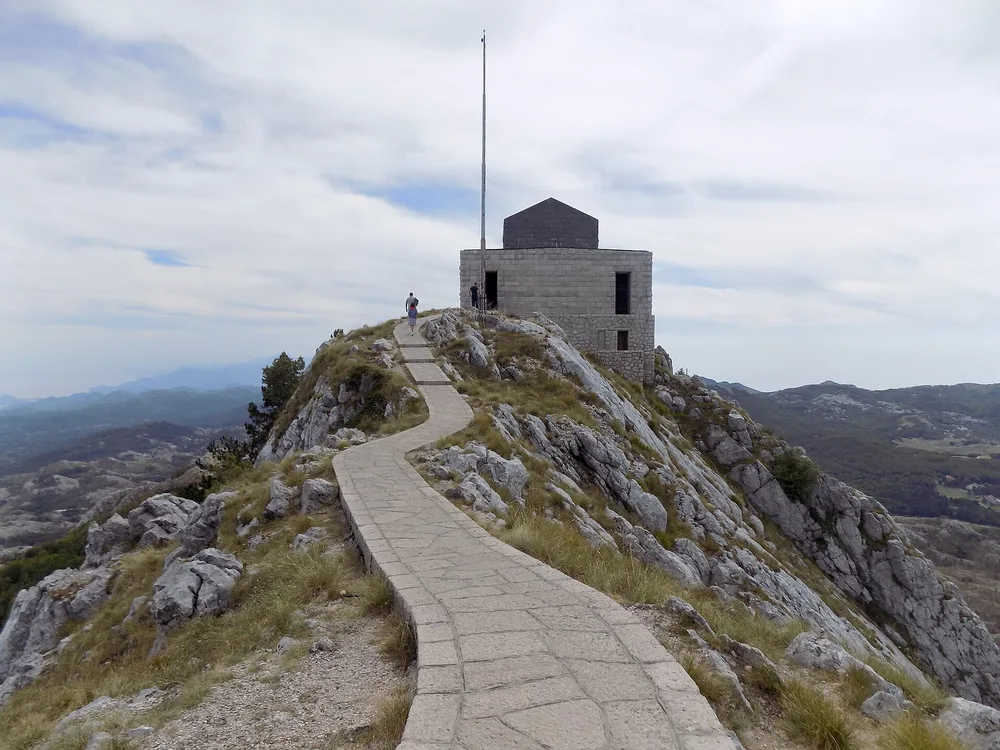
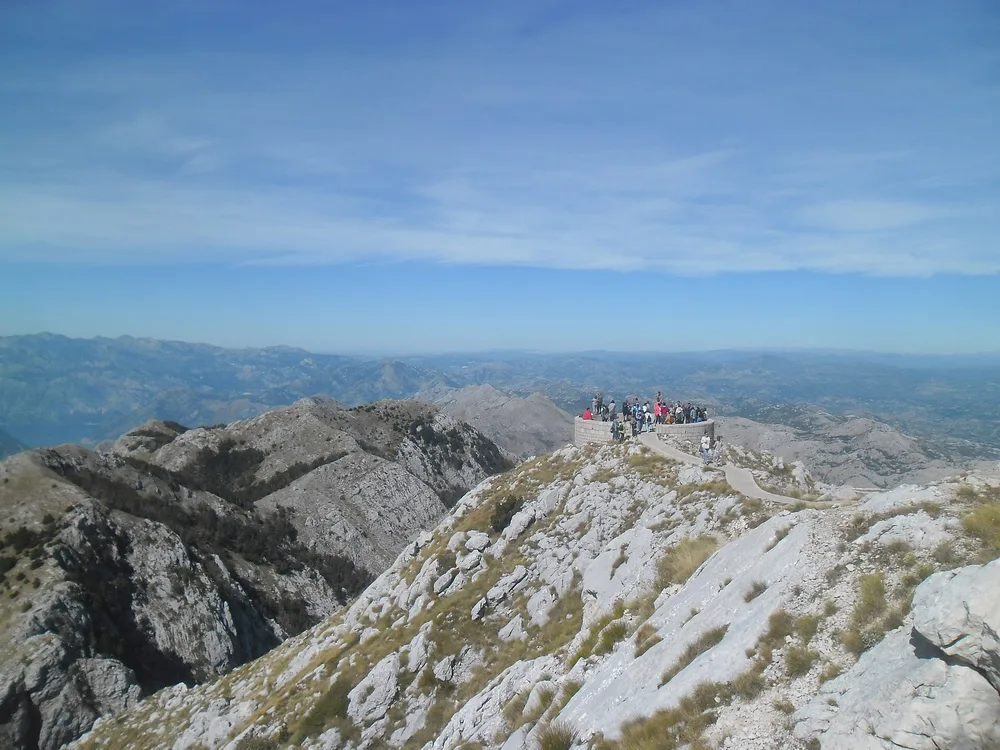
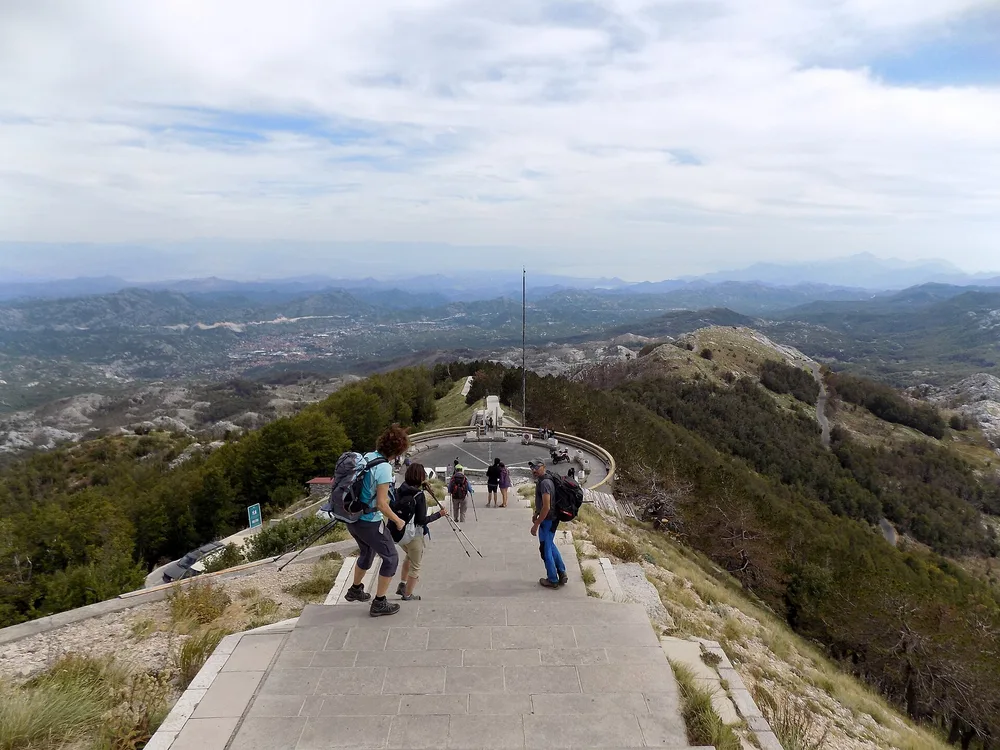
Most visitors come for one thing. On the summit of Jezerski vrh, the ‘lake peak’, named after the small seasonal pools in the hollows below it, stands the mausoleum of Petar II Petrović-Njegoš, the prince-bishop and poet, designed by the sculptor Ivan Meštrović and completed in 1974 on the site of the chapel Njegoš built for his own grave in 1845. From the car park a tunnel stairway of 461 steps climbs through the rock to the forecourt; inside, under a gilded mosaic vault, is Meštrović’s granite figure of the poet; behind the building a path runs along the ridge to a round viewing platform at the very edge of the peak.
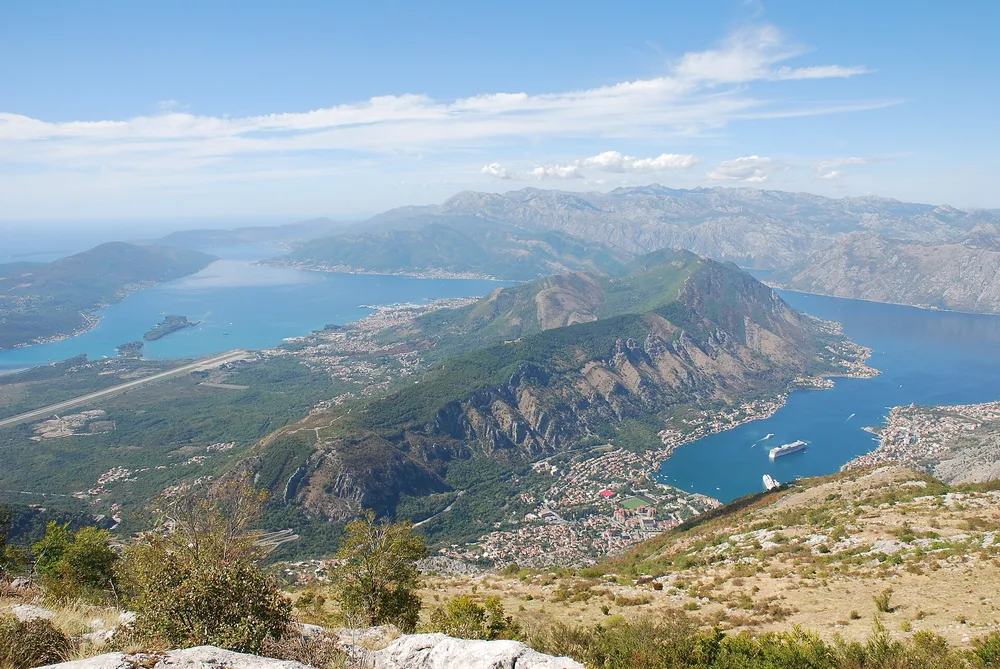
The view from the platform is the reason to choose a clear morning. To the west the land falls away to the Bay of Kotor and the open Adriatic; to the south-east you look over the chaotic grey karst of Old Montenegro to the glitter of Lake Skadar and, on the best days, the mountains of Albania; to the north the ranges roll away towards Durmitor. The National Museum gives the summit’s altitude as 1,660 m, the park and most maps 1,657 m.
The mausoleum is run by the National Museum of Montenegro, not by the park, and it keeps a summer season only: the museum’s timetable, as checked in November 2026, closes it to visitors from 16 November to the spring opening in April. Its history, the controversy over the chapel it replaced, opening hours and tickets are all on the Njegoš Mausoleum page.
Štirovnik, the highest summit
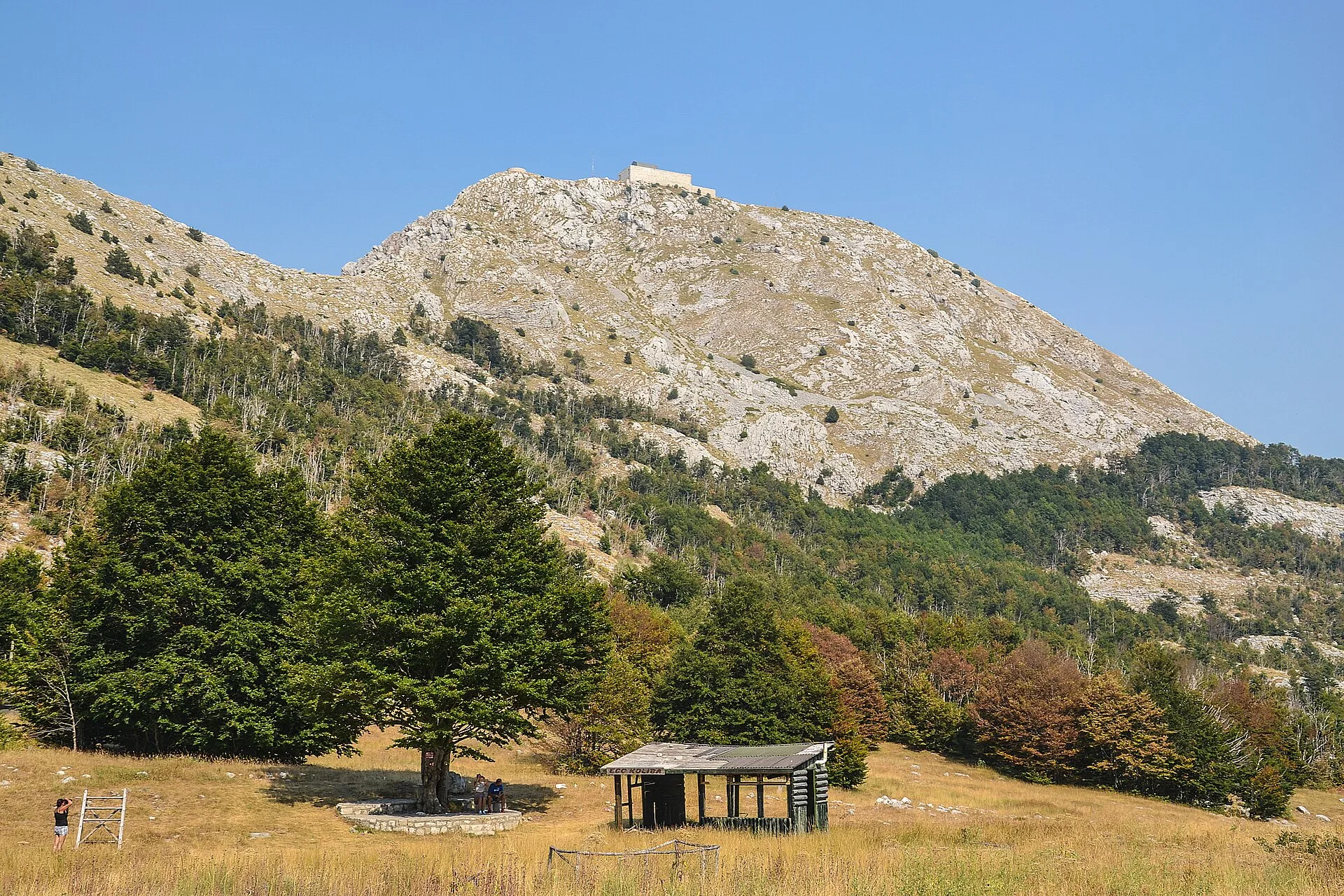
Štirovnik, at 1,749 m, is the true summit of Lovćen, a broad rocky dome a short distance west of Jezerski vrh and clearly visible from the mausoleum platform. Its top carries telecommunications masts, which is why it lacks the romance of its neighbour and why you should not assume free access to the very summit; ask locally or at the park before setting out.
The rock walls on its flanks are the setting for a via ferrata, a protected climbing route with fixed cables and rungs. We have not been able to confirm the route’s grade, length or season from an official source, so the safest way to try it is with a guide: GetYourGuide lists a guided Lovćen via ferrata on Štirovnik, which supplies the experience the title describes; read the listing for the equipment included, the minimum age and the meeting point. Do not attempt a via ferrata without a harness, lanyard set and helmet, or in wet weather, when limestone becomes slick.
Walking on Lovćen
The park describes its network as well-marked trails of light intensity between about 4 and 13 km, most of them starting from Ivanova korita or from the road to Jezerski vrh. Waymarks follow the standard Balkan pattern, a red ring with a white centre painted on rocks and trees. There are routes through the beech woods around Ivanova korita, longer loops up towards Jezerski vrh and the high pastures, and paths that descend towards Njeguši and the villages on the Cetinje side. The long-distance Coastal Mountain Transversal (Primorska planinarska transverzala), which links the mountains above the Montenegrin coast, also crosses the massif.
- Easy: the educational trails and forest paths around Ivanova korita, an hour or two on gentle gradients, with benches and shade. Good for families and for the day after a long drive.
- Moderate: from Ivanova korita towards Jezerski vrh through beech woods and open pasture, a half day with a few hundred metres of ascent, ending at the mausoleum steps. Arrange a pick-up or walk back the same way.
- Longer: the high karst between Jezerski vrh, Štirovnik and the villages above Njeguši, rough underfoot and largely without shade or water. Only with a map, a GPS track and settled weather.
Three warnings apply to every walk on the mountain. Water: there is almost none on the karst, so carry all you need, at least two litres in summer. Weather: Lovćen makes its own, and cloud can drop onto the summits in minutes even when Cetinje is sunny; in fog the grey rock all looks the same and the waymarks are easy to lose. Mobile signal is good on the main ridges but patchy in hollows. The general emergency number in Montenegro is 112.
If you prefer company, the park itself provides guides (see its price list), and GetYourGuide lists a private Lovćen hiking tour and a hike to Pestingrad peak above Njeguši. For the wider picture of walking in the country see our sister site’s Montenegro hiking guide.
Lovćen in history: from the Venetian border to 1916
For most of its history the mountain was a frontier. The old mule track from Kotor, the Kotorske skale or Ladder of Kotor, climbed its western face to Njeguši and on to Cetinje, and everything that reached the prince-bishops’ court from Europe, books, cloth, salt, guns, doctors and Njegoš’s famous billiard table, came up that path on the backs of men and mules. In 1879–1884 it was replaced by the carriage road whose 25 hairpins are now one of the great drives of the Adriatic; its story is told on the serpentine road page.
Njegoš built his chapel on Jezerski vrh in 1845 and was buried there in 1855. In the First World War the mountain became a battlefield. In August 1914 Montenegrin batteries on Lovćen began shelling the Austro-Hungarian naval base in the Bay of Kotor below; a French naval artillery detachment joined them that autumn, and Austro-Hungarian battleships in the bay replied. In early January 1916 an Austro-Hungarian offensive supported by naval guns took the Lovćen heights, and within days Montenegro asked for an armistice. The chapel was badly damaged in the fighting and the occupiers removed Njegoš’s remains to Cetinje. The history of Cetinje tells the rest: the chapel rebuilt in 1925, the decision of 1951 to replace it, and the mausoleum of 1974.
Today the park also protects the humbler history of the mountain’s people: the katuni, summer settlements where families from Njeguši and the Cetinje villages took their flocks; the circular stone guvna where grain was threshed; and the small single-nave churches scattered through the villages. They are best seen on foot, and the Njeguši guide covers the dynasty’s home village on the northern edge of the park.
Seasons and winter access
Late April to June is the greenest season, with spring flowers on the pastures and snow lingering in the hollows into May. July and August are the busiest months: the mountain is pleasantly cooler than the coast, but mid-day haze often softens the long views, so go early. September and October bring the clearest air and the autumn colour of the beech woods, and are our favourite months for the summit.
From November to March Lovćen is a winter mountain. Snow regularly covers Ivanova korita and the upper road, and the road to the mausoleum may be closed or impassable without winter tyres or chains; the mausoleum itself is closed to visitors from mid-November to April according to the National Museum. The park hires out snowshoes (4 euro a day on its price list, as checked November 2026), and on fine winter days the woods around Ivanova korita are beautiful and quiet. Check road conditions in Cetinje before you go and carry chains from November onwards. Climate and seasons in more detail are on the best time to visit page.
Tours that include Lovćen
Most guided days from the coast combine the mausoleum, Njeguši and Cetinje; some use the Kotor cable car for the climb. Compare what each listing includes, especially whether the mausoleum ticket and park fee are covered. A private Lovćen tour from Cetinje gives you your own driver-guide; for the classic circuit from Kotor see the Lovćen, cable car, Njeguši and Cetinje day tour. All options are compared on the Cetinje tours page.
Lovćen private tour
A private tour of Lovćen listed under Cetinje. Read the listing for the meeting point and whether the mausoleum and Ivanova korita are on the route.
Check availabilityBook via GetYourGuide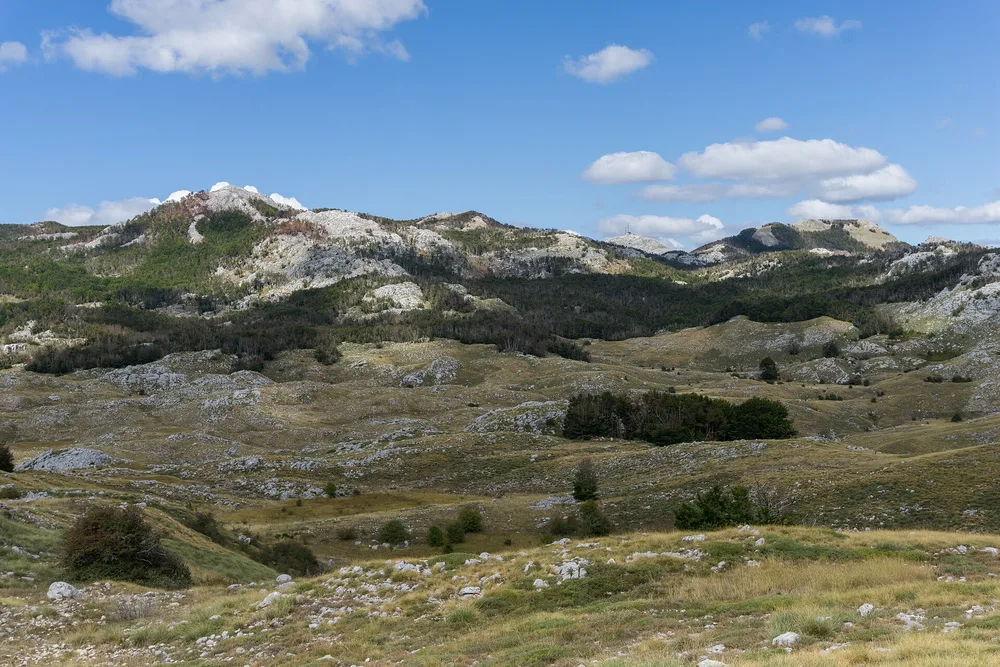
Lovćen hiking private tour
A private guided hike on Lovćen. Discuss the route and length with the guide; there is almost no water on the karst, so carry your own.
Check availabilityBook via GetYourGuide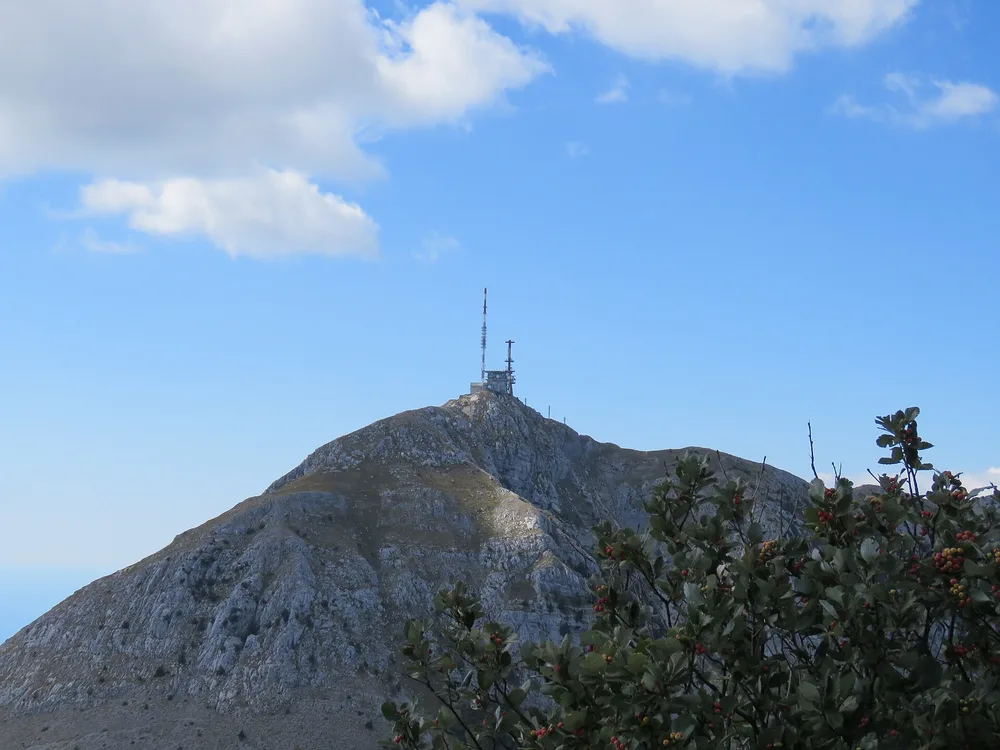
Lovćen via ferrata on Štirovnik, guided
A guided climb on the via ferrata of Štirovnik, the highest summit of Lovćen. Check the listing for the equipment provided, the minimum age and the fitness required.
Check availabilityBook via GetYourGuide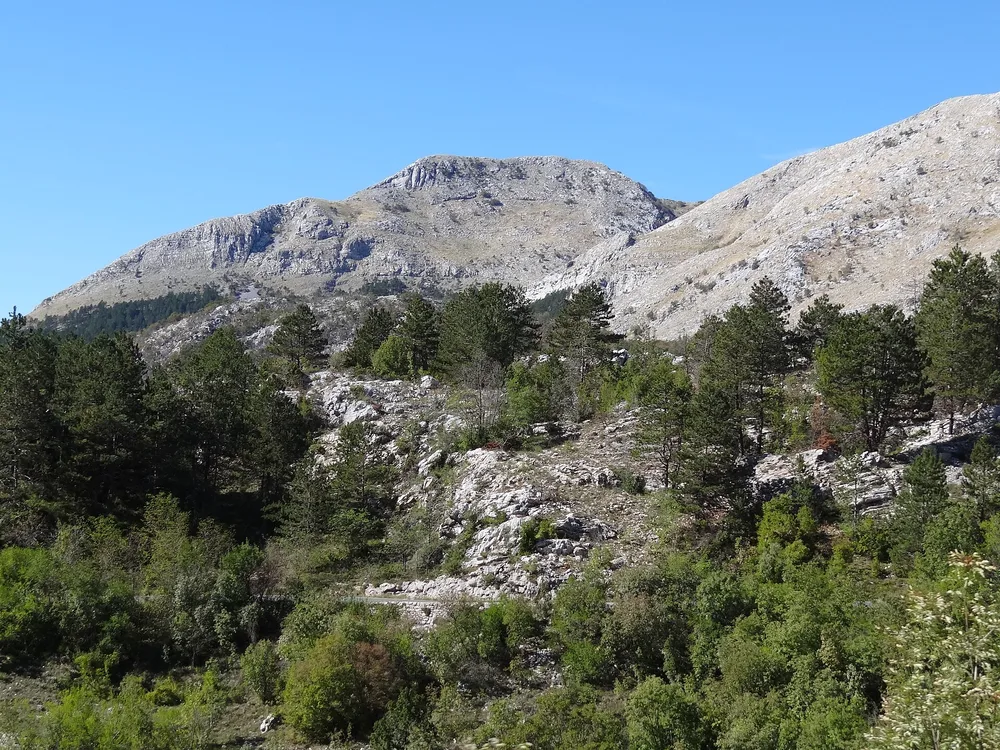
Njeguši: Pestingrad peak hiking tour
A guided hike from Njeguši to the Pestingrad summit above the village, according to the listing title. Good boots and water are essential.
Check availabilityBook via GetYourGuideTour listings are on GetYourGuide. Prices, dates and cancellation terms are shown live on each listing and can change; Cetinje.com may earn a commission at no extra cost to you.
Staying on the mountain
A night on Lovćen means cool air in August, a dark sky and the mausoleum before the coaches arrive. Ivanova korita has a hotel and bungalows; the villages of Bjeloši and the slopes above Cetinje have holiday houses and cabins with mountain views; Njeguši, on the far side, has guest houses. In winter check that your accommodation is open and that the road to it is cleared. All the options, in town and out, are compared in where to stay.
Hotel Monte Rosa
Lovćen & NjegušiHotel at Ivanova korita inside Lovćen National Park, about 15 km from Cetinje, with a restaurant, bar, spa and family rooms.
8.0Booking.com guest score · as checked in November 2026
See on Booking.comGorska Dolina
Lovćen & NjegušiBungalows at Ivanova korita on Lovćen, with garden, picnic area and free parking.
9.3Booking.com guest score · as checked in November 2026
See on Booking.comLOVCEN4ME
Lovćen & NjegušiTwo-bedroom holiday house at about 950 m near Bjeloši, on the edge of Lovćen National Park.
9.7Booking.com guest score · as checked in November 2026
See on Booking.comMountain Harmony Lovćen
Lovćen & NjegušiTwo-bedroom holiday home at Bjeloši on the Cetinje side of Lovćen, with a garden and free parking.
9.9Booking.com guest score · as checked in November 2026
See on Booking.comSee all stays in Lovćen & Njeguši on Booking.com
Accommodation links go to Booking.com, where you see live prices and availability. We do not list prices because they change daily; Cetinje.com may earn a commission.
Frequently asked questions
How much is the Lovćen National Park entrance fee?
The National Parks of Montenegro price list gives a day ticket of 3 euro per person, which includes the visitor centre and the educational trails, plus hourly parking (1 euro an hour for a car), as checked in November 2026. The Njegoš Mausoleum has its own ticket, sold by the National Museum.
How far is Lovćen from Cetinje?
About 14 km by road to Ivanova korita and about 20 km to the car park below the mausoleum on Jezerski vrh, roughly half an hour’s drive.
Can I get to Lovćen by bus?
No scheduled bus serves the park. Drive, take a taxi from Cetinje, join a guided tour, or ride the Kotor cable car to Kuk, which is closed until spring 2027 according to its operator and has no scheduled onward transport to the mausoleum.
Is Lovćen open in winter?
The park is, but the upper road is often snowbound and the mausoleum is closed to visitors from mid-November to April according to the National Museum. Carry chains and check conditions in Cetinje.
Which is the highest peak of Lovćen?
Štirovnik, at 1,749 m. Jezerski vrh, with the mausoleum, is 1,657 m (the National Museum gives 1,660 m).
Are there marked hiking trails?
Yes. The park describes well-marked trails of about 4 to 13 km, most starting at Ivanova korita. Carry water, as there is almost none on the karst, and turn back if cloud comes down.
Sources and official information
Facts were checked against these official and scholarly sources in November 2026. Opening hours, ticket prices, park fees and timetables change, so confirm before you go.
- nparkovi.me
- nparkovi.me
- parksdinarides.org
- en.narodnimuzej.me
- en.narodnimuzej.me
- cetinje.travel
- montenegro.travel
- kotorcablecar.me
- en.wikipedia.org
- en.wikipedia.org
- openstreetmap.org
Cetinje.com is an independent guide, not the official site of the Old Royal Capital Cetinje, the National Museum of Montenegro, any tour operator, hotel or the government of Montenegro. Some links are affiliate links: tours go to GetYourGuide and accommodation goes to Booking.com, and we may earn a commission at no extra cost to you.