In short
- Built in 1838 by Montenegro’s poet-ruler, Petar II Petrović-Njegoš, with Russian money and to a design by the Russian officer Yakov Ozeretskovsky, so that the government could move out of the monastery.
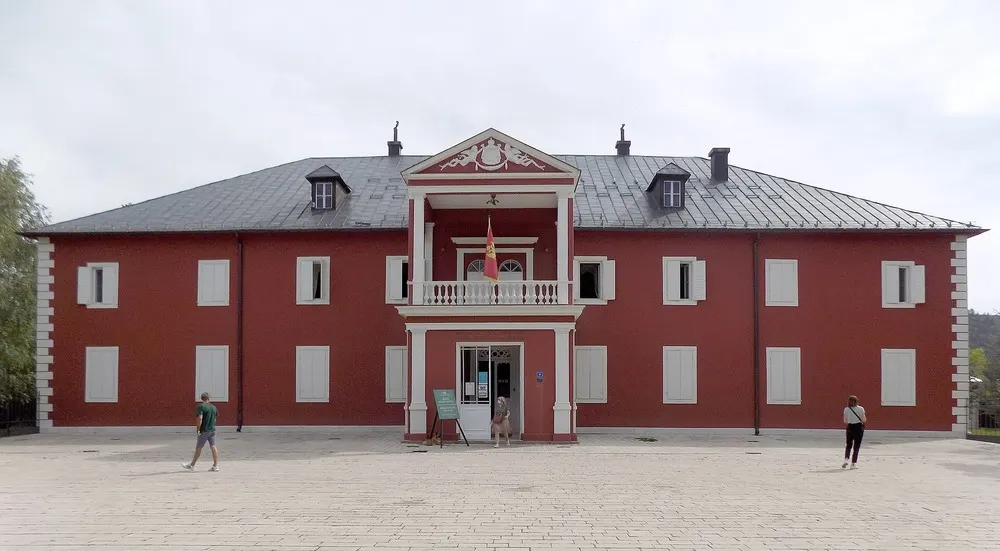
- Half house, half fort: one range of stone about 70 m long and only 7.5 m deep, 25 rooms on two floors, inside a walled enclosure with a round tower at each corner.
- Named for a billiard table that reached Cetinje in 1840. It is still there, in the room where Njegoš received his guests.
- The Njegoš Museum since 1951 shows his study, bedroom and library, the manuscript of The Mountain Wreath, and the armchair in which he died on 31 October 1851.
- Ticket 5 euro, including the Relief Map of Montenegro in the courtyard (as checked 22 November 2026). Allow an hour.
Why Njegoš needed a new house
When Rade Tomov Petrović became ruler of Montenegro in October 1830, not yet seventeen, he inherited a state with no building of its own. His uncle Petar I had governed from a cell in the Cetinje Monastery; the clan chiefs met in the open in front of it; visitors slept in the monks’ guest rooms. The young bishop, who took the name Petar II and is known to history by the name of his family’s village, Njegoš, spent the 1830s giving the country institutions: a Senate of chiefs, a small police force called the Guardia, a corps of bodyguards called the perjanici, a tax, a printing press and a school. All of it was lodged in the monastery, and by the middle of the decade there was no room.
In 1837 he returned from his second journey to Russia with a subsidy and with a Russian officer, Yakov Nikolaevich Ozeretskovsky, who came as an honoured guest and stayed to design a residence. Work began in the spring of 1838 on the level ground between the monastery and the site of the old Crnojević church. At first the building was called simply the New House. Two years later a billiard table bought in Austria arrived in Cetinje (carried, tradition says, up the mule track from Kotor), and the house has been Biljarda ever since.
Its completion is one of the turning points in the story of the town. With Biljarda, government in Montenegro left the church’s roof for the first time. Njegoš remained a bishop, but the house he built was a secular one, and every later palace and ministry in Cetinje took its bearings from it.
- Built
- 1838, for Petar II Petrović-Njegoš
- Designer
- Yakov Ozeretskovsky, Russian officer
- Size
- About 70 m long and 7.5 m wide; 11 rooms below, 14 above
- Royal residence
- Njegoš to 1851; Prince Danilo; Prince Nikola until 1867
- Museum
- Njegoš Museum since 1951 (National Museum of Montenegro)
- Ticket
- 5 euro with the Relief Map; pupils and students 2.50 euro (as checked 22 November 2026)
- Time needed
- 45 minutes, or an hour with the Relief Map
The building: a manor inside a fort
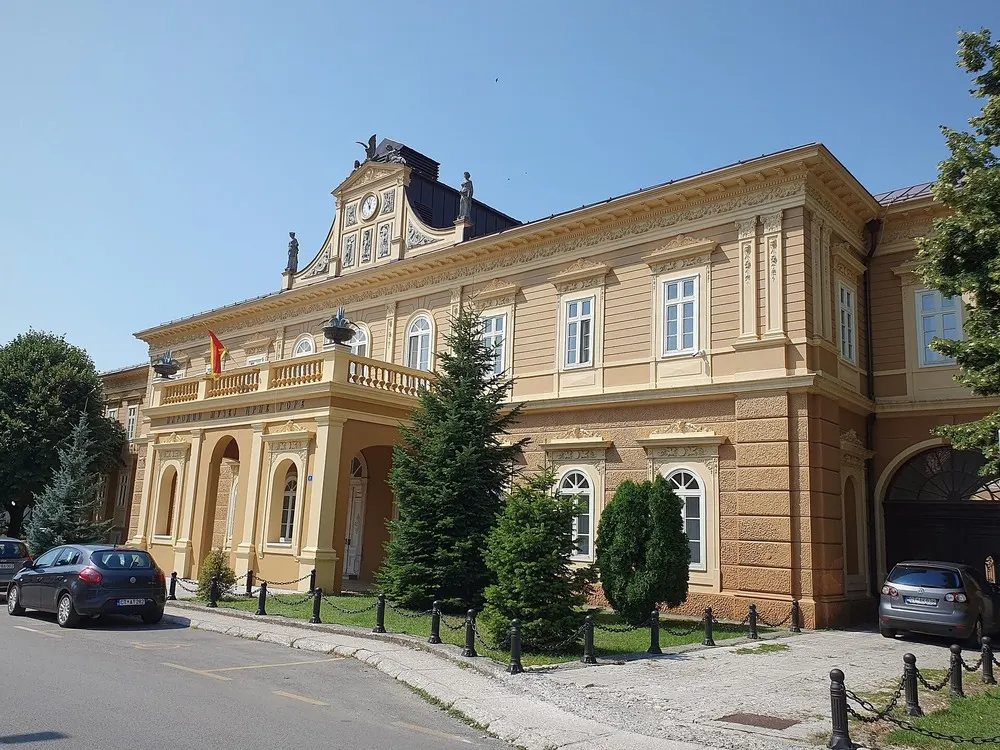
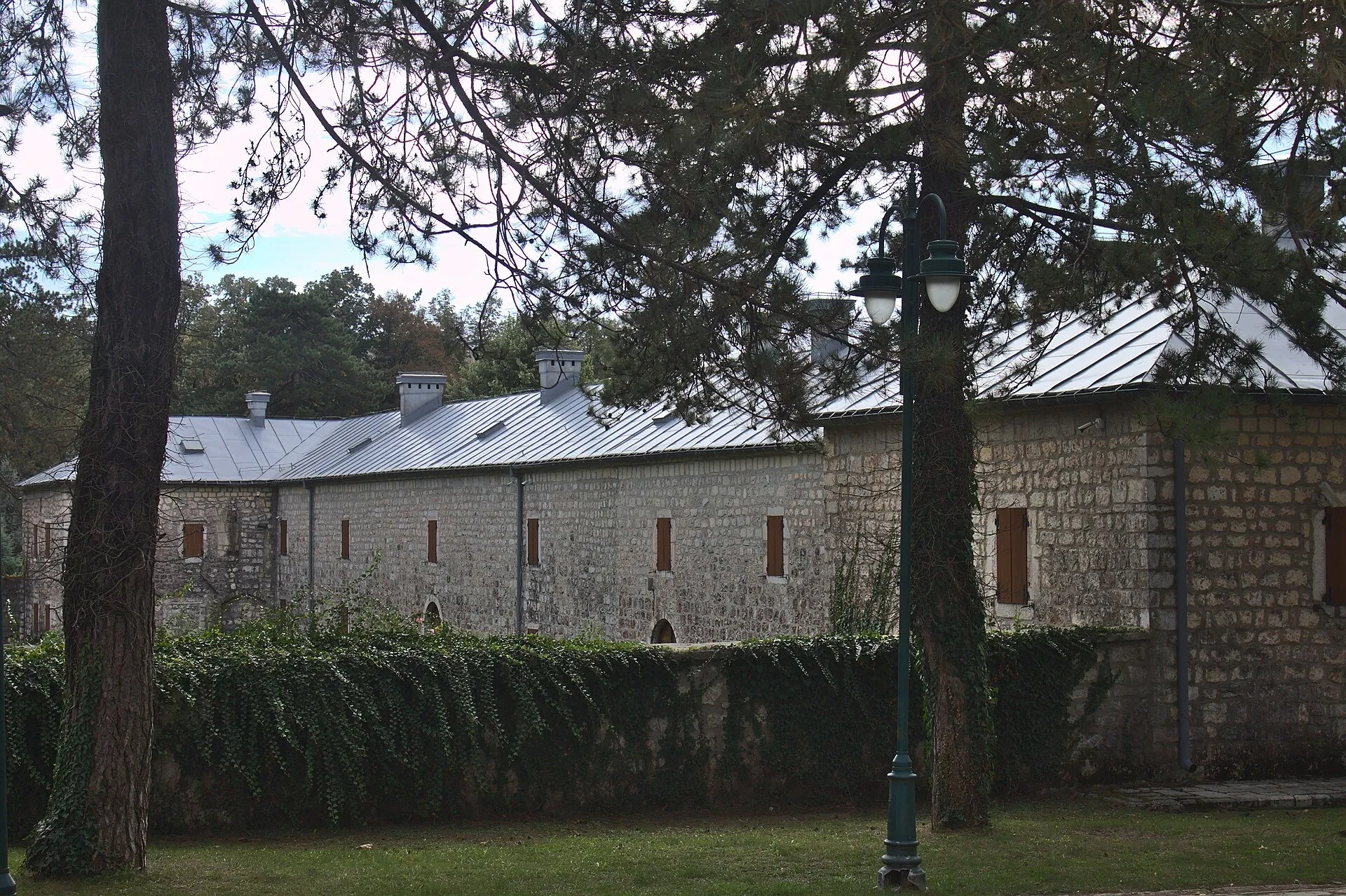
Biljarda looks like nothing else in Cetinje because it was designed for a country that was still at war every summer. The house itself is a single straight range of roughly dressed limestone, about 70 m long and 7.5 m wide (the tourist organisation’s figures are 72 by 8 m, with two short annexes), one room deep, with a ground floor of eleven rooms and an upper floor of fourteen. There is no portico, no central feature, almost no ornament. The roof was originally of lead.
Around it runs a high stone wall forming two courtyards, with a round tower at each of the four corners and a gate in each side. Contemporary visitors compared it to a medieval castle. The comparison flatters it: the walls would not have stopped artillery. But they would stop a raid, and they made a statement to chiefs who lived in stone towers of their own that the ruler’s tower was bigger.
Of the twenty-five rooms Njegoš kept three for himself. The rest housed the Senate, the perjanici and guests, and from the first year those guests were foreigners who wrote books: the German Heinrich Stieglitz, who wrote A Visit to Montenegro after staying here in 1840, the naturalist Wilhelm Ebel, the Englishman Sir John Gardner Wilkinson, the Russian Yegor Kovalevsky and the traveller Johann Georg Kohl all left descriptions of the house and its master. Much of what is known about how the rooms looked comes from them.
The enclosure has been altered twice. During the Austro-Hungarian occupation of 1916–1918, when the military governor made Biljarda his headquarters, the south wall was cut through for the pavilion of the Relief Map. And after the earthquake of 15 April 1979 the whole building was structurally repaired.
From residence to barracks to museum
Njegoš died in Biljarda on 31 October 1851 (19 October by the old calendar), aged thirty-seven, of tuberculosis. His successor Danilo, who gave up the bishop’s office and ruled as a secular prince, lived here with Princess Darinka until his assassination in 1860; the young Prince Nikola stayed until 1867, when he moved across the way into the house built for Darinka, now King Nikola’s Palace.
After the court left, Biljarda became the state’s spare building. At various times it held the theological and teacher-training school, the gymnasium, briefly the Girls’ Institute, a school of music and the Ministry of War; at the start of the twentieth century it was full of ministries, until the Government House took them in 1910; between the world wars the army used it. The cannons that Njegoš had mounted as trophies went to Vienna with the occupiers in 1916 and came back after the Second World War.
In 1951, for the centenary of the poet’s death, the building was restored and opened as the Njegoš Museum. It shared the space with the new Ethnographic Museum and a museum of the wartime liberation struggle until the earthquake; since the post-1979 restoration it has been given over to Njegoš, with galleries for temporary exhibitions. In 2026 and 2027 these hold ‘The Museum through Time’, the National Museum’s exhibition on its own 130-year history.
- 1837
Ozeretskovsky arrives
Njegoš returns from Russia with funds and the officer who will design the house.
- 1838
The New House
Built beside the monastery; Senate, guard and guests move in.
- 1840
The billiard table
Bought in Austria and brought to Cetinje; the house takes its name.
- 1847
The Mountain Wreath
Njegoš’s verse drama is printed in Vienna; the manuscript is now shown in his study.
- 1851
Death of Njegoš
He dies here on 31 October and is buried first in the monastery, then, in 1855, on Lovćen.
- 1867
The court moves out
Prince Nikola transfers to the new palace; schools and ministries follow.
- 1916–1917
Occupation
Seat of the Austro-Hungarian military government; the relief map is built in the south courtyard.
- 1951
Njegoš Museum
Opened for the centenary of the poet’s death.
- 1979
Earthquake
Damage on 15 April leads to a full restoration.
- 2012
Lapidarium
The Archaeological Museum opens a display of medieval tombstones in the north courtyard.
The museum, room by room
The display runs along the upper floor in a single sequence. The museum’s own guide numbers the rooms; this is what to look for in each.
- I. The armoury. Two boards of trophy weapons and the two bronze cannons, nicknamed Krnjo and Zelenko, that the men of Ceklin took from the fortress of Žabljak in March 1835; Njegoš had a verse inscription cut on Zelenko. The key of the Žabljak fortress is in the small case. A collection of weapons given by Josip Broz Tito at the opening in 1951 is also here.
- II. The billiard room. The table itself, in the middle of the room where Njegoš received visitors. On the wall, the portrait of him in national dress by the Austrian painter Johann Böss, with companion portraits of Prince Danilo, Prince Nikola and Grand Duke Mirko. His Venetian armchair had its legs lengthened, since he was exceptionally tall. His will, naming Danilo as successor, is displayed.
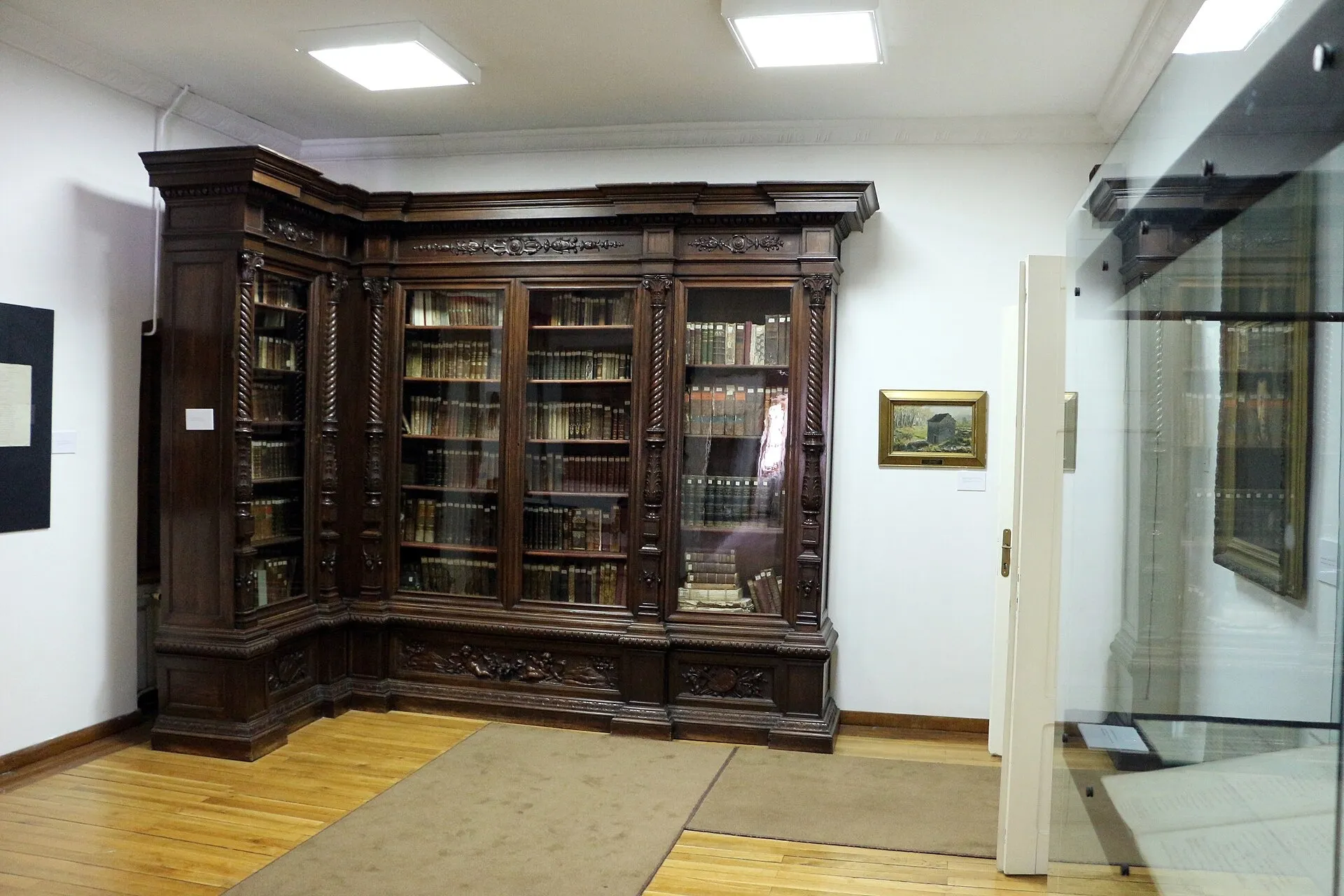
- III. The study. The emotional centre of the house. In the cases are the surviving manuscript of The Mountain Wreath (Gorski vijenac), the manuscript of the love poem A Night Worth More than a Century, his translation of Lamartine, and the notebook in which he jotted addresses, travel notes and drafts, with his gold pen and inkwell. His library held the French, Italian, Russian and German writers of his day and, in his last years, books on medicine.
- IV. The bedroom. The armchair in which, when he came home dying from Italy, Montenegrins carried him up from Kotor, and in which he spent his last hours. The bishop’s vestments and staff were a gift from the Russian emperor at his consecration in St Petersburg in 1833; the consecration charters, on silk, hang nearby. The portrait in bishop’s robes was painted in Trieste in 1837 by Giuseppe (Josip) Tominz.
- V. Contemporaries. Products of the press he brought from Russia in 1834: proclamations, a primer, the almanac Grlica of 1835, an early Montenegrin passport. The press ended in 1852, when Prince Danilo had the type melted down for bullets, replying to objectors that if the state survived there would be type again.
- VI. The statehood room. The end of the office of guvernadur in 1830, the Guardia and the perjanici, the first tax. Documents include the protocol fixing the border with Austria, signed on 15 July 1841, and the peace made at Dubrovnik in 1842 with Ali Pasha Rizvanbegović of Herzegovina.
- VII. The Senate. The chamber of the council of chiefs, with portraits of its president, Njegoš’s brother Pero, and vice-president, his cousin Đorđije; the Senate’s seal; a senator’s costume and silver pipes.
- VIII. Coin and cosmos. The tools and a wax impression for the perun, the coin Njegoš planned and never issued; an early edition of his philosophical poem The Ray of the Microcosm; and his telescope, made in Vienna in 1835. The paintings in this and the next rooms are from a cycle of thirty-eight on The Mountain Wreath by the Montenegrin painter Pero Poček.
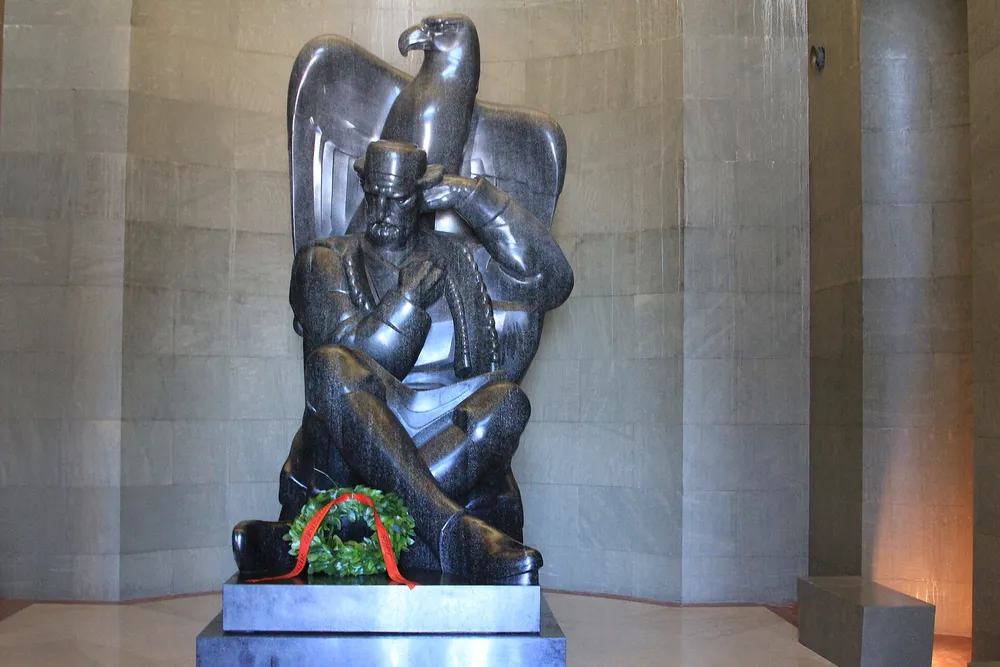
- IX–XI. The afterlife of the poems. Editions and translations, bronze figures of characters from The Mountain Wreath by Risto Stijović, a marriage chest that belonged to his mother, Ivana Proroković, a portrait by Petar Lubarda of 1947 and two bronzes by Ivan Meštrović, the sculptor of the mausoleum on Lovćen.
- XII and the room of Prince Danilo. Views of the places where the young Rade was schooled, Topla near Herceg Novi and the Savina Monastery (see the Herceg Novi guide on ExploreMontenegro), the will of Petar I naming him heir, and his Russian and German passports. The last room is given to Danilo I and Princess Darinka: his legal code of 1855, a map of Montenegro made in 1859 after the victory at Grahovac, and her personal belongings.
Readers who know Njegoš’s work will want to linger in the study. Those who do not will still take away the essential oddity of the man: a bishop who wrote the national epic, played billiards, owned a telescope and tried to mint a coin named after a pagan god. For his life and for the arguments about how The Mountain Wreath should be read, see Njegoš.
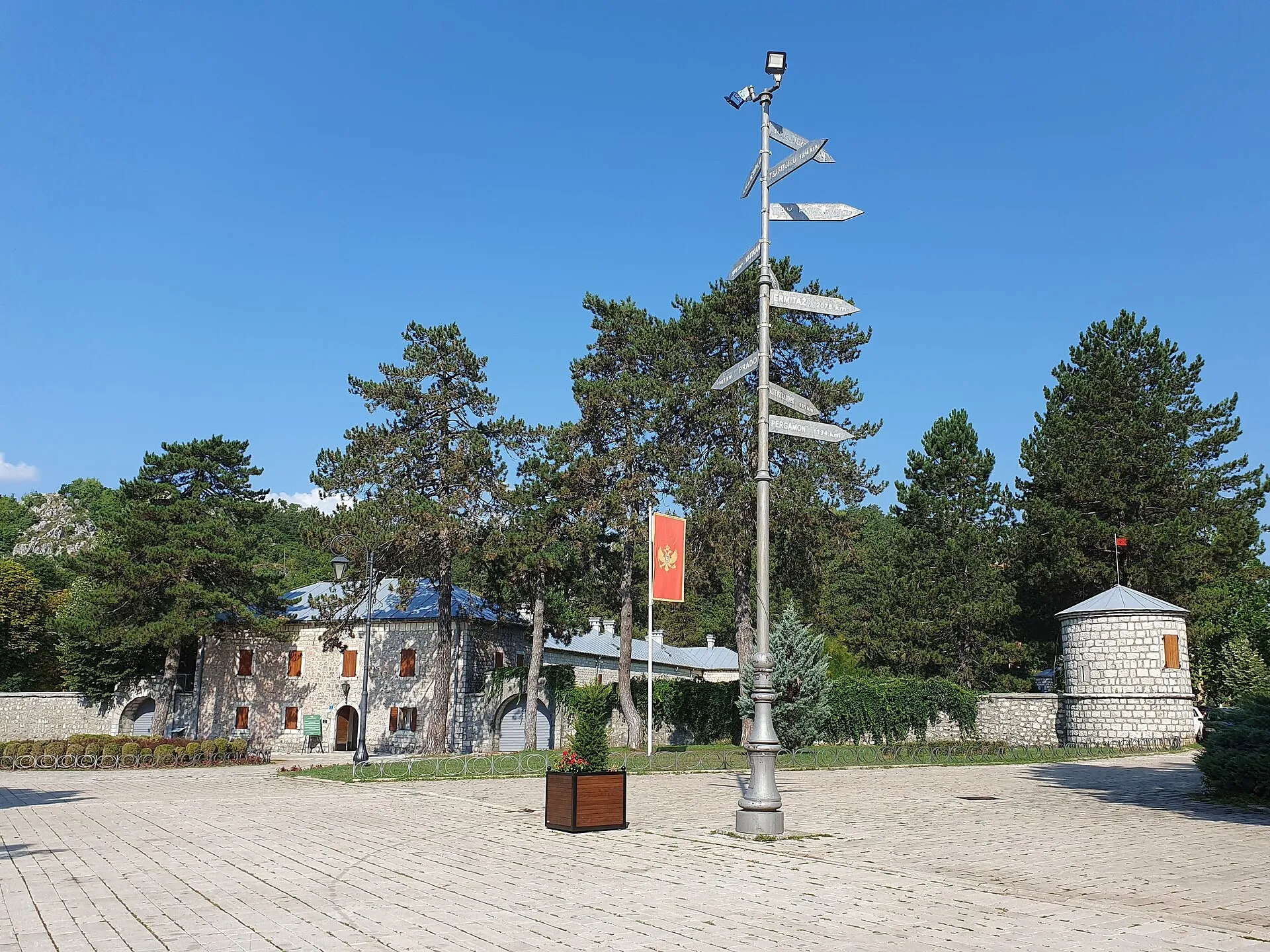
The courtyards: Relief Map and Lapidarium
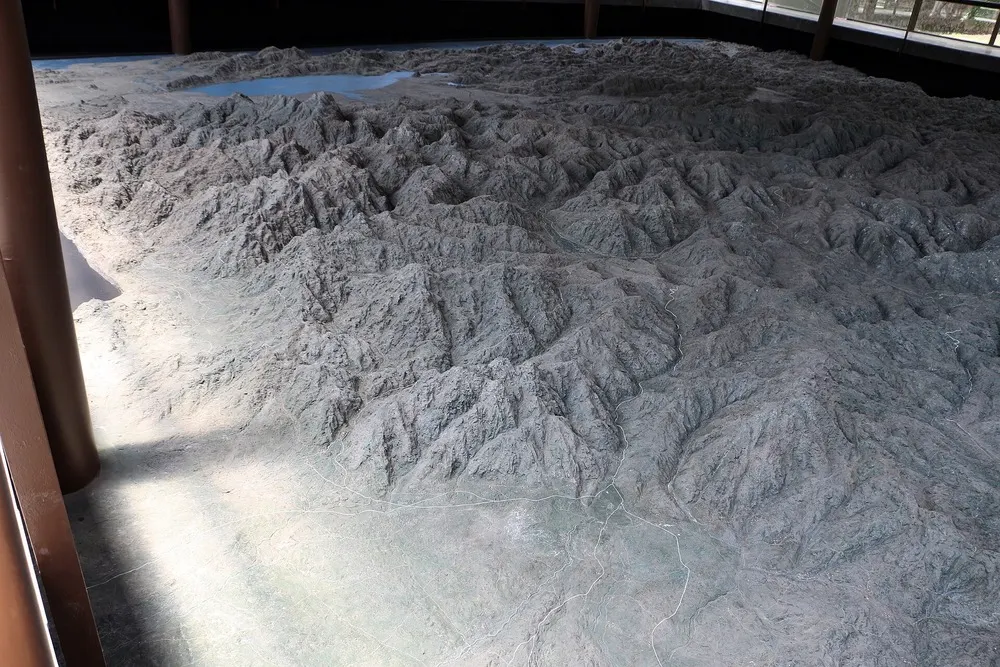
The same ticket admits you to the glass pavilion in the southern courtyard and the Relief Map of Montenegro, a hand-modelled concrete landscape of about 280 square metres made in 1916–17. It is described on its own page; do not skip it, and note that the pavilion keeps a shorter season than the museum.
In the north-eastern courtyard, free of charge, the Lapidarium of the Archaeological Museum was opened in 2012 during the European Heritage Days. It shows eleven medieval tombstones (stećci), gabled and slab-shaped, brought from sites in the Nikšić and Pljevlja areas where they were at risk. If you have not met stećci before, these and the pair outside the Vlach Church are a good introduction to a form of monument found across Bosnia, Herzegovina, western Serbia and Montenegro.
Visiting
- Where: between King Nikola’s Palace and the monastery, a minute from Dvorski trg. The entrance is through the gate in the enclosure wall.
- Hours, as published in November 2026: 15 April to 15 November, daily 9:00 AM to 5:00 PM; 16 November to 14 April, Monday to Friday 9:00 AM to 3:00 PM. Last admission 30 minutes before closing. The English versions of this unit’s page and of the museum’s timetable give 11 April to 15 November, 9:00 AM to 4:00 PM, so plan on 4:00 PM; see museums. Local time.
- Relief Map: open with Biljarda in summer; its own page says it is closed from 16 November to 14 April.
- Tickets: 5 euro for Biljarda with the Relief Map, 2.50 euro for pupils and students; the Relief Map alone 3 euro; under-12s free. Combined ticket for all National Museum units 20 euro.
- Guide: the museum’s English room-by-room leaflet can be downloaded from its website; curators occasionally lead public tours on special days.
Biljarda pairs naturally with the palace next door: together they take about two hours and tell the story from the first secular ruler to the last. The Cetinje guided walking tour with museum entry covers this quarter; check the listing for which museum is included.
Frequently asked questions
Why is it called Biljarda?
After the billiard table that Njegoš bought in Austria and had brought to Cetinje in 1840, two years after the house was built. Before that it was called the New House. The table is still on display.
Who built Biljarda?
Petar II Petrović-Njegoš, prince-bishop of Montenegro, in 1838. It was designed by the Russian officer Yakov Ozeretskovsky and paid for largely with Russian funds.
What is inside Biljarda?
The Njegoš Museum: his billiard room, study, bedroom and library, the manuscript of The Mountain Wreath, his vestments, weapons and personal belongings, and rooms on the institutions he founded. The Relief Map of Montenegro and an archaeological lapidarium are in the courtyards.
Did Njegoš die in Biljarda?
Yes, on 31 October 1851 (19 October in the Julian calendar). The armchair in which he died is shown in his bedroom. He was buried in the monastery and moved in 1855 to the chapel he had built on Mount Lovćen.
How much is the ticket?
5 euro for adults, including the Relief Map of Montenegro, and 2.50 euro for pupils and students, according to the National Museum’s price list as checked on 22 November 2026.
How long does a visit take?
About 45 minutes for the museum and 15 to 20 minutes for the Relief Map.
Sources and official information
Facts were checked against these official and scholarly sources in November 2026. Opening hours, ticket prices, park fees and timetables change, so confirm before you go.
- narodnimuzej.me
- narodnimuzej.me
- narodnimuzej.me
- narodnimuzej.me
- narodnimuzej.me
- narodnimuzej.me
- cetinje.travel
- cetinje.travel
- en.wikipedia.org
- sr.wikipedia.org
- tib.oeaw.ac.at
Cetinje.com is an independent guide, not the official site of the Old Royal Capital Cetinje, the National Museum of Montenegro, any tour operator, hotel or the government of Montenegro. Some links are affiliate links: tours go to GetYourGuide and accommodation goes to Booking.com, and we may earn a commission at no extra cost to you.