In short
- Built 1894–1895 as the residence of Crown Prince Danilo, the eldest son of Prince Nikola, at the park end of Njegoševa Street.
- A small, elegant villa in a late Empire manner, with paired columns on both floors. Its architect is not recorded; the works were supervised by the engineer Marko Đukanović.
- Its building settled an argument: when work began, Nikola declared that Cetinje would remain the permanent capital.
- Gymnasium, gallery, residence: a school between the wars, an exhibition space of the National Museum and the Cetinje Biennial afterwards, and the President’s official residence since 2010.
- Exterior only. There is no public access; you see it through the railings, in five minutes, on the way to or from the British legation next door.
What it is
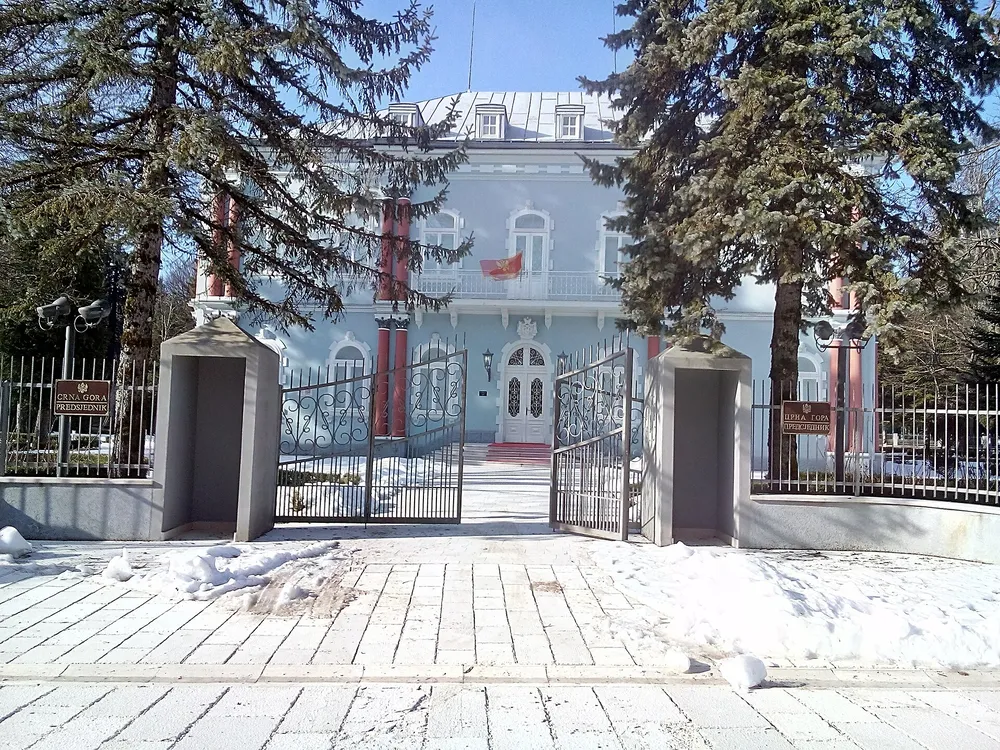
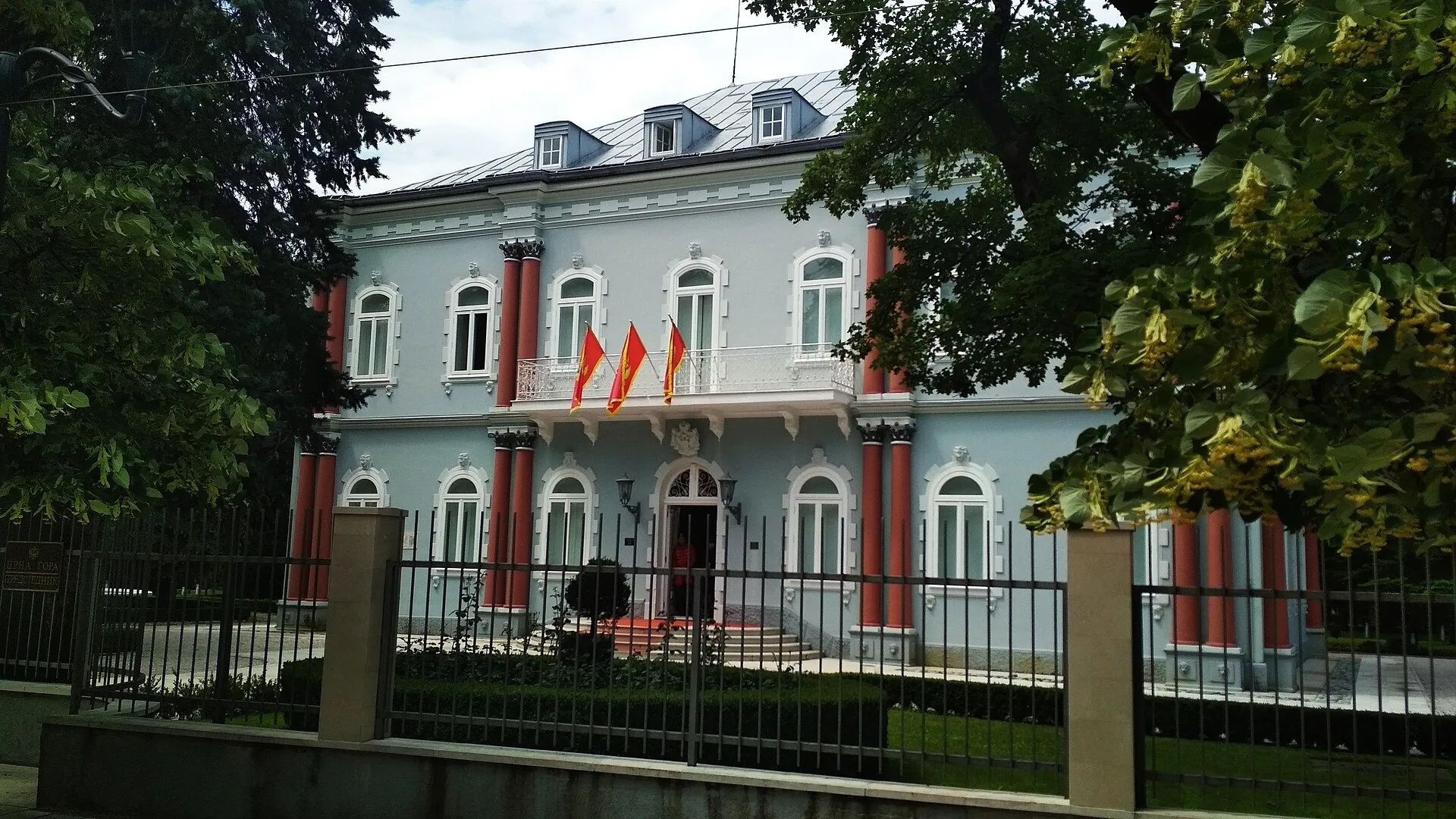
At the south-eastern end of Njegoševa Street the houses stop and the town’s two parks begin, the Palace Park on one side and the City Park on the other. Between them, behind tall iron railings and a formal garden, stands a compact two-storey villa painted a pale grey-blue, with red columns framing its windows and a balcony over the door. Montenegrin flags hang from the balcony and there is often a guard of honour. This is Plavi dvorac, the Blue Palace, and since 2010 it has been the official residence of the President of Montenegro.
The country’s constitution names Podgorica as the capital and Cetinje as the Old Royal Capital, the Prijestonica, and it is here, not in Podgorica, that the head of state has his ceremonial seat (see why Cetinje is the Old Royal Capital). The building is therefore one of the few in the historic core that still does the kind of work it was built for. The price is that you cannot go in.
- Built
- Foundation April 1894; consecrated June 1895
- Built for
- Crown Prince Danilo of Montenegro (1871–1939)
- Architect
- Not recorded; supervision by Marko Đukanović
- Style
- Late Empire (neoclassical)
- Today
- Official residence of the President of Montenegro, since 2010
- Access
- Exterior only
- From Dvorski trg
- About 250 m along Njegoševa Street
A house for the heir
Danilo Aleksandar Petrović-Njegoš, born in 1871, was the first son of Prince Nikola after a run of daughters, and the heir to the throne. By the 1890s the palace on Dvorski trg was full of his brothers and sisters, and a prince of marriageable age needed an establishment of his own. In April 1894 the foundations of a new residence were blessed by Metropolitan Mitrofan Ban and a foundation stone was laid on which the prince-poet had four lines of his own verse cut. In translation they run: May this little palace be a happy one for Danilo, my son; may the gracious Lord send him His blessing from on high.
The ‘New Palace’ was consecrated in June 1895, when the shell was finished; fitting out the interior and laying out the grounds took longer, and Danilo is recorded as taking a close interest in the garden. A high stone enclosure was built with two sentry boxes for the perjanici, the princely guard. Later the grounds acquired tennis courts, and in 1910, with the rest of the court quarter, the house was wired for electric light.
According to the Cetinje tourist organisation, it was after work started here that Prince Nikola declared Cetinje would remain Montenegro’s permanent capital. The declaration, and the building boom that followed it, gave the town its legations and its Government House.
In 1899 Danilo married Duchess Jutta of Mecklenburg-Strelitz, who took the name Milica on becoming Orthodox, and the couple lived here until the court left Montenegro in 1916. They had no children. Danilo held the title of king in exile for a few days in March 1921 after his father’s death, before renouncing it in favour of his nephew; he died in Vienna in 1939. His character is drawn on the page about the Petrović-Njegoš dynasty.
The architecture
The Blue Palace is the most polished of the dynasty’s houses, and the least documented. The fullest study of it, by the museum historian Tatjana Jović, concludes that the architect is not known and that the works were supervised by the Montenegrin engineer Marko Đukanović; Serbian-language reference works add only that it was built by Italian and Montenegrin craftsmen. Names of well-known foreign architects are attached to it on some travel websites without evidence, and we have not repeated them.
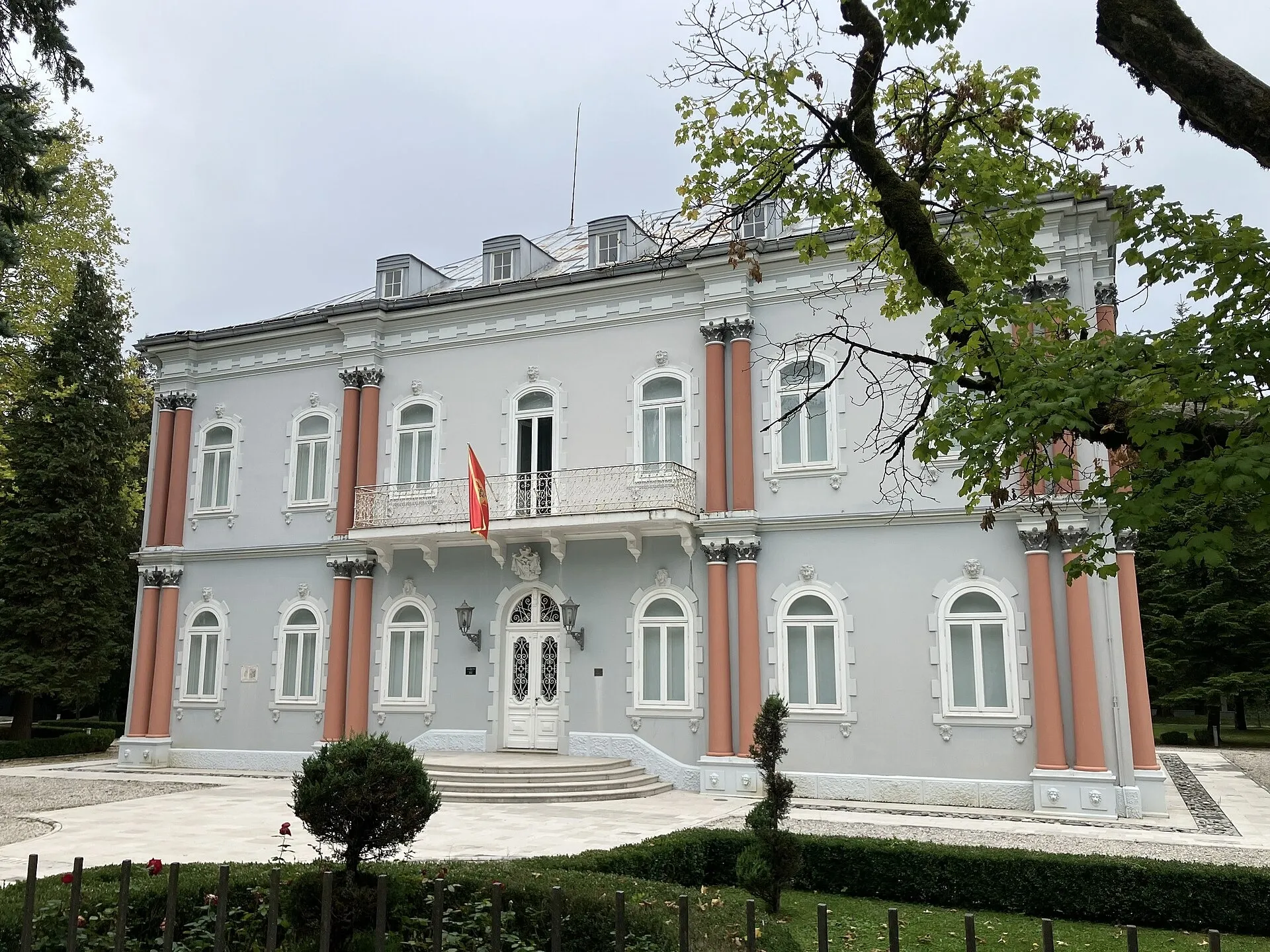
The style is a late version of Empire, the neoclassicism of Napoleonic France as it survived in Central Europe to the end of the century. The front is symmetrical, on two floors. On each floor four pairs of engaged columns with Corinthian capitals divide the bays, the lower order carrying a balcony across the centre; the windows are round-headed; a low attic with dormers sits above the cornice. Travellers who saw it new wrote of ‘a tasteful, artistic front with a loggia and marble columns’ and called it ‘a graceful little palace of Viennese architecture, surrounded by a railing’. Inside, the entrance hall and the ceremonial room on the upper floor, with its richly decorated ceiling, were the showpieces.
It was not always blue. The historical evidence suggests that the walls were first painted grey, like the old palace at the time, with the columns in red; the blue that gave the house its popular name came later. The columns, described locally as red terrazzo with gilded capitals, are still the detail that catches the eye.
The house also served as a pattern. Other residences built for members of the family in Montenegrin towns in the following years followed its general scheme of a two-storey villa with a columned centre.
After the dynasty
Between the world wars, and during the second, the building housed the Cetinje Gymnasium, the town’s grammar school. In socialist Yugoslavia it became an exhibition space: it belonged for longer than to anyone else to the National Museum, which used it as a gallery, and it was one of the venues of the Cetinje Biennial of contemporary art in the 1990s and early 2000s.
It was repaired after the 1979 earthquake. In 1998 there was a plan to rebuild it, with new ancillary buildings, as a presidential residence; that scheme was dropped, and after further repairs the palace was handed back to the National Museum in April 2007. A few years later the idea returned in a simpler form, the building was adapted for the head of state, and it has had a residential function again since 2010. It is a protected cultural monument.
Seeing it
There is nothing to book and nothing to pay. Walk down Njegoševa Street from the palace square, past the cafés, for about 250 m; the Blue Palace is where the street reaches the parks, with the dark red former British legation, now the Music Academy, beside it and the Hotel Grand a little further on. The front faces the street.
- Access: none to the building or its garden. Stay outside the railings and follow any instructions from the guard, particularly on days when official ceremonies are taking place.
- Time: five to ten minutes, or longer if you sit in the park opposite.
- Combine with: the British legation next door, the City Park, and across it the Russian legation and Zetski dom.
It is one of the last stops on our self-guided walking tour. A guide on the Cetinje city private tour or the guided walking tour with museum entry can tell you more about the house and the prince than the railings will.
Frequently asked questions
Can you visit the Blue Palace in Cetinje?
No. It is the official residence of the President of Montenegro and is not open to the public. You can see and photograph the exterior from Njegoševa Street.
Why is it called the Blue Palace?
After the colour of its walls. The building appears to have been grey when new, with red columns; the blue paint and the name came later.
Who lived in the Blue Palace?
Crown Prince Danilo of Montenegro, the eldest son of King Nikola, and from 1899 his wife Jutta (Milica) of Mecklenburg-Strelitz. They lived there until 1916.
Who designed the Blue Palace?
The architect is not documented. The works of 1894–1895 were supervised by the Montenegrin engineer Marko Đukanović, and reference works say Italian and Montenegrin craftsmen built it.
Does the President of Montenegro live in Cetinje?
The Blue Palace is the President’s official residence and is used for state occasions. The government and parliament sit in Podgorica, the capital.
Sources and official information
Facts were checked against these official and scholarly sources in November 2026. Opening hours, ticket prices, park fees and timetables change, so confirm before you go.
Cetinje.com is an independent guide, not the official site of the Old Royal Capital Cetinje, the National Museum of Montenegro, any tour operator, hotel or the government of Montenegro. Some links are affiliate links: tours go to GetYourGuide and accommodation goes to Booking.com, and we may earn a commission at no extra cost to you.